
PROP · CHECKED 10 OCT 2026
Apex Trader Funding review.
US futures evaluation firm whose Evaluation and Performance Accounts are both simulated, with each funded account capped at six payouts.
OK-ISH
OUT OF 10
Apex Trader Funding Inc. is a Texas corporation selling simulated futures evaluations. Its own Risk Disclosure states that all trading in Evaluation and Performance Accounts is simulated and involves no real funds, which covers the stage it markets as funded. No regulator oversees it, and for a prop firm that is normal rather than a finding. What is not normal is the distance between a homepage promising no payout denials and a rulebook that caps each account at six payouts and calls rewards discretionary.
Each criterion is scored 1 to 10 from primary sources. The overall score is their unweighted mean. How scoring works.
| Founded | 2021 |
|---|---|
| Headquarters | US |
| Platforms | rithmic, tradovate, wealthcharts, ninjatrader |
- Publishes drawdown, safety net, consistency and payout ceilings as exact numbers with worked examples, before purchase
- A named Texas corporation at a published street address with a named CEO, rather than an anonymous offshore entity
- Risk Disclosure and Terms of Use are both dated 22 October 2025 and state plainly that Evaluation and Performance Accounts are simulated
- Evaluation fees start at $199 list for a 25K intraday account, with real time data and a NinjaTrader licence included
- New products are one off purchases rather than the recurring monthly billing that legacy accounts still carry
- Three platform vendors to choose between, Rithmic, Tradovate and WealthCharts, plus NinjaTrader through Rithmic
- A public payouts ledger lists individual payouts by date, country, amount and status, which most competitors do not publish
- Governing law, arbitration forum and procedure are all named in the Terms of Use, so a claim has a stated venue
- Oversized orders are rejected rather than treated as a rule breach, and ordinary news and holiday trading are both allowed
- Challenges remain on sale and nothing we found indicates the firm has stopped funding new accounts
- The funded Performance Account is simulated, so a payout is a discretionary reward from fee revenue rather than a share of trading profit
- The homepage advertises no payout denials while the Risk Disclosure reserves the final right to grant or deny any reward
- Each Performance Account is capped at six payouts, from $6,000 lifetime on a 25K account to $21,500 on a 150K intraday
- After the sixth payout the account closes and the trader must buy and pass another evaluation to continue
- A trader invited into live trading who declines has the whole member account deactivated for a flat $3,000
- Simulated profit moved to the Bonus Vault carries, in the firm's own words, no rights, obligations, duties, gains or actual stored value
- The Risk Disclosure says services are not directed at residents outside the United States while the firm pays traders in dozens of countries
- The Evaluation and Performance Account User Agreement, which prevails in any conflict, is not published on the public site
- Support is help desk tickets only, with no telephone number or support email published anywhere on the site
- Four unresolved US federal civil cases name the company, one docketed on 24 July 2026 under a Commodity Exchange Act cause
Overview
Apex Trader Funding Inc. is a Texas corporation in Austin selling futures trading evaluations. It is not a broker. It is not a futures commission merchant. It says so itself, in its Risk Disclosure dated 22 October 2025: “Apex is not a broker-dealer, futures commission merchant, investment advisor, or any similar financial institution. It is not regulated by financial regulatory authorities and does not offer investment opportunities or solicit funds for investment purposes.” That sentence is accurate and it is not a criticism. Prop firms are unregulated by design, because they are not holding anyone’s money for investment. The question that decides whether you lose money here is a different one, and Apex answers it two paragraphs later.
The question is whether the funded account is real. It is not. The same Risk Disclosure states: “All trading conducted in Evaluation and Performance Accounts is simulated and does not involve real funds. Users never deposit funds into any trading account and do not trade using their own capital.” The Performance Account, which Apex markets as the funded stage, is a simulation. Passing an evaluation buys you a second simulation with better rules. A payout from it is a reward paid out of Apex’s fee revenue, not a share of money made in the market, and the same document calls it discretionary: “Performance Account Rewards are offered solely at Apex’s discretion, and any determination to grant or deny a Reward payout is final.”
That is a lawful business model and plenty of people knowingly buy it. What makes this review necessary is the distance between that clause and the homepage, which advertises “NO Payout Denials” in its opening list and, further down, “No denied payouts. No payout reviews.” Apex’s own help centre carries a question headed “What happens if my payout is denied?”, its own news archive published an article on 19 March 2026 titled “Payout Purgatory: Heightened Compliance Audits at Apex trader funding” which asks “Why Are Traders Failing the Performance Account Audit?”, and the footer of every page on the site reads “Reward payouts are discretionary and subject to eligibility, compliance, and applicable tax laws.” Four statements from one company, and only one of them is on the homepage.
There is a real live trading programme underneath, but it is invitation only, Apex decides who enters and when, and entering it closes every simulated account you hold. We cover what that costs a successful trader in the Payout Terms section, because it is the most expensive clause on the site and almost nobody reads it before buying.
Overview Table
| Headquarters | 2028 E. Ben White Blvd Ste 240-9873, Austin, TX 78741, United States |
| Established | 2021, per the firm’s About page. Site copyright reads 2021 to 2026 |
| Countries Served | Marketing claims over 150 countries; the Risk Disclosure says services are not directed at residents outside the United States. 87 countries and territories are on the restricted list |
| Regulated By | Nobody, by the firm’s own statement. Normal for a prop firm and not a finding in itself |
| Minimum Deposit | None. Traders deposit nothing into a trading account. The entry cost is an evaluation fee from $199 list, plus a Performance Account activation fee from $69 |
| Maximum Leverage | Not applicable. Futures contract limits apply instead: 4 to 12 contracts on evaluations, 2 to 10 on Performance Accounts |
| Total Instruments | Futures only, across equity index, currency, agricultural, energy, metal, micro and crypto contracts on CME, CBOT, NYMEX, COMEX and EUREX |
| Platforms | Rithmic, Tradovate, WealthCharts, plus NinjaTrader connected through Rithmic |
| Customer Support | Help desk tickets only, advertised as 24/7. No telephone number or support email published on the site |
| Languages | English. The restricted countries page cites language barriers as one reason for exclusions |
Facts List
- Every Evaluation Account and every Performance Account is simulated. The firm states this in its Risk Disclosure, its Terms of Use and its restricted countries article.
- Evaluation fees at list: intraday drawdown $199, $249, $399 and $599 for 25K, 50K, 100K and 150K accounts. End of day drawdown versions cost $390, $490, $790 and $1,490.
- Performance Account activation costs a further $69 to $159 depending on size and drawdown type. Evaluation resets cost $80.
- A permanent banner advertises “Any Size Evals up to 90% Off” with a countdown timer, so the list prices above are rarely what anyone pays.
- Profit targets are $1,500, $3,000, $6,000 and $9,000 for the four account sizes. The minimum is one qualifying trading day to pass.
- Trailing drawdown is $1,000, $2,000, $3,000 and $4,000 by size. It never moves down, and touching it liquidates positions and ends the account.
- A Performance Account allows a maximum of six payouts, after which it closes and a new evaluation must be bought.
- Lifetime payout ceilings per account: $6,000 on a 25K, $13,000 to $14,500 on a 50K, $18,000 to $18,500 on a 100K and $20,500 to $21,500 on a 150K.
- The Evaluation and Performance Account User Agreement, the contract that actually governs the money, is not published on the public site. The Terms of Use restricts it to account holders.
- Four unresolved US federal civil cases name the company, including Lawton v. Apex Trader Funding Inc., 1:26-cv-02078 in the Western District of Texas, filed 24 July 2026.
Key Takeaways
- The funded account is a simulation. Apex’s Risk Disclosure of 22 October 2025 says “All trading conducted in Evaluation and Performance Accounts is simulated and does not involve real funds.” The Performance Account is the product Apex calls funded, and it is on that list.
- Payouts are discretionary in writing and denial free in marketing. The Risk Disclosure says “any determination to grant or deny a Reward payout is final”. The homepage says “NO Payout Denials”. Both are published by Apex, on the same domain, at the same time.
- There is no counterparty because there is no market. Rithmic, Tradovate and WealthCharts supply the simulated platform and the data. No futures commission merchant stands behind an Evaluation or Performance Account, because no order reaches an exchange.
- Six payouts and the account is gone. Each Performance Account is capped at six approved payouts on a rising scale, then closes. On a 25K account that is $6,000 across the account’s entire life.
- Success is the expensive outcome. A trader Apex invites into live trading has all simulated accounts closed. Declining the invitation deactivates the whole member account for a flat $3,000 and forfeits every simulated balance.
- The rules are unusually well documented. Drawdown tables, safety nets, minimum daily profit, consistency arithmetic and payout ceilings are all published as numbers. That is rare in this sector and it is the firm’s strongest point.
- Recourse is a Texas arbitration. Disputes go to binding arbitration under AAA Commercial Rules in Travis County, Texas. For a trader in Manila with a $1,500 claim, that is a theoretical remedy.
- Litigation is live and unresolved. A Commodity Exchange Act cause of action was docketed against the company on 24 July 2026. Nothing has been adjudicated and we have not read the complaint.
Company & Accountability
Apex Trader Funding Inc. is a Texas corporation headquartered in Austin. The Terms of Use names it as “a Texas corporation headquartered in Austin, Texas” and every page footer carries a street address, 2028 E. Ben White Blvd Ste 240-9873, Austin, TX 78741. The About page names Darrell Martin as CEO and dates the founding to 2021. That combination puts Apex at the better end of its sector on plain identifiability: a named US company at a real address in a jurisdiction with functioning courts, rather than an offshore shell whose officers cannot be traced. Identifiability is not the same as good conduct, and it cuts both ways, since it is also what makes the firm and its officers reachable by a claimant.
There is no licence, and there should not be one. Apex’s Risk Disclosure says it “is not regulated by financial regulatory authorities and does not offer investment opportunities or solicit funds for investment purposes”, and that is the correct legal position for a firm selling simulated evaluations. It holds no client money, executes nothing on an exchange for a customer, and therefore triggers no registration duty we are aware of. Our regulators field is empty for this review and that emptiness is the accurate answer, not a gap. Marking a prop firm down for having no regulator tells a reader nothing.
What we did not check, and will not pretend to have checked: we did not query NFA BASIC, which publishes membership, disciplinary and arbitration records, so we have no result for Apex Trader Funding Inc., Apex Investing Institute or its CEO from that source. We did not query the FCA, ASIC, OSC, BaFin, AMF, CONSOB or FSMA warning lists. Those are gaps in our work and nothing should be read into them in either direction.
What recourse actually exists
The Terms of Use answers this directly, which is more than most of the sector manages. Governing law is Texas. “All disputes arising out of or relating to these Terms or the Site shall be resolved by binding arbitration held in Travis County, Texas, pursuant to the Commercial Arbitration Rules of the American Arbitration Association”, with a carve out preserving small claims court. So a trader has a named forum and a named procedure. Whether that is a usable remedy is a separate question: a Filipino or Indian trader disputing a $1,500 reward faces an individual arbitration in central Texas, and the clause names no class mechanism.
The contract that governs the money is not on the public site. The Terms of Use refers to an “Evaluation and Performance Account User Agreement” and a “Live Market Proprietary Account User Agreement”, states that “In the event of a conflict, the User Agreement shall prevail”, and restricts access to them to “users who have opened an account(s)”. We searched every href on every page we retrieved, including the full footer link set, and found no public link to either document. That is a statement about what the site publishes, not an accusation of concealment: Apex says openly that the agreement sits behind account creation. The consequence for a reader is simply that the terms with the final word cannot be read before paying.
Litigation on the public docket
We queried CourtListener, a public mirror of US federal dockets, for the company name and retained the results. Four matters name the company and none is resolved:
| Case | Docket | Court | Filed | Cause as docketed |
| Lawton v. Apex Trader Funding Inc. Defendants on the docket: Apex Trader Funding Inc., Darrell Roland Martin, John Mark Skelton |
1:26-cv-02078 | W.D. Texas | 24 July 2026 | 07:6(b) Federal Commodity Exchange Regulation, nature of suit 370 Other Fraud |
| Patel v. Apex Trader Funding, Inc. | 3:26-cv-02079 | S.D. California | 2 April 2026 | Not stated in the docket record we retrieved |
| McCrudden v. Apex Trader Funding, Inc. | 3:26-cv-01073 | M.D. Florida | 30 April 2026 | Not stated in the docket record we retrieved |
| Riot v. Apex Trader Funding Inc. | 1:24-cv-01557 | W.D. Texas | 18 December 2024 | 17:501 Copyright Infringement. Not a consumer matter |
A complaint is an allegation and nothing more, and this one deserves the most careful wording in the review. The Lawton docket shows a single entry, a complaint filed by Steven Lawton on 24 July 2026 through Rain Levy Minns of Austin, with no answer and no ruling. Its Parties and Attorneys panel lists three defendants: the company, and two individuals, Darrell Roland Martin and John Mark Skelton. We name them only because the public docket does, and only as defendants in a pending matter. The complaint itself sits behind PACER and we have not read it, so we do not know and will not guess what it claims, about the company or about anybody. The cause line above is a court clerk’s classification code, not a summary of anyone’s case. Nothing has been adjudicated, no defendant has answered, and an unanswered complaint proves nothing whatsoever about any person or company named in it.
What is verifiable, and what we think somebody deciding whether to pay this firm this week is entitled to know, is simply that the case exists: a Commodity Exchange Act cause of action was docketed against Apex Trader Funding Inc. and two individuals on 24 July 2026 and remains unanswered. A reader can check the docket themselves at the URL in our sources.
Context that cuts the other way belongs here just as much. The McCrudden matter was filed by a plaintiff acting without counsel who had sued Topstep, a competing prop firm, three weeks earlier on 9 April 2026 in the same district. A repeat filer against several firms in one sector is a fact worth weighing before treating any single filing as a signal about any of them.
We found no CFTC enforcement action naming this firm in the sources we reached. We say that as a description of our own search, not as a statement about what the CFTC has or has not done.
How to Trade
Everything at Apex is a futures contract, and none of it reaches an exchange. The firm describes its own service as “access to a simulated trading environment through third-party platform operators intended solely for educational purposes and the evaluation of trading performance under predefined rules and criteria”. Orders are filled against simulated liquidity by the platform vendor. The Risk Disclosure warns in terms that “Simulations may not reflect real-world trading conditions, including liquidity, slippage, execution speed, or market volatility”, which is the honest caveat and one a reader should take seriously before treating an evaluation result as a measure of live skill.
Who supplies the platform
Three vendors, each carrying identical pricing and rules, chosen at checkout. The firm’s own product data, embedded in its homepage, tags all 90 purchasable products with one of three vendor values:
| Vendor | What it provides | Note from Apex’s own documents |
| Rithmic | Data and order routing infrastructure. NinjaTrader connects through it | Listed as a partner on the homepage, with a Rithmic account setup guide in the help centre |
| Tradovate | Futures trading platform | Apex tells Canadians they “cannot purchase a LIVE account with Tradovate” and directs them to Apex simulated accounts instead |
| WealthCharts | Charting and trading platform | Listed as a partner, with its own Apex login guide hosted on wealthcharts.com |
A NinjaTrader licence valued by Apex at $75 and real time data valued at $55 are bundled into every evaluation, per the feature list carried in the product data. That is a genuine cost saving against buying either separately.
The one place a real broker appears
It is not in the evaluation and it is not in the Performance Account. It is in the invitation only Live Prop Trading Program, where Apex writes: “If you use a platform other than Tradovate or NinjaTrader, you must make sure the charting platform is compatible with Ninja Brokerage.” The same document says “Commissions are set by the broker” and warns that rule violations may expose a live trader to “disciplinary and legal action by the Futures Commission Merchant (Broker), Chicago Mercantile Exchange and/or Commodity Futures Trading Commission (CFTC)”. So an FCM exists at the live stage. Apex does not name it beyond the Ninja Brokerage reference, and we did not verify that entity’s registration status independently.
Where a trader’s money sits
Nowhere, in the sense a reader will assume. The money a trader hands over is an evaluation fee and an activation fee paid to Apex Trader Funding Inc. It becomes the company’s revenue on receipt. There is no segregated client account, no trust, no compensation scheme and no regulator supervising any of it, because none of those obligations attach to a company selling access to a simulator. The balance shown in a Performance Account is a number in Apex’s system. If Apex stopped trading tomorrow, that number would be worth nothing and an unpaid reward would be an unsecured claim against a private Texas corporation, pursued through arbitration in Travis County.
Session and position rules
Two documents govern conduct and they are not the same one. The simulated Evaluation and Performance Accounts are governed by the Prohibited Activities article, which both evaluation pages link to; the invitation only live programme has its own longer rulebook. We set the simulated rules out in the Drawdown and Breach Rules section, since that is where they cost a trader an account.
The shape is the same in both. No positions held through the market close, the live rulebook putting a hard time on it at 4:50 PM ET. No automation or algorithms, on the stated ground that rewards are “intended to recognize human traders actively participating in the learning process, not to reward automated systems executing preprogrammed logic.” No hedging in any form, the article calling it “Directional Trading only”. The trading day resets at 6:00 PM ET.
News trading is worth singling out because it is widely reported the wrong way round. Apex does not ban it: “Trading during news is allowed for your normal trading strategy.” What it bans is a specific abuse, “‘news trading’ strategies that ‘chase the market’ or place orders on both sides but to be lucky or gamble the outcome of news”. A trader whose ordinary system happens to run through a payroll print is fine. A trader who brackets both sides of the print is not.
Challenges & Funding
Apex restructured its product line on 1 March 2026, and a reader needs to know which side of that date they are buying on. Accounts opened before it are Legacy: they keep a 30% consistency rule, a $50 profit floor, an eight day payout cycle and recurring monthly billing until cancelled. Accounts bought after it are New Products: a 50% consistency cap, a five day payout path and a one off fee. The firm’s own news archive summarises the split, and its summary of the legacy tier states that legacy status requires uninterrupted billing and that a lapse is permanent. We read that from the archive listing rather than the full article, so we paraphrase it rather than quote a sentence we only have in part. Traders may hold a mix of both.
The two drawdown families
Every new product is one of two shapes, and the choice is the most consequential one at checkout. End of day (EOD) accounts recalculate the drawdown threshold once daily at 4:59:59 PM ET from the closing balance, then enforce it in real time through the next session. Intraday accounts trail the threshold continuously against the highest balance reached at any moment. Intraday costs roughly half as much and is materially harder, because a position that is briefly deep in profit permanently raises the level at which the account dies.
Evaluation pricing and parameters
Identical across all three vendors. These are list prices; a coupon banner advertising up to 90% off runs permanently on the site with a resetting countdown timer, so few traders pay them.
| Account size | Intraday fee | EOD fee | Profit target | Trailing drawdown | Contracts | EOD daily loss limit |
| 25K | $199 | $390 | $1,500 | $1,000 | 4 mini | $500 |
| 50K | $249 | $490 | $3,000 | $2,000 | 6 mini | $1,000 |
| 100K | $399 | $790 | $6,000 | $3,000 | 8 mini | $1,500 |
| 150K | $599 | $1,490 | $9,000 | $4,000 | 12 mini | $2,000 |
Every evaluation carries a 30 calendar day access period from the date of purchase, stated in both evaluation articles as a parameter and confirmed in their FAQs. Miss the profit target inside it and the account expires. Pass, and there are 7 calendar days to activate the Performance Account before that lapses too. Neither deadline appears in the marketing. Intraday evaluations carry no daily loss limit. Resets cost $80 on every product. Five packs are sold at a discount, for example five 50K intraday evaluations at $950 against $1,245 bought singly. There is also a “No Activation Fee” variant of each product, which costs more upfront and waives the Performance Account activation charge. On a 50K intraday that is $790 against $249 plus $79, a $462 premium to avoid a $79 fee. The premium is not uniform and one product breaks the pattern: the 100K intraday runs $590 in that form against $399 plus $99, a $92 difference. A buyer should compare the two forms of the exact product they want rather than assume.
The Performance Account
Passing an evaluation does not produce a funded account. It produces the right to pay an activation fee for a second simulated account with different rules. Apex’s own product data carries the Performance Account parameters alongside each evaluation:
| Account size | Activation, intraday | Activation, EOD | Contracts | Max drawdown | Daily loss limit | Safety net |
| 25K | $69 | $99 | 2 mini | $1,000 | $1,250 | $26,100 |
| 50K | $79 | $129 | 4 mini | $2,000 | $3,000 | $52,100 |
| 100K | $99 | $139 | 6 mini | $3,000 | $3,500 | $103,100 |
| 150K | $129 | $159 | 10 mini | $4,000 | $4,000 | $154,100 |
Contract limits fall when you get funded. A 50K evaluation allows six mini contracts; the 50K Performance Account it leads to allows four. A 150K drops from twelve to ten. The strategy that passed the evaluation is therefore not the strategy available afterwards, and a trader sizing to the evaluation limit will need to resize. Apex does not flag this on the homepage.
The cheapest complete route to a simulated funded account is a 25K intraday evaluation at $199 plus $69 activation, or $268 at list price. On the 50K intraday it is $328. Both figures are before any reset.
Legacy Performance Accounts remain on monthly recurring billing, which the homepage confirms: legacy accounts “still remain on recurring billing until canceled”. New products are one off. A trader carrying legacy accounts is therefore paying every month for a simulated account whether or not they trade it, and the Legacy tier is lost permanently if a payment lapses.
Drawdown & Breach Rules
There is no negative balance risk here in the ordinary sense, because there is no balance and no capital. A trader cannot lose more than the fees they paid. What they can lose is the account, and Apex’s breach rules are published in enough numeric detail to be checked, which is genuinely unusual for this sector and is the firm’s strongest single quality.
The trailing threshold
Each account starts with a fixed maximum drawdown by size: $1,000 on a 25K, $2,000 on a 50K, $3,000 on a 100K, $4,000 on a 150K. The threshold is the highest balance achieved minus that amount, and it moves in one direction only. Apex is explicit: “It always trails the highest achieved EOD balance and never moves downward.” Touch it and the consequence is immediate and total: “All open positions are automatically liquidated. Your evaluation is failed or PA is closed. Trading stops immediately.”
The EOD version recalculates once a day at 4:59:59 PM ET from the closing balance, then holds that level fixed but live through the following session. Apex’s own worked example runs a 50K account from a $48,000 opening threshold up to $50,000 across four sessions. The intraday version trails the peak continuously, and Apex is explicit that this “moves dynamically with your account’s highest balance (Peak Balance), including unrealized gains”. A position that goes $900 in front and is closed flat has still raised the floor by $900, permanently. Apex adds one further warning that traders miss: because liquidation happens at market price, “the final filled balance may be slightly above or below the Trailing Threshold”, and either way “the account is considered failed”.
Where the threshold stops moving, and why the vendor matters
On a Performance Account the threshold locks once it reaches the starting balance plus $100, so a 50K Performance Account ends up with a permanent floor of $50,100 once the balance has touched $52,100. On evaluations the behaviour is not the same across vendors, and this is buried in one paragraph of one help centre article: on Rithmic and WealthCharts the threshold “stops trailing and becomes fixed when it reaches an amount equal to the Target Profit balance”, while on Tradovate the “EOD Drawdown trails indefinitely with the peak EOD account balance.” Two traders who bought the same 50K EOD evaluation at the same price on the same day face different risk depending on which logo they clicked. A Tradovate evaluation never stops trailing.
The daily loss limit is a separate trapdoor
EOD accounts also carry a daily loss limit: $500, $1,000, $1,500 and $2,000 on evaluations by size, and $1,250, $3,000, $3,500 and $4,000 on Performance Accounts. Apex distinguishes the two cleanly: “the DLL ends your trading day, while the EOD Threshold disqualifies your Evaluation and/ or PA.” Hitting the daily limit flattens positions and pauses trading until the next session; the account survives. Intraday evaluations carry no daily loss limit at all, which sounds like freedom and is the reason the intraday trailing threshold is so much easier to hit.
What else ends an account
The governing document here is the Prohibited Activities article, linked from both evaluation pages, and it closes with the consequence: “Traders engaging in these prohibited activities will forfeit their accounts and all associated balances.” Its bright line rules are checkable in advance. Holding open positions through the market close is prohibited. Automation and algorithmic execution are prohibited. Hedging of any kind is prohibited, described as “Directional Trading only”, and evaluations may not be passed by hedging two accounts against each other. High frequency trading and “non-directional bracket trading, where orders are left open on both sides of the market” are prohibited. So is sharing MAC addresses, computers, IPs or credit cards, trade copying, creating multiple user accounts including through household members, and using a VPN or proxy to conceal location. Fees may only be paid from “a bank account, debit card, or credit card that is in your own name”, rewards may only be sent to a bank account in the trader’s own name, and a chargeback or refund request made in bad faith is itself a violation. Using a payment method issued in a restricted country is grounds for “immediate account termination”, applies “to both successful and declined transactions” and bites “at every stage of your account’s lifecycle, including after approval and during active trading.”
Six further grounds carry no number at all. A trader must have “either pending or mental stop losses and a well-defined risk management strategy”. High risk strategies are banned, illustrated by a five tick target against a 150 tick stop. Using the account’s full threshold as a stop loss is banned. Stockpiling discounted evaluations to cycle through and deliberately blow up is banned. Unsustainable strategies are banned, defined only as any approach “that fails to demonstrate consistent growth and sustainability”. And traders must not deviate from “Professional Standards”, meaning techniques they would use “in a personally funded account at a registered broker”. None of the six can be checked against a number before trading, and each is judged by Apex after the fact. That is the real gap between “Simple Rules. No Gray Area”, which the homepage promises, and the rulebook as written. It is a wider gap than a reader skimming the marketing would guess, and it is worth weighing against the numeric precision of everything else Apex publishes.
Technology failure is the trader’s risk
The Risk Disclosure allocates outages to the customer: if a platform, connection or data feed fails, “This may result in a violation of one or more of the Trading Rules, and may result in any of the penalties associated with violation of the Trading Rules. Apex is in no way liable or responsible.” It adds that on a limit move day “you may not be able to close a position and your Evaluation or Performance Account may be liquidated. Company shall not be liable for such results.” In a simulated account, a vendor outage can therefore destroy something a trader paid several hundred dollars for, with no remedy stated.
Trading Instruments
Apex is futures only, and unusually specific about what that means. The homepage publishes a full contract table with symbol, exchange, tick size and point value for every instrument, which is more disclosure than most CFD brokers manage for their spreads. Nothing here is a contract for difference, nothing is spot forex and nothing is a share. Every instrument is an exchange listed futures contract, simulated.
| Category | Contracts named by Apex | Exchanges |
| Equity index futures | E-mini S&P 500 (ES), E-mini NASDAQ 100 (NQ), Mini-DOW (YM), E-mini Midcap 400 (EMD), Russell 2000 (RTY), Nikkei (NKD) | CME, CBOT |
| Currency futures | Australian Dollar (6A), British Pound (6B), Canadian Dollar (6C), Euro FX (6E), Japanese Yen (6J), Swiss Franc (6S), New Zealand Dollar (6N) | CME |
| Agricultural futures | Lean Hogs (HE), Live Cattle (LE), Feeder Cattle (GF), Corn (ZC), Wheat (ZW), Soybeans (ZS), Soybean Meal (ZM), Soybean Oil (ZL) | CME, CBOT |
| Energy futures | Crude Oil (CL), Mini Crude Oil (QM), Natural Gas (NG), E-mini Natural Gas (QG), Heating Oil (HO), New York Harbor (RB) | NYMEX |
| Metal futures | Gold (GC), Silver (SI), Copper (HG), Platinum (PL), Palladium (PA) | COMEX |
| Micro futures | Micro E-Mini S&P 500 (MES), Micro E-Mini Dow (MYM), Micro E-Mini Nasdaq-100 (MNQ), Micro E-Mini Russell 2000 (M2K), E-Micro Gold (MGC), E-Micro Silver (SIL), E-Micro AUD/USD (M6A), E-Micro EUR/USD (M6E), Micro Crude Oil (MCL) | CME, CBOT, COMEX, NYMEX |
| Crypto futures | Micro Bitcoin (MBT), Micro Ethereum (MET) | CME |
| European futures | DAX (FDAX), Mini-DAX (FDXM), Euro Stoxx 50 (FESX), VSTOXX (FVS), STOXX Europe 600 (FXXP), Micro DAX (FDXS), Micro Euro Stoxx 50 (FSXE), Euro-Buxl (FGBX), Euro-Schatz (FGBS), Euro-Bobl (FGBM), Euro-Bund (FGBL) | EUREX |
The EUREX block carries a footnote reading “Exception: Certain exchanges only available on Tradovate Platform”, so a trader whose strategy needs DAX or Bund contracts should choose the vendor before choosing the account.
Contract limits, not leverage
There is no leverage figure to quote, and any review that gives Apex a leverage ratio has invented it. Futures exposure is set by contract count and point value. Apex caps contracts at 4, 6, 8 and 12 minis on evaluations by account size, dropping to 2, 4, 6 and 10 on the Performance Account. The product data records a micro equivalent at ten times the mini count, so a 50K evaluation allows six minis or sixty micros. Apex says its plans “cap your contracts at the max contracts without failing you for going over your allowed contracts”, meaning an oversized order is rejected rather than treated as a breach. That is a real and unusual kindness in a sector that mostly fails accounts for it.
To put the risk in ordinary terms: one E-mini S&P 500 contract moves $50 per index point. A 50K Performance Account with a $2,000 maximum drawdown and four contracts permitted dies on a ten point adverse move if fully sized. Apex does not restrict trading on holidays, and it allows news trading for “your normal trading strategy” while banning orders placed on both sides of a release to gamble the outcome. So nothing prevents a trader from being fully sized into a payroll print, as long as the position is directional.
Education & Analysis
Apex’s educational output is the help centre, and judged as documentation rather than as teaching it is good. Roughly forty articles cover drawdown mechanics, payout eligibility, consistency arithmetic, platform setup, billing and restricted countries, each with a contents list, worked numeric examples and an FAQ block. The 50% consistency article is the clearest example: it gives the formula, a division shortcut, and a nine day table showing a trader’s consistency percentage moving from 100% down to 50% across profitable and losing sessions. A prospective buyer can work out whether the rules suit them before paying, which is not true of most competitors.
What it is not is trading education. There is no course, no curriculum, no signal service, no economic calendar and no market analysis published on the site. The About page describes the CEO’s earlier venture, Apex Investing, as “an educational site”, but that is a separate brand and we did not assess it. The homepage promises “All new FAQ and Training” and “Trader reports and analytics” under a Technology heading; the FAQ exists and is substantial, and we could not evaluate the reporting and analytics because they sit inside the members area behind a purchase.
Tools that come with an account
- Real time data, valued at $55 by Apex and included with every evaluation. On the live programme, by contrast, a trader is classified as a professional and data runs to roughly $140 a month, with Apex covering the main feed.
- A NinjaTrader licence, valued at $75 by Apex and included. NinjaTrader connects through Rithmic.
- A consistency calculator and violation alerts, both listed on the homepage under new platform features. We could not test either from outside the members area.
- Trader reports and progress analytics, again listed but not publicly demonstrable.
The news archive, and what it actually is
Apex publishes at /news/. On the copy we retrieved it carried four articles dated 16 to 19 March 2026, all written about Apex’s own rules: the legacy transition, the difference between EOD and intraday scaling, the $250 minimum daily profit rule on new EOD 50K accounts, and one titled “Payout Purgatory: Heightened Compliance Audits at Apex trader funding”. That last piece describes “a rigorous review process defined by strict internal risk metrics like the Apex 50% Consistency Rule”, says it is “primarily used by the firm’s compliance team to prevent gambling and ensure long-term, sustainable trading behaviors before releasing funds”, and asks “Why Are Traders Failing the Performance Account Audit?”
We flag that not as a criticism of the article, which is informative, but because it is the clearest internal contradiction on the site. A homepage that promises “No payout reviews” and a news archive describing a compliance review that traders fail cannot both be a complete account of how payouts work.
The About page’s “In The Press” list runs to more than forty entries. Read carefully, most of it is one press release chain: PR Newswire releases from November 2022 through August 2023 reprinted by Yahoo Finance, Business Insider, Markets Insider, MSN and NewsBreak. That is paid syndication rather than editorial coverage, and a reader should count it as one source repeated rather than forty outlets independently examining the firm.
Payout Terms
This is the section that decides the review, so it is worth reading the numbers rather than the adjectives. Apex advertises a 100% payout split and it is not lying: “Approved payouts are issued at a 100% payout split, you receive 100% of the approved payout amount.” The load is carried entirely by the word “approved”, because Apex caps how much can ever be approved.
The four gates before any money moves
A Performance Account must clear all of these at once. Figures differ slightly between the EOD and intraday families.
| Account size | Min trading days | Min daily profit, EOD | Min daily profit, intraday | Safety net | Min balance to request |
| 25K | 5 | $100 | $100 | $26,100 | $26,600 |
| 50K | 5 | $250 | $200 | $52,100 | $52,600 |
| 100K | 5 | $300 | $250 | $103,100 | $103,600 |
| 150K | 5 | $350 | $300 | $154,100 | $154,600 |
Five separate days must each clear the minimum daily profit; days below it do not count, however profitable the account is overall. The safety net is the drawdown limit plus $100 and, in Apex’s words, “must be maintained for the lifetime of the Performance Account”. Only profit above it is payable. And the 50% consistency rule requires that “no single profitable trading day may account for 50% or more of total profit earned since your last approved payout”.
The interaction, worked through on a 50K intraday account
Take the cheapest realistic route: a 50K intraday evaluation at $249 and $79 activation, $328 all in. The Performance Account starts at $50,000 with a $2,000 drawdown, four contracts and a $52,100 safety net.
- Nothing is payable until the balance reaches $52,600. That is the $52,100 safety net plus the $500 minimum request, so $2,600 of simulated profit releases the minimum $500, not the headline figure.
- Those profits must include five separate days of at least $200 each.
- The first payout is capped at $1,500, and only profit above the safety net is requestable, so taking the full $1,500 requires the balance to reach $53,600, or $3,600 of profit.
- Apex instructs traders to “trade as if the requested payout amount has already been removed from your balance”. Take the full $1,500 from $53,600 and the balance returns to $52,100, which is exactly the safety net. The safety net is not a one time test: Apex says it “must be maintained for the lifetime of the Performance Account” and “does not disappear after your first payout”. So the account is back at the floor and every subsequent payout has to be earned again from scratch, another $500 of fresh profit at minimum before the request button reappears.
Now add consistency. Apex’s shortcut is “Highest Profit Day / 0.5 = Minimum net profit required”, so a single $1,500 day obliges the trader to reach $3,000 net before requesting anything. Losing days make it worse, and Apex’s own FAQ gives the example: “if you make $1000 profits on day 1 then take a $200 loss on day 2, your consistency will be $1000 (highest day net profit) divided by $800 (net profit balance) which is 125%. You would need to keep trading until you meet the 50% requirement.”
That is the mechanism worth understanding. A good day does not bring a payout closer; it pushes it further away, and the only way to dilute it is to keep trading, which means keeping the account exposed to a trailing drawdown that never moves back down. A trader who is up $1,800 on one day and flat since is not near a payout. They are locked out of one until they earn another $1,800, with the account at risk throughout. None of this is hidden, and Apex publishes the arithmetic and a nine day worked table itself. It is simply a good deal harder than “5 Trading Days” on the homepage suggests.
The lifetime ceiling
Six approved payouts per Performance Account, on a rising ladder, and then it is over: “After 6 payouts, the PA is closed, and you will be able to obtain another PA by qualifying for another evaluation.”
| Account size | Payout 1 | Payout 6 | Lifetime maximum, EOD | Lifetime maximum, intraday |
| 25K | $1,000 | $1,000 | $6,000 | $6,000 |
| 50K | $1,500 | $3,000 | $13,000 | $14,500 |
| 100K | $2,000 | $4,000 | $18,000 | $18,500 |
| 150K | $2,500 | $5,000 | $20,500 | $21,500 |
Apex is explicit that this ceiling is absolute: Performance Accounts “are limited to the max payouts specified below, regardless of the total profit generated in the account.” A trader who turns a 25K simulated account into $60,000 of simulated profit receives $6,000 and then buys another evaluation. Running up to twenty accounts, which Apex permits and advertises, is the intended way around this, and it multiplies the fees accordingly. It also has a stated boundary that the marketing does not mention: the Prohibited Activities article bans “Purchasing multiple discounted evaluation accounts to cycle through and intentionally ‘blow up’ accounts in pursuit of windfall profits”, and where the line falls between running twenty accounts and stockpiling them is not defined anywhere we could find.
The clause that costs a successful trader the most
It is not in the payout articles. It is in the Live Prop Trading Program FAQ, and it triggers on success rather than failure. Apex may move a trader into live trading “at any time”, at its discretion. When it does, every Evaluation and Performance Account is closed, and accumulated simulated profit is converted into something called the Bonus Vault, which Apex describes without ambiguity: “This is not real money, not real profits, not real gains, not live funds, and not a cash account. There are no rights, obligations, duties, gains, or actual stored value in the ‘Bonus Vault’, it is simply a tracking report.” It is then released at 20% of monthly live withdrawals, paid on the 15th of the following month, and only while the live account remains active.
A trader may decline the invitation. The consequence is stated plainly: “If you decline, your Apex user/member account is fully deactivated”, and Apex “will issue a final reward payment in the amount of $3,000 total”, while “Bonus Vault amounts and any other simulated balances are forfeited and are not available for use, rewards, payout, or bonus.” So a trader with, say, five Performance Accounts holding $2,000 of simulated profit each has one of two options: accept a live account starting at $0 with a $3,000 drawdown, or take $3,000 and lose access to everything.
Worth saying in fairness: the live programme’s gating rules are much better than the simulated ones. Requests may be made daily, with no minimum trading days, no minimum daily profit, no consistency rule at Level 1 and no cap on the request amount, and approved profits go to payment processing within 48 hours. The split is worse, not better: live trading is “90% to the trader / 10% to Apex”, against 100% of an approved reward on the simulated side. And the live account carries its own floor, a $500 minimum request and a $3,100 safety net that profits must exceed before anything can be drawn, with balances inside that safety net reachable only after 90 days of trading and only by closing the account. So the live programme trades a hard ceiling for a slice of the upside. The catch remains that almost every customer is in the simulated programme, and the route between the two is Apex’s choice rather than theirs.
Opening an Account
Opening an account with Apex is a purchase, not an onboarding. There is no suitability assessment, no appropriateness test and no risk questionnaire, because Apex is not selling an investment. A buyer picks a drawdown type, an account size and a platform vendor from the configurator on the homepage, pays, and receives credentials for a simulated account. Apex’s product data records trading_days_til_eligible: 1 on every evaluation, matching the homepage claim of “ONE DAY TO PASS”: a trader who hits the profit target in a single session has passed.
Identity verification
Verification happens, and it is stricter than the sales flow suggests. The restricted countries article lists what Apex accepts: a driver’s licence, residency permit excluding temporary or student visas, passport, state ID or physical government issued ID card. It also lists what it refuses: “copies, temporary IDs, expired IDs, visas alone, student/work IDs, digital versions, or photos of IDs displayed on a screen”. The Privacy Policy adds bank statements, utility bills and corporate documents to the categories collected. Accounts may be registered as a person or as a business, and users must be 18 or over.
Three things must line up and stay lined up: a government ID from a non restricted country, a primary residence and mailing address in a non restricted country, and a bank account in a non restricted country. Apex enforces this continuously rather than once at signup, and says so.
Payment
The Privacy Policy names the rails: “any financial data required for authorized ACH, debit, and/or credit payments (handled by third-party processors)”, together with bank account verification. So card and US bank transfer, processed by unnamed third parties. We were unable to reach the help centre article on payment methods and checkout errors during our fetch, so we have not confirmed whether other methods exist, and we are not going to guess.
One payment rule carries unusual weight. Using a card or account issued in a restricted country is grounds for immediate termination, and Apex applies it “to both successful and declined transactions, regardless of the country of residence listed on your account”. A declined attempt is enough. A trader who has moved country, or who tries an old card, can lose an account they have already paid for and passed.
What to check before paying
- Which vendor. On a Tradovate evaluation the EOD drawdown trails indefinitely; on Rithmic and WealthCharts it stops at the profit target. Same price, different difficulty.
- Which drawdown family. Intraday is roughly half the price and permanently records unrealised peaks against you.
- Legacy or new. Legacy accounts carry a 30% consistency rule and monthly recurring billing; new products carry 50% and a one off fee.
- The contract you cannot read. The Evaluation and Performance Account User Agreement is not published publicly and, per the Terms of Use, prevails over everything else in a conflict.
- The clock. Evaluations expire. Both evaluation articles set an “Access Period” of 30 days on all four account sizes, and the FAQ confirms “the time limit to reach the profit target is set to 30 calendar days from the date of account purchase”. Passing then gives “7 calendar days to activate your corresponding Performance Account”. The 30 day limit does not apply to the Performance Account itself.
- The coupon. A banner advertising up to 90% off with a countdown ran on every page we fetched over several days. Paying list price appears to be optional.
Refunds
We were unable to retrieve the refund policy article during our fetch, so we make no claim about it. The one refund term we did find sits in the Live Prop Trading Program FAQ: when a trader is selected for live trading, “Refunds will be issued only for Evaluation Accounts that are active at the time of selection. Evaluation Accounts that have been blown prior to selection are not eligible for a refund.”
Payout Record
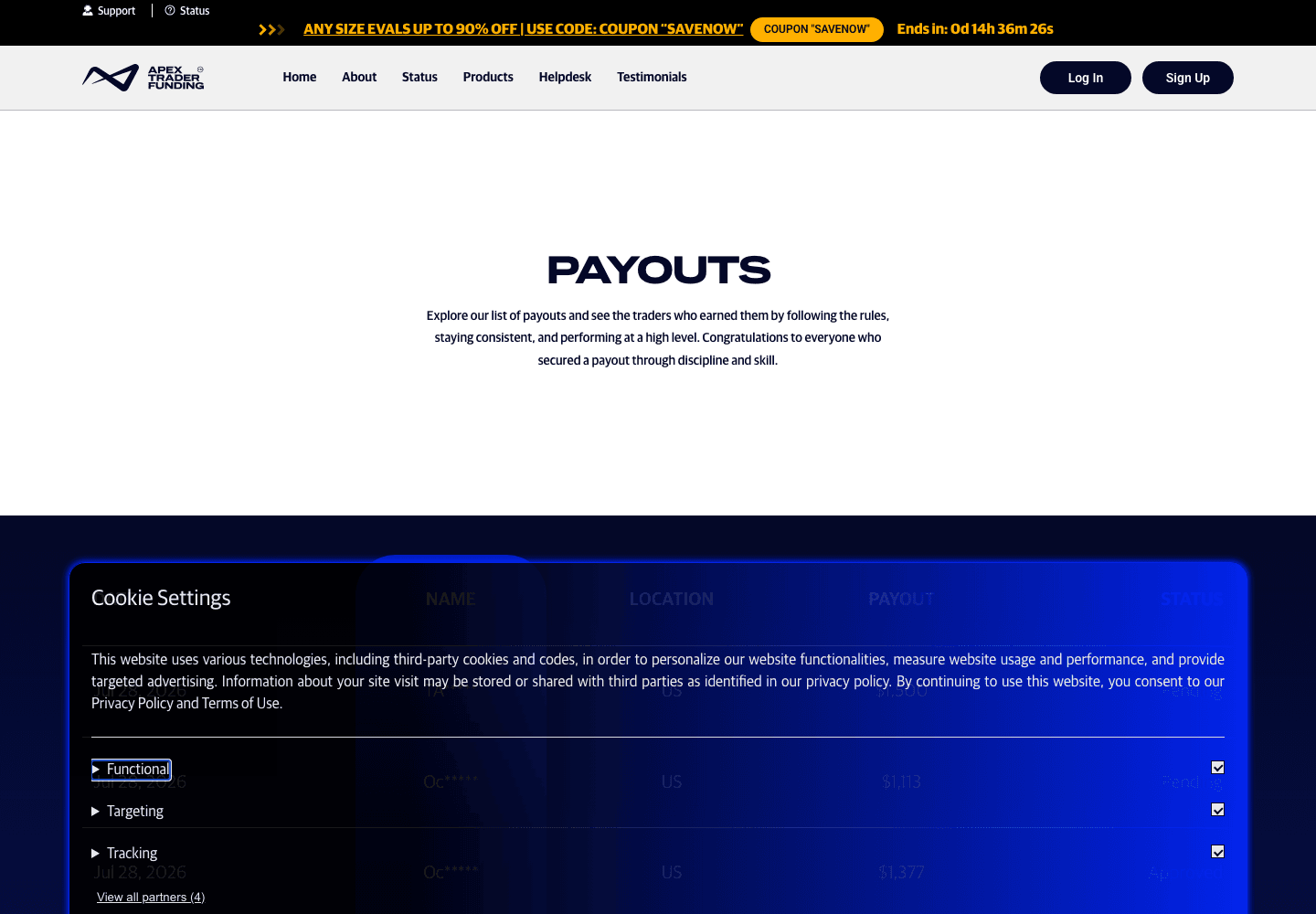
Apex publishes a public payouts page, which most of its competitors do not, and that deserves credit before anything else is said about it. It lists individual payouts with a date, a partly redacted name, a two letter country code, an amount and a status.
What we counted
We captured the page on 29 July 2026. The snapshot carried 150 rows, all dated 28 July 2026, totalling $185,195. Every row on that snapshot read Approved. The distribution:
| Measure | Value on our snapshot |
| Rows | 150, single day |
| Total | $185,195 |
| Smallest / median / largest | $500 / $1,500 / $3,000 |
| United States | 79 rows |
| Outside the United States | 71 rows across 31 countries |
| Largest non US groups | Canada 16, India 6, South Korea 4, Chile 4, France 3, Germany 3, Taiwan 3, Philippines 3 |
A later render of the same page, captured for the screenshot above, showed rows marked Pending as well as Approved, so the status column is live rather than a filtered list of successes. That is a point in Apex’s favour and we correct our own first reading of it: the page is not only showing approved payouts.
Apex’s own headline totals
The homepage carries three animated counters that display as zero in the served HTML, with the values held in data-count attributes. Read out of the markup on 29 July 2026 they were $28.61M average monthly compensation to customers since April 2024, $826.62M total since 2022 and $83.06M in the last 90 days. These are Apex’s own figures, unaudited, from a live counter that moves between page loads, and we publish them as the firm’s claim rather than as a fact. We mention them because a review asking whether a firm pays should not omit the firm’s own answer, and because the number is checkable against nothing at all.
What this evidence can and cannot support
It is the firm’s own page, generated by the firm’s own system, and we have no way to audit a single row. It cannot tell a reader what proportion of requests are refused, how long approval takes, or how many traders never reach the threshold. Marketing screenshots are not evidence and neither is a self published ledger, however detailed. What it does establish is that money moves and that Apex is willing to attach dates and amounts to the claim in public, continuously, where anyone can check the numbers change.
The maximum figure is itself informative. The largest payout on a 150 row day was $3,000, and the payout tables explain why: the ceiling on any single request runs from $1,000 on a 25K account to $5,000 on the sixth payout of a 150K. Nobody is withdrawing five figures from a simulated account here, by design.
The geography contradicts the terms
Seventy one of the 150 payouts on our snapshot went outside the United States, to France, Greece, the Czech Republic, Germany, India, Brazil, Argentina, Australia, Taiwan, Great Britain, Canada, Thailand, South Korea, Israel, Romania, the Philippines, Mexico, Ireland, Singapore, Finland, Chile, Ethiopia, Bolivia, Sweden, Italy, Colombia, El Salvador, Bulgaria, Malaysia, Puerto Rico and Spain. Apex’s Risk Disclosure, effective 22 October 2025, states that “The Services offered are not directed at, or intended for, residents outside the United States”, and the footer of every page reads “Services are intended for U.S. users only.” Meanwhile the About page says the programme is “Available globally where allowed by law” with members in over 150 countries, and the restricted countries article opens with “Traders from over 100 countries can participate.”
The firm’s own payouts ledger settles which of those statements describes the actual business. A non US trader is not reading a document written for them, and if a dispute ever turned on the point, the Risk Disclosure is the document with the signature block.
Timing
We could not source a stated processing time for simulated payouts and have left the field empty rather than guess. The only processing commitment we found applies to the live programme: “Approved live profits are withdrawn and sent to Payment Service Processing within 48 hours of the request.” The homepage’s “5 Days for Payouts” refers to the five qualifying trading days required before a request can be made, not to how long the money takes.
Customer Support
Support is a ticket queue. Every page footer reads “Contact Support 24/7 Via Help Desk”, and that is the whole of the channel list. We found no telephone number, no support email address and no published response time anywhere on the public site. A chat widget labelled “Need Help?” appears on help centre pages and routes into the same help desk. There is a status page for platform incidents and a Facebook group at facebook.com/groups/apextraderfunding, which is the only social channel the site links to.
For most product questions this is adequate, because the help centre is genuinely good and answers most of them without a ticket. For the situation that actually matters at a prop firm, it is thin. The moment a trader most needs to reach a human is a disputed payout or a rule violation notice, and at that moment they have one asynchronous channel, no escalation path published, no ombudsman, no regulator to complain to and an arbitration clause pointing at Travis County, Texas.
What we could confirm
| Channel | Help desk tickets. A “Need Help?” widget on help centre pages |
| Hours | Advertised as 24/7. No response time commitment published |
| Telephone | None published on the public site |
| None published on the public site. The Privacy Policy directs analytics questions to “support” without giving an address | |
| Postal address | 2028 E. Ben White Blvd Ste 240-9873, Austin, TX 78741 |
| Languages | English only. Apex cites language barriers as a reason for excluding some countries |
| Social | Facebook group. No X, LinkedIn, Instagram or YouTube account linked from the site we fetched |
How support behaves around money
Three published behaviours tell a reader more than any hours table. First, denial is automated rather than negotiated: if a balance drops below the threshold after a request is submitted, “the payout will be denied automatically”, and the trader simply reapplies. Second, eligibility itself is machine checked, since consistency “is automatically evaluated by the system when determining payout eligibility” and the request button does not appear until it passes. Third, and pulling the other way, Apex’s own news archive describes a human compliance layer above that: a “rigorous review process” run by “the firm’s compliance team” before funds are released. A trader caught by the first two can fix them with arithmetic. A trader caught by the third has one help desk ticket and no published appeal.
Apex does commit to notice on rule changes. The Terms of Use says material changes will be notified “which may include sending an email to your registered address, posting on our Site, or providing notice through your Account dashboard”. The Live Prop FAQ is blunter: “Apex reserves the right to update these rules, policies, requirements, and program details at any time, with or without notice.” The 1 March 2026 restructuring shows what that looks like in practice, though it is worth noting Apex protected existing customers on that occasion, promising legacy accounts “No rules or program changes” and “No ‘retroactive’ changes”.
Restricted Countries
Apex publishes an explicit exclusion list, which is the standard we ask for: a restriction has to come from the firm’s own words, not from an inference. The heading reads “LIST OF COUNTRIES WE ARE NOT ABLE TO SERVICE AT THIS TIME WITH New or Additional ACCOUNTS”, and the table below it holds 29 rows of three cells, so 87 countries and territories. We counted the cells in the page markup rather than the rendered text, because the table reads column first and is easy to miscount.
The reasons Apex gives are sanctions and embargoes, “Service Limitations by Providers” where a broker, platform or data provider cannot operate in a region, elevated fraud risk including card fraud and foreign card spending restrictions, and language and training barriers. The second of those is a useful admission: the vendors, not Apex, decide part of this map.
The published list
Afghanistan, Algeria, Azerbaijan, Bahrain, Bangladesh, Belarus, Benin, Brunei, Burkina Faso, Burundi, Cameroon, Central African Republic, Chad, China, Cuba, Cyprus, Egypt, Eritrea, Gabon, Grenada, Guinea, Guinea-Bissau, Haiti, Iran, Iraq, Jersey, Jordan, Kazakhstan, Kenya, Kosovo, Kuwait, Latvia, Lebanon, Lesotho, Liberia, Libya, Madagascar, Maldives, Mauritania, Mauritius, Moldova, Mongolia, Morocco, Mozambique, Myanmar, Namibia, Nepal, New Caledonia, Nicaragua, Niger, Nigeria, North Korea, Oman, Pakistan, Palestine (State of), Papua New Guinea, Qatar, Republic of the Congo, Reunion, Russia, Rwanda, Saint Pierre and Miquelon, Saudi Arabia, Senegal, Serbia, Somalia, South Africa, South Sudan, Sri Lanka, Sudan, Syria, Tanzania, Togo, Trinidad and Tobago, Tunisia, Turkiye, Uganda, Ukraine, Uzbekistan, Vanuatu, Venezuela, Vietnam, Western Sahara, Yemen, Zambia, Zimbabwe, and Cote d’Ivoire.
Some entries follow sanctions logic and some plainly do not. Cyprus and Latvia are European Union member states. Jersey is a Crown Dependency. South Africa, Nigeria and Kenya are three of Africa’s largest retail trading markets. Those exclusions look like payment risk and vendor coverage rather than law, which matches the reasons Apex itself gives.
How the restriction actually bites
Nationality is not the test; presence and payment rails are. A trader originally from a restricted country may still qualify if they hold a government ID from an approved country and their primary residence, mailing address and bank account are all in one. But while physically in a restricted country, Apex says a trader cannot “Purchase new accounts, Request payouts, Place trades on your active accounts” or “Maintain full access to your account until you return to a non-restricted country”, and adds that “These restrictions are automatically enforced, and no exceptions are permitted.”
The consequence deserves stating plainly. A trader who travels to a restricted country loses the ability to close open positions in an account that is still subject to a trailing drawdown. Combine that with the Risk Disclosure’s allocation of technology and access failures to the customer, and a holiday in the wrong place can cost an account. Using a VPN to work around it is separately prohibited and is grounds for closure.
The contradiction a non US reader should weigh
We fetched the site through country-targeted exits in Great Britain, Singapore, Japan, Germany, India and the United Arab Emirates. Unlike a CFD broker, Apex serves one page everywhere: the content was the same from every exit that returned a body, and the US-only footer disclosure appeared on all of them. There is no per-country entity routing here and no disappearing risk warning, which is worth recording because it means the contradiction below is not a geo artefact. It is the same document contradicting the same ledger, everywhere.
Apex tells traders in over 100 countries they may participate, pays them, and lists their countries publicly. Its Risk Disclosure says the services “are not directed at, or intended for, residents outside the United States” and makes non US users responsible for their own local law: “Accessing Apex Services in violation of local regulations is prohibited.” That risk sits entirely with the trader, and no regulator anywhere is holding a file on their behalf.
Conclusion
Apex Trader Funding is a real company that answers the hard question honestly in its legal documents and then contradicts itself on its homepage. Both halves of that sentence matter.
The funded account is a simulation. Not the challenge alone, the funded stage too. Apex writes that “All trading conducted in Evaluation and Performance Accounts is simulated and does not involve real funds” and that “Users never deposit funds into any trading account and do not trade using their own capital.” There is no futures commission merchant behind an Evaluation or Performance Account because no order reaches an exchange; Rithmic, Tradovate and WealthCharts supply the simulator and the data feed. The money a trader hands over is a fee, it becomes Apex’s revenue immediately, and a payout is a reward paid from that revenue at the firm’s discretion. Anyone comfortable with that description can buy this product with their eyes open. Anyone who thought they were being staked to trade real futures was misled, and not by us.
What we would want a buyer to price in. Six payouts per account and then it closes, with lifetime ceilings of $6,000 on a 25K and $21,500 on the largest intraday account. A safety net that must hold for the account’s life and that a full payout drops you straight back to, so every cycle needs fresh profit. A consistency rule under which a good day pushes the payout further away and the only cure is to keep the account exposed. A trailing drawdown that never moves back down, and that never stops trailing at all on a Tradovate evaluation. And the clause almost nobody reads before buying: if Apex invites a successful trader into live trading and they decline, the member account is deactivated for a flat $3,000 and every simulated balance is forfeited. Success has a ceiling here and the firm decides where it sits.
What Apex does better than its sector. It is a named Texas corporation at a published address with a named CEO, not an anonymous offshore entity. Its rules are published as numbers, with worked examples, before purchase. Its instrument table gives tick sizes and point values. It publishes a running payouts ledger with dates, countries and amounts. Its governing law, forum and procedure are stated. Challenges are on sale and we found nothing suggesting it has stopped funding new accounts, which is the single leading indicator of a prop firm in trouble and it is absent here. Its live programme, for the small number who reach it, has better payout terms than the simulated one in every respect.
Where the evidence contradicts the firm. Two places, and we checked a third that turned out to favour Apex. The homepage promises “NO Payout Denials” and “No payout reviews”; the Risk Disclosure reserves the right to “grant or deny a Reward payout” finally and at Apex’s sole discretion, the payout FAQ carries a section headed “What happens if my payout is denied?”, and Apex’s own news archive describes a compliance audit that traders fail. Separately, the Risk Disclosure restricts the service to US residents while the firm’s own ledger shows it paying traders in 31 other countries in a single day.
The third we tested and dropped, because a review should report the checks that clear as well as the ones that do not. The homepage claims “NO Eval consistency rules” while the product data embedded in that same page tags every evaluation with a 30% consistency figure. We fetched both evaluation articles and they settle it in Apex’s favour: the parameter table for all four account sizes reads “Consistency: Not Applied”, and the intraday article states “Consistency requirements are introduced later in the Performance Account phase.” The 30% value in the product data is a stale field that is not enforced. The homepage claim is true.
What we did not check. We did not query NFA BASIC, which publishes membership, disciplinary and arbitration records. We did not query the FCA, ASIC, OSC, BaFin, AMF, CONSOB or FSMA warning lists. We could not reach the Better Business Bureau profile. We have not read the complaint in Lawton v. Apex Trader Funding Inc., 1:26-cv-02078, filed in the Western District of Texas on 24 July 2026 under a Commodity Exchange Act cause, because it sits behind PACER; the case exists, it is unanswered, and an unanswered complaint proves nothing. We gathered no verified user reports of our own. Each of those is a gap in our work and none of them is evidence against Apex.
Who this suits. A disciplined futures trader who understands they are buying a simulator with a cash prize attached, who can clear five qualifying days without one outsized session, who is comfortable that the maximum extractable from any single account is between $6,000 and $21,500, and who does not need a regulator standing behind the arrangement. It does not suit anyone who needs the funded stage to be real, anyone who cannot afford to lose the fee, or anyone who would be unable to pursue an arbitration in Texas if a reward were refused.
Our score is 6.8 out of 10, the unweighted mean of regulation 6, fees 9.5, platform 5.8, support 5.8 and reviews 7. Two of those need explaining. We scored reviews at 7, computed from the firm’s own public rating rather than argued: Apex’s Trustpilot profile carries 4.2 stars across 20,993 reviews. Competitor scores are never used here, and the only payout evidence in our hands is Apex’s own and is positive. An absence in our research is not a finding against the firm and we have not treated it as one. We scored regulation at 6 on corporate accountability and recourse, not on the missing licence, which for a prop firm is normal and carries no penalty at all.
Our own guidance says a well run prop firm with a clean payout record, clear rules and no regulation should sit in the 7s, and it is worth saying why we did not put Apex there. It has the clear rules, plainly, and it has no paused challenges. What it does not have is the clean payout record, not because the record is bad but because no independent record exists and the firm’s headline claim about denials is contradicted by its own terms, its own FAQ and its own news archive. Those are the two things the 7s band assumes are settled. Until one of them is, 6.9 is workable rather than clean, and that is our reading of it.
Score history
Recomputed daily; every move is on the record. The current score is always the latest row.
| Date | Score | Move |
|---|---|---|
| 2026-09-13 | 6.8 | ▼ |
| 2026-09-12 | 6.9 | · |
FAQ
Is Apex Trader Funding regulated and safe?
Apex Trader Funding Inc. is not regulated by anyone, and says so itself: its Risk Disclosure states it is not a broker-dealer, futures commission merchant or investment advisor and is not regulated by financial regulatory authorities. For a prop firm selling simulated evaluations that is the normal and correct position, because it holds no client money. Safety here is a question about the company rather than about supervision. It is a real Texas corporation at a published Austin address with a named CEO, its rules are published in unusual numeric detail, and it runs a public payouts ledger. Against that, recourse is limited to binding arbitration in Travis County, Texas, the contract that governs the money is not published publicly, and four unresolved US federal civil cases name the company. We did not query NFA BASIC or any regulator warning list, so we have no result from those sources in either direction.
Is the Apex funded account real money or a simulation?
A simulation, including the funded stage. Apex’s Risk Disclosure, effective 22 October 2025, says: All trading conducted in Evaluation and Performance Accounts is simulated and does not involve real funds. Users never deposit funds into any trading account and do not trade using their own capital. The Performance Account is what Apex markets as funded, and it is named in that clause. No order reaches an exchange, so there is no futures commission merchant behind it; Rithmic, Tradovate and WealthCharts supply the simulator and the data. A separate live programme does exist with real market execution, but it is invitation only and Apex decides who enters.
How much can you actually withdraw from an Apex account?
Less than most buyers expect, because each Performance Account is capped at six approved payouts and then closes. The ceilings run from $6,000 across the life of a 25K account to $21,500 on a 150K intraday account. Before any payout, five separate trading days must each clear a minimum daily profit, the balance must sit above a safety net equal to the drawdown limit plus $100, and no single profitable day may account for 50% or more of profit since the last approved payout. On a 50K intraday account, $2,600 of simulated profit releases only the $500 minimum, and taking the full $1,500 first payout needs $3,600, after which the balance sits back at the safety net and the whole cycle restarts.
What is the Apex Bonus Vault and why does it matter?
It matters because it is what happens to a trader who succeeds. Apex may move a trader into its live programme at any time at its own discretion. When it does, every Evaluation and Performance Account is closed and accumulated simulated profit is converted into a Bonus Vault, which Apex describes as not real money, not real profits, not real gains, not live funds and not a cash account, with no rights, obligations, duties, gains or actual stored value. It is then released at 20% of monthly live withdrawals while the live account stays active. A trader who declines the invitation has their member account fully deactivated, receives a flat $3,000, and forfeits every simulated balance.
Which countries can trade with Apex Trader Funding?
Apex publishes a list of 87 restricted countries and territories that cannot buy new or additional accounts, citing sanctions, limits imposed by its own brokers and data providers, fraud and card payment risk, and language barriers. The list includes Cyprus, Latvia, Jersey, South Africa, Nigeria, Kenya, China, Russia and Vietnam. Traders elsewhere must hold a government ID, primary residence, mailing address and bank account all in non restricted countries, and Apex enforces this continuously rather than once at signup. Note the contradiction a non US reader should weigh: the Risk Disclosure says services are not directed at residents outside the United States, yet the firm’s own payouts page showed 71 of 150 payouts on one day going to 31 other countries.
How this review works
Track Apex Trader Funding live: score moves and red notices, in your pocket.