
PROP · CHECKED 25 OCT 2026
Blue Guardian review.
Saint Lucia-registered prop trading firm offering funded accounts across four linked entities
RISKY
OUT OF 10
Blue Guardian is a proprietary trading firm offering funded trading accounts, with its platform entity, Blue Guardian Limited, confirmed on the Saint Lucia IBC register. Client-facing functions are split across four separate entities with no clear statement of which handles what, and Trustpilot has flagged fabricated reviews on its profile.
Each criterion is scored 1 to 10 from primary sources. The overall score is their unweighted mean. How scoring works.
| Minimum deposit | Not stated |
|---|---|
| Platforms | MT5, Match-Trader, NinjaTrader, TradeLocker, TradingView, Tradovate, DeepCharts |
- The cheapest 100K challenge, Futures Reserve, lists at USD 148 as a one time fee with no activation fee (USD 111 with a code)
- Platforms include MT5, Match-Trader, TradeLocker, TradingView, NinjaTrader, Tradovate and DeepCharts
- Support by email, live chat and tickets, plus a Discord community
- Blue Guardian Limited is on the Saint Lucia company register
- No non-disparagement clause in its terms, unlike several firms on our record
- No financial licence of any kind; the Saint Lucia listing is a company registration only
- Its contracting company, Iconic Exchange FZCO, sits in Dubai's IFZA free zone, which publishes no public register to check it against
- Four companies share the business: Iconic Exchange FZCO signs the terms, Blue Guardian Limited runs the platforms, Blue Guardian Marketing LLC handles marketing and Odeonpay ALE S.R.L takes payments
- Trustpilot rates it 3.2 from 2,110 reviews and shows its own warning that it found fabricated reviews on the profile
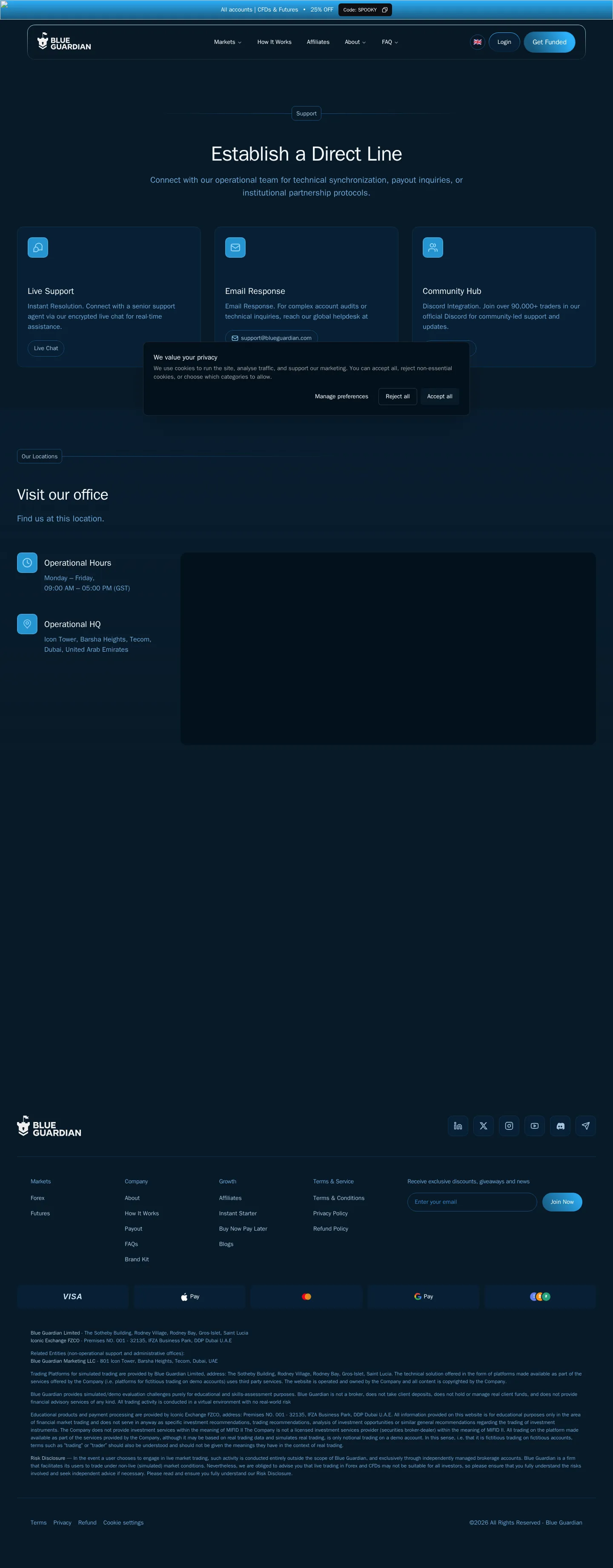
- Support is marketed as 24/7, but the contact page gives operational hours of Monday to Friday, 09:00 AM to 05:00 PM (GST)
- The futures page advertises trading up to USD 750K, but the largest futures account on its pricing selector is 150K
Overview
TrueBroker is a free broker safety checker, and this page is our review of Blue Guardian, scored 5.8 out of 10 across regulation, fees, platform, support and reviews.
Blue Guardian is a proprietary trading firm. Its own terms name Iconic Exchange FZCO, trading as Blue Guardian, with a registered address at Premises NO. 001, 32135, IFZA Business Park, DDP, Dubai, U.A.E., as the “Company” that contracts with clients. The firm’s root page names a second entity, Blue Guardian Limited, registered at The Sotheby Building, Rodney Village, Rodney Bay, Gros Islet, Saint Lucia, as the provider of the trading platforms used for what the terms call simulated trading. A third entity, Blue Guardian Marketing LLC, sits at 801 Icon Tower, Barsha Heights, Tecom, Dubai, UAE, and is described on the root page as non operational support and administrative offices. A fourth, Odeonpay ALE S.R.L, trading as Paysagi, acts as merchant of record for settlement of certain payments on the website. The about page names Sean Bainton as founder and CEO.
We searched the Saint Lucia Registry of International Business Companies name search (Pinnacle St. Lucia) and found “Blue Guardian Limited (IBC)” listed there, marked as an International Business Company. The Saint Lucia register’s free name search publishes no registration number, incorporation date or status, those sit behind a paid, account only search, and an IBC registration is a company registration, not a licence to deal in forex or CFDs. We also attempted IFZA, the Dubai free zone named in Iconic Exchange FZCO’s address, but IFZA publishes no public searchable register, so a company registered there exists, but the registration confers no financial services permission and cannot be independently verified from outside.
The most important thing to know before anything else
We read Blue Guardian’s own terms and conditions, and they state plainly that the Company “is not a broker, does not take client deposits, does not hold or manage real client funds” and that “all trading activity is conducted in a virtual environment with no real world risk,” with trading described as “notional” or on a “fictitious” account. The same terms state the Company “does not provide investment services within the meaning of MIFID II” and “is not a licensed investment services provider (securities broker dealer).” Elsewhere on the same domain, marketing copy describes “Institutional Trading,” “prime execution, tight spreads, and low slippage across all assets,” and trader testimonials about real cash payouts. A reader relying on the marketing could reasonably believe they are trading real markets with institutional grade execution and withdrawing real trading profits, when the firm’s own terms describe the entire activity as simulated and unlicensed.
Overview Table
| Headquarters | Premises NO. 001, 32135, IFZA Business Park, DDP, Dubai, U.A.E. (Iconic Exchange FZCO, the Terms’ contracting Company) |
| Established | Not stated |
| Countries Served | Not stated, beyond a general restriction that product and site use is limited to the territory the specific site is directed to and subject to US export controls |
| Regulated By | Not regulated as a financial services provider; the firm’s own terms state it is not a licensed investment services provider. Blue Guardian Limited is registered as an International Business Company on the Saint Lucia registry name search; Iconic Exchange FZCO’s Dubai address sits in the IFZA free zone, which publishes no public searchable register |
| Minimum Deposit | Not stated as a deposit; the Instant Starter one time entry fee is $11 for a $5,000 account on one fee page, while the standard pricing widget on the same domain prices the equivalent Instant 5K account at $54.00 |
| Maximum Leverage | 1:100 Max (1 Step Standard account); other accounts list 1:30, 1:50 and 1:100 depending on the programme |
| Total Instruments | Not stated as a count; markets listed are Forex, Futures, Commodities and Indices |
| Platforms | MT5, Match Trader, NinjaTrader, TradeLocker, TradingView, Tradovate, DeepCharts |
| Customer Support | Live chat, email (support@blueguardian.com), Discord; office hours Monday to Friday, 09:00 AM to 05:00 PM (GST), despite marketing elsewhere describing “24/7” support |
| Languages | Not stated |
Facts List
- Blue Guardian’s own terms describe all trading on the site as “notional” or “fictitious,” conducted in a virtual environment with no real world risk.
- The same terms state the Company is not a licensed investment services provider and does not provide investment services within the meaning of MIFID II.
- Iconic Exchange FZCO, trading as Blue Guardian, is the Terms’ contracting “Company,” registered at IFZA Business Park, DDP, Dubai, U.A.E.
- Blue Guardian Limited, registered in Saint Lucia, is named as the provider of the trading platforms.
- We found “Blue Guardian Limited (IBC)” on the Saint Lucia Registry of International Business Companies name search, marked as an International Business Company, which is a company registration rather than a financial services licence.
- IFZA, the Dubai free zone named in Iconic Exchange FZCO’s address, publishes no public searchable register, so that registration cannot be independently verified from outside.
- Blue Guardian Marketing LLC, at 801 Icon Tower, Barsha Heights, Tecom, Dubai, is described on the root page as non operational support and administrative offices.
- Odeonpay ALE S.R.L, trading as Paysagi, acts as merchant of record for settlement of certain payments on the site, under its own terms of use presented at checkout.
- Published office hours on the contact page are Monday to Friday, 09:00 AM to 05:00 PM (GST), alongside separate marketing claims of “24/7” support.
- No phone number for support is published on any of the pages we fetched.
Who actually runs Blue Guardian
Four distinct entities appear in Blue Guardian’s own pages: Iconic Exchange FZCO as the Terms’ contracting Company, Blue Guardian Limited in Saint Lucia as platform provider, Blue Guardian Marketing LLC in Dubai as non operational support, and Odeonpay ALE S.R.L as merchant of record for payments. Which entity a client is actually dealing with, and so what recourse or escalation applies, depends on which function, platform, payments or marketing, is at issue.
Key Takeaways
What the Saint Lucia and IFZA checks turned up
- The Saint Lucia Registry of International Business Companies name search (Pinnacle St. Lucia) lists “Blue Guardian Limited (IBC)” as an International Business Company. That free search does not publish a registration number, incorporation date or status, and an IBC registration is a company filing, not a licence to deal in forex or CFDs.
- IFZA, the Dubai free zone where the terms say the contracting entity Iconic Exchange FZCO sits, publishes no public searchable register, so that address cannot be independently verified from outside, and a free-zone registration confers no financial-services permission in any case.
- No licence from any financial regulator appears anywhere in the pages we fetched. That absence of a licence, set against the two company-registration findings above, is what the regulation score reflects.
What Blue Guardian’s own pages say about pricing
- Blue Guardian’s Instant Starter landing page prices the $5,000 instant-funded entry at $11, marked “Limited Time Offer” and “45% off,” bypassing the evaluation phase. The firm’s own pricing widget on the same domain prices what appears to be the equivalent “Instant” 5K account at $54.00, discounted from $72.00. The firm’s own pages give two different prices for a comparable $5,000 entry.
- The pricing widget shows bundle discounts for buying multiple challenge accounts at once: 30% off extra (saving $187) for two accounts, 35% off (saving $405) for three, and 40% off (saving $654) for four.
- The Futures landing page advertises “Trade up to $750K,” but the account size options actually on offer in the pricing selector for all four Futures programmes (Standard, Reserve, Express, Direct) top out at $150K.
- The Futures landing page claims no activation fees, contrasting this with “Other Firms” that it says charge USD 50 to 150 or more.
Platforms and markets on Blue Guardian’s pricing page
- The homepage lists MT5, Match-Trader, NinjaTrader, TradeLocker, TradingView, Tradovate and DeepCharts as supported platforms.
- Markets on offer span forex, futures (CME-listed contracts), commodities and indices, per the site’s own market descriptions.
- Account structures range from the no-evaluation “Instant” account (up to 90% profit split, 1:30 max leverage per the published table) through 1-step and 2-step challenges at up to 1:100 leverage, to four separate Futures programmes with their own payout caps and drawdown rules.
Blue Guardian’s published support hours against its own marketing
- The homepage advertises Dedicated 24/7 Support… always available, and the Futures page promises “24/7 support via ticket & email.” The firm’s own Contact page gives the office’s Operational Hours as Monday to Friday, 09:00 AM to 05:00 PM (GST), and no phone number appears on any page we fetched.
- Support channels listed on the Contact page are live chat, email (support@blueguardian.com), a compliance email (compliance@blueguardian.com) and a Discord community described as “90,000+ traders.”
- Our reviews score of 3.0 comes from Trustpilot alone: the blueguardian.com profile, listed as Blue Guardian CFD, rates the firm 3.2 stars across 2,110 reviews, and Trustpilot shows its own warning on that profile that it found fabricated reviews, which costs 1.5 points under our rules (checked 23 Oct 2026). Blue Guardian publishes no app of its own.
Terms that bind a trader at Blue Guardian
- Disputes go to binding arbitration under ICDR International Arbitration Rules before a single arbitrator seated in Dubai, with proceedings in English, and the terms carry a class action waiver barring class, representative or consolidated claims. Any dispute not resolved by arbitration goes exclusively to the courts of Dubai under UAE law.
- The “Prohibited Trading” clause is written broadly enough to cover trading that “jeopardizes the relationship that the Company has with a broker” or “creates regulatory issues for the Broker,” and a breach finding can mean forfeiture of fees already paid.
- Under the Multiple Accounts / Identity Misuse clause, the Company has “sole and absolute discretion” to find a breach and may suspend or terminate accounts, void trades, adjust profit or loss, or deny a payout, and those decisions are final with no stated liability on the Company’s part.
- A separate risk-review clause lets Blue Guardian terminate an account or deny a withdrawal if it judges, by its own subjective standard, that a trader has “abused margin availability” or used a “Prohibited Strategy” such as a “Boom or Bust approach,” independent of whether the account breached its stated daily-loss or drawdown limits.
- The Company can change the terms at any time at its sole discretion, with continued use treated as acceptance (a 30-day notice carve-out applies only to Quebec customers), and it can assign its rights and duties to another party, including on a sale of the business, while the client is barred from assigning theirs.
- The liability disclaimer excludes the Company and its suppliers from direct, indirect, incidental, special or consequential damages, and the indemnification clause makes the client responsible for the Company’s costs and legal fees arising from the client’s own use of the site or breach of the terms.
The gap between Blue Guardian’s legal notices and its marketing
- The terms state plainly that Blue Guardian “is not a broker, does not take client deposits, does not hold or manage real client funds,” that “all trading activity is conducted in a virtual environment with no real-world risk,” and that trading is “notional”/”fictitious.” They also state the Company “does not provide investment services within the meaning of MIFID II” and “is not a licensed investment services provider (securities broker-dealer).”
- Against that, the same domain’s marketing describes “Institutional Trading” and “prime execution, tight spreads, and low slippage across all assets,” alongside trader testimonials about real cash “payouts.” A reader relying on the marketing pages could reasonably believe they are trading live markets and withdrawing trading profits, when the firm’s own terms describe the whole activity as simulated and outside any investment services licence.
- At least four entities sit behind the site: Blue Guardian Limited (Saint Lucia, provides the trading platform), Iconic Exchange FZCO (Dubai, the terms’ contracting “Company,” also handling education products and payment processing), Blue Guardian Marketing LLC (Dubai, described as non-operational support and administrative offices), and Odeonpay ALE S.R.L (“Paysagi”) as Merchant of Record for payment settlement. Which entity a trader is actually dealing with, and what recourse applies, depends on which function is in question.
- The Paysagi settlement clause itself contains the line “Paysagi is not the supplier of the gods or services,” an apparent drafting error that points to boilerplate language in a document that governs real money moving in and out of trader accounts.
Licenses & Regulation
Blue Guardian’s own terms are explicit about what this is: the firm’s legal pages describe the “Company” as “not a broker,” state it “does not take client deposits, does not hold or manage real client funds,” and say all trading happens “in a virtual environment with no real-world risk,” with activity described as “notional trading on a demo account” and “fictitious trading on fictitious accounts.” The same terms state the Company “does not provide investment services within the meaning of MIFID II” and “is not a licensed investment services provider (securities broker-dealer).” There is no licence in the evidence we gathered for any entity behind this operation. Nothing here is permissioned to deal in forex or CFDs with client money; the entire structure is a challenge-fee and simulated-account business.
The entities behind Blue Guardian
The site’s own pages split the operation across at least four entities. Iconic Exchange FZCO, trading as Blue Guardian, is named as the “Company” that is counterparty to the Terms, registered at IFZA Business Park, DDP, Dubai, and also described as providing educational products and payment processing. Blue Guardian Limited, a separate entity at The Sotheby Building, Rodney Village, Rodney Bay, Gros-Islet, Saint Lucia, is named as the provider of the trading platforms used for simulated trading. Blue Guardian Marketing LLC sits at 801 Icon Tower, Barsha Heights, Tecom, Dubai, and is described on the firm’s own page as “non-operational support and administrative offices.” A fourth party, Odeonpay ALE S.R.L, trading as “Paysagi,” is named in the terms as Merchant of Record for settlement of certain payments, subject to its own separate terms of use at checkout. Which of these a client is actually dealing with, and so what recourse applies, depends on whether the issue is the platform, the marketing, or the payment.
What the Saint Lucia registry shows for Blue Guardian Limited
We searched the Saint Lucia Registry of International Business Companies through its free name search (Pinnacle St. Lucia). “Blue Guardian Limited (IBC)” is confirmed on that register, marked as an International Business Company. The free name search does not publish a registration number, incorporation date, or status; those sit behind a paid, account-only search we did not run. An IBC registration of this kind is a company registration, not a licence to deal in forex or CFDs, and the register does not record one.
IFZA and the Dubai side of the business
Iconic Exchange FZCO’s registered address, “IFZA Business Park, DDP, Dubai, U.A.E.,” points to registration in the IFZA free zone. We attempted to check this register directly; IFZA publishes no public searchable list of the companies registered there. That makes an IFZA registration unverifiable from outside: a company can exist on paper at that address, but the registration itself confers no financial-services permission and nothing about it can be independently confirmed the way the Saint Lucia filing could be. No registration number for Iconic Exchange FZCO appears on any page we fetched.
No licence, by the firm’s own account
Nothing in the evidence shows a financial-services licence for Iconic Exchange FZCO, Blue Guardian Limited, or Blue Guardian Marketing LLC in any jurisdiction, and the firm’s own terms say as much directly: Blue Guardian “is not a licensed investment services provider (securities broker-dealer).” That statement sits awkwardly next to the marketing on the same domain, which describes “Institutional Trading,” “prime execution, tight spreads, and low slippage across all assets,” and trader testimonials about receiving real cash “payouts.” A reader working from the marketing pages alone could reasonably conclude they are trading live markets through an institutional-grade broker; the terms describe something else entirely, a notional account with no broker-client relationship and no deposit of real funds.
What the contract does if something goes wrong
Because there is no licence and no regulator standing behind the relationship, the terms are the only recourse a client has, and they are drafted heavily in Blue Guardian’s favour. Disputes go to binding arbitration under the ICDR International Arbitration Rules before a single arbitrator seated in Dubai, in English, under the Class Action Waiver clause that bars class, representative, or consolidated claims. Anything not resolved by arbitration goes “exclusively” to the courts of Dubai, UAE, under UAE law. The Liability Disclaimer section disclaims all warranties and excludes the Company’s liability for direct, indirect, incidental, special or consequential damages “to the maximum extent permitted by law,” while the Indemnification section requires the client to cover the Company’s own losses, costs, and attorney’s fees arising from the client’s use of the Site. Under “Your Account” and “Termination / Access Restriction,” the Company can refuse service, terminate an account, or cut off Site access “at any time without notice.” The “Prohibited Trading” clause is broad enough to cover trading that “jeopardizes the relationship that the Company has with a broker” or “creates regulatory issues for the Broker,” with forfeiture of fees paid as a stated consequence. A separate clause gives Blue Guardian “sole and absolute discretion” over multiple-account and identity-misuse determinations, including voiding trades, adjusting profit and loss, and denying payouts, with the terms stating such decisions are final and the Company bears no liability for the result.
How to Trade
Iconic Exchange FZCO, trading as Blue Guardian, runs this as a funded trading challenge business, not a brokerage holding client money to trade real markets, and the firm’s own terms and conditions, which we read directly, are explicit about that split. The homepage lists Forex, Futures (described as “CME listed active contracts”), and a CFD category covering “currencies, commodities, indices & more” as the markets on offer, and names seven platforms traders can use: MT5, Match Trader, NinjaTrader, TradeLocker, TradingView, Tradovate and DeepCharts.
The challenge tiers Blue Guardian sells
The pricing page sets out several account structures, each with its own rule set rather than one standard contract. The Instant account skips any evaluation phase, advertises up to a 90 percent profit split and on demand payouts, and caps leverage at 1:30, with a Max Daily Loss of $3,000 and a Trailing Drawdown of $6,000 at the tier shown; it allows weekend holding, expert advisors, trade copiers and overnight holding, but not news trading, and sets no limit on trading days.
The same pricing page lists two “1 Step” tiers and two “2 Step” tiers. The 1 Step Standard account carries a $9,000 phase one profit target, a $4,000 Max Daily Loss, a $6,000 Trailing Drawdown, 1:100 leverage, and is marketed as having “no consistency rule.” The 1 Step Nano account sets a $10,000 profit target, a $4,000 Max Daily Loss, a $6,000 Trailing Drawdown, a 50 percent consistency requirement and 1:50 leverage, marketed as the “cheapest 1 step” tier with “up to 100% profit split.” The 2 Step Standard account sets an $8,000 phase one target and a $4,000 phase two target, a $4,000 Max Daily Loss and an $8,000 static drawdown, with no consistency rule, at 1:50 leverage. The 2 Step Nano account sets an $8,000 phase one target and a $5,000 phase two target, a $3,000 Max Daily Loss and a $10,000 static drawdown, also with no consistency rule, also at 1:50 leverage. Across all of these tiers the pricing page allows news trading, weekend holding, expert advisors, trade copiers and overnight holding, and sets no limit on the number of trading days.
Blue Guardian’s futures tiers
The Futures landing page markets the ability to “trade up to $750K,” but the account size options actually offered in the pricing selector for all four futures programmes, Standard, Reserve, Express and Direct, top out at a $150K account. Within those four programmes the terms differ sharply. Futures Standard pays out every three days, which the page calls the fastest non daily cadence in futures prop trading, with payout caps scaling up to $4,500 and the $25K size carrying no daily loss limit at all; its stated figures are a $6,000 profit target, an eight mini or eighty micro position cap, no consistency rule, no time limit, a $2,000 soft breach daily loss limit and a $3,500 end of day trailing drawdown. Futures Reserve sets flat payout caps of $1,000, $2,000, $2,500 or $3,000, moves an account straight to live status after five payouts, and offers a choice between no daily loss limit or a lower priced daily loss limit option, against a $6,000 profit target, a customisable 40 or 50 percent consistency rule, a $1,700 daily loss limit and a $3,000 drawdown. Futures Express advertises an $1,100 daily payout cap that the page calls the highest in the industry, with payouts processed in under an hour on every business day and news trading allowed, against a $6,000 profit target, a 40 percent consistency rule, a $1,500 daily loss limit and a $3,000 drawdown. Futures Direct skips the evaluation and demo stages entirely for an instantly funded account with instant payout, a profit split described on the page as 90 percent to the trader, a consistency requirement that rises from 20 to 25 to 30 percent across the first, second and third payouts, a $2,500 daily loss limit and a $3,500 drawdown. The Futures page also states there are no activation fees, contrasting itself with “other firms” it says charge $50 to $150 or more.
The rules that can cost a trader a payout
Beyond the stated drawdown and loss figures, Iconic Exchange FZCO’s terms and conditions give the firm wide discretion to intervene regardless of whether those numeric limits were breached. The terms restrict traders to one active account per challenge level without prior written approval, and bar anyone who is a principal, owner or otherwise directly associated with a competing proprietary trading firm from trading with the Company at the same time. A “Prohibited Trading” clause is written broadly enough to cover trading that “jeopardizes the relationship that the Company has with a broker” or “creates regulatory issues for the Broker,” and the terms state that a finding under this clause ends a trader’s participation and may include forfeiture of fees already paid. A separate “Trading Styles” clause allows Blue Guardian to run a risk review at any stage and to terminate an account or deny a withdrawal if it judges that a trader has “abused margin availability” or failed to apply “appropriate risk management,” citing subjectively judged “Prohibited Strategies” such as taking excessive risk in a single trade or what the terms call a “Boom or Bust” approach, independent of whether the account’s stated daily loss or drawdown limits were formally breached. For disputes over multiple accounts or profiles, the terms give the Company “sole and absolute discretion” to find a breach and to suspend or terminate accounts, void trades, adjust profit or loss, or deny a payout, stating these decisions are final and that the Company bears no liability for the resulting losses.
What Blue Guardian’s own terms say trading here actually is
The clearest fact governing how trading works here sits in the legal text rather than the marketing copy. Iconic Exchange FZCO’s terms and conditions state that the Company “is not a broker, does not take client deposits, does not hold or manage real client funds,” that “all trading activity is conducted in a virtual environment with no real world risk,” and that trading under the agreement is “notional trading on a demo account,” elsewhere described as “fictitious trading on fictitious accounts.” The same terms state the products “are not in any way intended to be considered an investment” and that the Company “does not provide investment services within the meaning of MiFID II” and “is not a licensed investment services provider (securities broker dealer).” That legal description sits alongside marketing on the same domain describing “Institutional Trading,” “prime execution, tight spreads, and low slippage across all assets,” and trader testimonials about receiving real cash payouts. A trader relying on the marketing language could reasonably believe they are trading live markets with institutional grade execution, when the firm’s own contract describes the whole exercise as simulated.
Account Types
Blue Guardian sells trading challenges and instant-funded accounts across two product lines, forex/CFD and futures, each with several tiers set out on the firm’s own pricing pages. None of these are brokerage accounts in the ordinary sense: the firm’s terms and conditions state that “the products and services offered on this Site are not in any way intended to be considered an investment,” that the Company does not provide investment services within the meaning of MIFID II… is not a licensed investment services provider, and that all trading is “notional trading on a demo account” on “fictitious accounts.” Whatever tier is bought, what it buys is access to a simulated account, not a real brokerage one, even though the same site’s marketing talks about “Institutional Trading” and “prime execution, tight spreads, and low slippage.”
Instant accounts, and a price that does not match itself
The Instant tier skips the evaluation phase. Blue Guardian’s own root page lists it with up to 90% profit split, on-demand payouts, a Max Daily Loss of $3,000 and Trailing Drawdown of $6,000 at the 50K size, an indefinite max trading day limit, 1:30 maximum leverage, and permission for weekend holding, EAs, trade copiers and overnight holding, with news trading disallowed. The root page lists a separate “90% Profit Split” add-on among its “Add-Ons Available” for this tier, but does not carry a price for it. The firm’s dedicated Instant Starter landing page prices the $5,000 Instant entry at $11, calling this a “Limited Time Offer” and “45% off.” The standard pricing widget on the same domain prices what appears to be the same $5,000 Instant account at $54.00, discounted from $72.00. The two of Blue Guardian’s own pages do not agree on what this account costs.
1 Step and 2 Step challenges
The pricing widget lists four evaluation tiers. 1 Step Standard carries a $9,000 profit target, $4,000 Max Daily Loss, $6,000 Trailing Drawdown, unlimited trading days and 1:100 maximum leverage, marketed as “9% Profit Target, No Consistency Rule.” 1 Step Nano carries a $10,000 profit target, the same $4,000/$6,000 loss and drawdown limits, a 50% consistency requirement, and 1:50 maximum leverage, marketed as the “Cheapest 1-Step.” 2 Step Standard splits its target across two phases ($8,000 then $4,000), uses a static $8,000 drawdown rather than a trailing one, and carries no consistency rule. 2 Step Nano also splits across two phases ($8,000 then $5,000), with a $3,000 Max Daily Loss, a $10,000 static drawdown, and no consistency rule, marketed as the “Cheapest 2-Step.” All four permit news trading, weekend holding, EAs, trade copiers and overnight holding.
Futures programmes at Blue Guardian
Four futures tiers appear on the same pricing widget. Futures Standard advertises payouts every three days, caps on individual payouts that scale up to $4,500 with consistency, and no Daily Loss Limit at the $25K size; its baseline terms are a $6,000 profit target, a $2,000 soft-breach Daily Loss Limit and a $3,500 end-of-day trailing drawdown. Futures Reserve offers flat payout caps of $1,000 to $3,000, moves a trader straight to a live account after five payouts, and lets the trader choose no Daily Loss Limit or a lower-priced one, against a $6,000 profit target, a 40% or 50% consistency rule, a $1,700 Daily Loss Limit and a $3,000 drawdown. Futures Express advertises an $1,100 daily payout cap described as “the highest in the industry” and same-business-day payouts processed “in under an hour,” with a $6,000 target, 40% consistency rule, $1,500 Daily Loss Limit and $3,000 drawdown. Futures Direct is instant-funded with no evaluation and no demo step: its consistency requirement scales from 20% to 30% across successive payouts, the profit split is 90% to the trader, the Daily Loss Limit is $2,500 and the drawdown cap $3,500. A separate Futures landing page states there is “No Activation Fees,” contrasting this with “Other Firms” that it says charge USD 50 to 150 or more. The same Futures landing page markets the ability to “Trade up to $750K,” but the account sizes actually offered in the pricing selector for all four futures programmes top out at $150K.
Bundling and discounts
Blue Guardian’s root page offers a discount for buying more than one challenge account at once: 30% off an extra account (saving $187) for two accounts, 35% off (saving $405) for three, and 40% off (saving $654) for four, stacked on top of whatever standard or promotional rate applies. The firm’s terms also cap a trader to one active account per challenge level “absent prior written approval,” so the bundle discount applies to accounts at different levels or multiple approved accounts at the same level rather than to unlimited duplicates.
Negative Balance Protection
Blue Guardian funds trading through evaluation and instant-funded accounts rather than a live brokerage account with client deposits, so the “loss limit” that matters here is the per-account daily loss and drawdown figure that triggers a breach, not negative-balance protection on a funded trading account. The firm’s own terms and conditions make that distinction explicit: they state the Company is not a broker, does not take client deposits, does not hold or manage real client funds… All trading activity is conducted in a virtual environment with no real-world risk, and separately describe the activity as “notional trading on a demo account” and, elsewhere in the same terms, as “fictitious trading on fictitious accounts.”
The daily loss and drawdown figures Blue Guardian publishes
The pricing material fetched from Blue Guardian’s site sets a different daily loss limit and drawdown ceiling for each account tier, with no single figure applying across the board.
| Account | Max daily loss | Drawdown limit |
|---|---|---|
| Instant | $3,000 | Trailing Drawdown $6,000 |
| 1 Step Standard | $4,000 | Trailing Drawdown $6,000 |
| 1 Step Nano | $4,000 | Trailing Drawdown $6,000 |
| 2 Step Standard | $4,000 | Static Drawdown $8,000 |
| 2 Step Nano | $3,000 | Static Drawdown $10,000 |
| Futures Standard | $2,000 (listed as a “soft breach”) | Max Drawdown $3,500, EOD Trailing |
| Futures Reserve | $1,700 | Max Drawdown $3,000, EOD Trailing |
| Futures Express | $1,500 | Max Drawdown $3,000, EOD Trailing |
| Futures Direct | $2,500 | Max Drawdown $3,500, EOD Trailing |
The pricing widget labels the Futures Standard daily loss limit a “soft breach” without the page explaining what that term changes about the consequence, and it notes that the $25K size of that same programme “carries no Daily Loss Limit” at all. The Futures Reserve programme is sold on the pricing widget as offering a choice of No DLL or lower-priced DLL option, so on that tier the daily loss limit itself is an optional, priced feature rather than a fixed rule.
What Blue Guardian’s terms say happens at a breach, and even without one
The firm’s terms and conditions give Blue Guardian wide latitude over what counts as a breach and what it can do once it decides one occurred. Under the “Prohibited Trading” clause, conduct that merely “jeopardizes the relationship that the Company has with a broker” or “creates regulatory issues for the Broker” is enough to end participation, and the terms state that forfeiture of fees paid “may” follow. A separate “Trading Styles; Risk Management” clause lets Blue Guardian run a risk review “at any stage” and terminate the account or deny a withdrawal if it judges the trader to have “abused margin availability” or failed to apply “appropriate risk management,” measured against subjectively defined “Prohibited Strategies” such as a “Boom or Bust” approach. On the wording of that clause, a payout can be refused on the firm’s read of trading style even where the account never actually crossed the published daily-loss or drawdown number.
The terms also address breaches involving multiple accounts or profiles: Blue Guardian is given “sole and absolute discretion” to determine whether a breach occurred and may respond with suspension, termination, voided trades, adjustment of profit or loss, or denial of a payout, and the terms state these decisions are final with the Company “not liable for resulting losses.” That clause covers payouts already earned, not only the evaluation stage, so money the trader believed had cleared can still be withheld under this provision.
No stated protection against owing Blue Guardian money, because the terms frame trading as simulated
Because the terms describe the funded accounts as notional and fictitious rather than real trading capital, the usual broker-side negative-balance question, whether a client can end up owing the firm more than they deposited, is framed differently here: the same terms state “the products and services offered on this Site are not in any way intended to be considered an investment” and that the Company does not provide investment services within the meaning of MIFID II… is not a licensed investment services provider (securities broker-dealer). Read against the marketing elsewhere on the same domain, which describes “Institutional Trading” and “prime execution, tight spreads, and low slippage across all assets” and carries trader testimonials about real cash payouts, the legal basis for what a trader is actually risking, a challenge fee rather than a funded trading balance, sits in the terms rather than in the pages promoting the programme.
Beyond the per-account daily loss and drawdown numbers in the pricing material and the discretionary breach clauses in the terms, the fetched pages do not set out a separate negative-balance or margin-call policy.
Trading Instruments
Blue Guardian’s own pages describe simulated-trading markets, not live brokerage execution, and the two sets of claims about those markets do not fully agree with each other.
What Blue Guardian lists as tradable
The site’s top-level “Markets” navigation names Forex, and a separate Futures option is marketed as the ability to “Trade CME listed active contracts.” The CFD market description on the same page adds “Trade currencies, commodities, indices & more,” which is the only mention of commodities and indices in the evidence gathered. No instrument list, symbol count, or specification sheet was fetched, so the breakdown here is the category names the firm’s own homepage uses, not a count of actual tradable products.
Platforms named on the Blue Guardian site
The homepage states it is “Powered by major platforms” and names MT5, Match-Trader, NinjaTrader, TradeLocker, TradingView, Tradovate and DeepCharts. The page does not say which platform applies to which account type or instrument class, so a trader cannot tell from this page alone whether, say, the Futures programmes run on NinjaTrader and Tradovate specifically versus the full list being available across every account.
The gap between “Institutional Trading” marketing and the terms
This is the part of the assets picture that matters most. Blue Guardian’s own terms and conditions state that the company “is not a broker, does not take client deposits, does not hold or manage real client funds,” that “all trading activity is conducted in a virtual environment with no real-world risk,” and that trading is “notional trading on a demo account” or “fictitious trading on fictitious accounts.” The same terms state the company “does not provide investment services within the meaning of MIFID II” and “is not a licensed investment services provider (securities broker-dealer).” Set against that legal language, the firm’s marketing elsewhere on the same domain describes “Institutional Trading,” “prime execution, tight spreads, and low slippage across all assets,” and trader testimonials about real cash “payouts.” Nothing in the evidence gathered reconciles these two descriptions of what a client is actually buying: the contract calls the forex, futures, commodities and indices access notional and fictitious, while the marketing copy around it describes institutional-grade execution across those same markets. A reader relying on the marketing language could reasonably believe they are trading live markets; the terms they’d be agreeing to say otherwise.
Futures account sizes versus the headline figure
The Futures landing page markets the ability to “Trade up to $750K.” The pricing selector on that same page, covering all four Futures programmes on offer, Standard, Reserve, Express and Direct, tops out at a $150K account across every size option actually listed for purchase. The $750K figure appears nowhere among the purchasable account sizes in the evidence gathered, so a trader looking for an account at that size would not find one in the selector.
Leverage and holding rules by account
Leverage and overnight/weekend rules differ by account type on the pricing pages read for this review. The Instant account is listed at 1:30 maximum leverage, with weekend holding, EAs, trade copiers and overnight holding all permitted, and an indefinite maximum trading-day limit. The 1 Step Standard account is listed at 1:100 maximum leverage with the same holding and EA permissions and news trading additionally allowed. The 1 Step Nano, 2 Step Standard and 2 Step Nano accounts are each listed at 1:50 maximum leverage, with the Nano variants also carrying a stated consistency rule (50% on 1 Step Nano, none stated on 2 Step Nano) that the Standard variants do not. None of the fetched pages state a minimum deposit figure for any account, only the challenge fee and the profit targets, daily loss limits and drawdown figures tied to each tier.
Payouts: Rise and crypto, named on the Blue Guardian site itself
The homepage states payouts are made “via Rise or Crypto,” with Ethereum, Bitcoin and Tether symbols shown alongside the crypto option. Separately, the terms and conditions disclose that certain payments on this website may be settled via Odeonpay ALE S.R.L. (‘Paysagi’), acting solely as Merchant of Record for transaction settlement purposes, and that those payments are subject to Paysagi’s own terms presented at checkout, a second contractual layer a trader funding or receiving funds through that route would be agreeing to beyond Blue Guardian’s own terms.
Education & Analysis
Blue Guardian runs challenge and instant-funded accounts across several platform options rather than its own. The home page is headed “Powered by major platforms,” followed by the list “Trade on MT5, Match-Trader, NinjaTrader, TradeLocker, TradingView, Tradovate and DeepCharts.” That is a wide spread of third-party terminals rather than anything Blue Guardian built itself, and the fetched pages give no detail on which account types pair with which platform, what a trader actually sees on login, or whether charting tools, indicators or order types differ between them.
What Blue Guardian’s platform list covers
MT5 and TradingView are included, which between them cover most of what a retail trader expects from charting: MT5 for order execution and basic technical analysis, TradingView for the broader charting and screening tools many traders already use elsewhere. NinjaTrader and Tradovate sit alongside the Futures account programmes (Futures Standard, Futures Reserve, Futures Express and Futures Direct), which fits NinjaTrader and Tradovate’s normal role as futures-trading platforms. Match-Trader and TradeLocker are the remaining two, both commonly used by other prop firms for the CFD side of the business. DeepCharts is named on the same list but the fetched pages give no description of what it is or does beyond appearing in that one line.
Beyond the name, the evidence does not cover platform mechanics: no fetched page describes spreads or execution venue by platform, available order types, mobile app availability, or whether a trader’s challenge progress carries over if they switch platforms mid-evaluation. A reader comparing Blue Guardian to a firm that publishes platform walkthroughs or demo videos will not find that level of detail in what we fetched.
Markets traders can analyze
The site’s top-level “Markets” navigation lists Forex and Futures, with the CFD side separately described as letting traders “trade currencies, commodities, indices & more.” Futures gets its own dedicated market option and its own landing page, described there as trading “CME listed active contracts.”
Trading rules that shape how charts and analysis get used
The account specification tables give a fuller picture of what a trader can actually do on these platforms than anything billed as “charting” marketing. Leverage caps differ sharply by account: the Instant account caps leverage at 1:30, while 1 Step Standard tops out at 1:100. Every account tier listed (Instant, 1 Step Standard, 1 Step Nano, 2 Step Standard, 2 Step Nano) permits expert advisors (EAs) and trade copiers, and all permit weekend holding and overnight holding, meaning algorithmic and copy-trading setups are not fenced off from any of the CFD tiers in the evidence. News trading is allowed on the Standard and Nano step accounts but marked “No” on the Instant account.
On the Futures side, the account tables set out drawdown mechanics rather than platform features: Futures Standard and Futures Reserve use an “EOD Trailing” drawdown type with maximum drawdowns of $3,500 and $3,000 respectively, and Futures Express allows news trading with a 40% consistency rule and a $1,500 daily loss limit. Futures Direct is marketed as instant-funded with no evaluation or demo step, an instant payout structure, and a consistency rule that scales from 20% on the first payout to 30% by the third.
What is advertised but not shown
The Futures landing page states Blue Guardian charges “No activation fees,” contrasting itself against unnamed “Other Firms” that it says charge USD 50 to 150 or more. That is the firm’s own comparison claim on its own page, not a figure independently checked against any other firm. The pages we fetched do not show, for example, whether DeepCharts is a charting add-on bundled into an account or a separate product, what indicators or drawing tools ship by default, or whether a demo of any platform is available to try before buying a challenge. A trader deciding between Blue Guardian and a competitor on platform grounds alone will need to go further than what these pages publish.
Special Offers
Blue Guardian’s own pages quote two different prices for the same entry point. A dedicated Instant Starter landing page prices the $5,000 Instant account at $11, marked “Limited Time Offer” and framed as 45% off, letting a trader skip the evaluation phase and go straight to a funded account. The standard pricing widget on the same domain, for what appears to be the same $5,000 Instant account, shows $54.00 discounted from $72.00. Nothing on the fetched pages reconciles the two figures, so the actual entry cost for that account depends on which page a trader lands on.
Multi-account bundle discounts
Blue Guardian’s root page advertises stacked discounts for buying more than one challenge account at the same checkout: 30% off the extra accounts (described as saving $187) for two accounts, 35% off (saving $405) for three, and 40% off (saving $654) for four. These are listed as applying on top of whatever standard or promotional rate is already in effect for a single account, though the page does not show the underlying arithmetic that produces those dollar savings figures.
Add-ons priced at checkout, not on the page
The same root page lists a 90% Profit Split as an available add-on for the Instant account, offered at checkout. No price for this add-on appears on the fetched pages, so what a trader actually pays to raise their split above the account’s base rate is not stated anywhere we read.
What Blue Guardian frames as the absence of a fee
The Futures landing page markets “no activation fees” as a point of difference, pairing it with a comparison line claiming other firms charge $50 to $150 or more for the same thing. This is presented as a standing feature of the Futures programmes rather than a time-limited promotion, and the page does not name which other firms it is comparing against.
The $750K headline against what the pricing selector actually sells
The Futures page’s marketing banner reads “Trade up to $750K.” The pricing selector that sits on the same domain, however, only offers account sizes up to $150K across all four of its Futures programmes (Standard, Reserve, Express and Direct). A trader drawn in by the $750K figure would not find an account anywhere near that size available to purchase through the selector we read.
Terms that govern whether a payout, once earned, survives
Discounted entry is only half of what “offer” means here; the terms and conditions set out when Blue Guardian can decline to pay out even after a target is hit. The “Prohibited Trading” clause is written broadly enough to cover trading that “jeopardizes the relationship that the Company has with a broker” or “creates regulatory issues for the Broker,” and a finding under it terminates participation and can include forfeiture of fees already paid. Separately, under “Trading Styles; Risk Management,” Blue Guardian reserves the right to run a risk review at any stage and to terminate an account or deny a withdrawal if it judges the trader to have abused margin availability or failed to apply appropriate risk management, measured against subjectively defined “Prohibited Strategies” such as taking excessive risk in a single trade or a “Boom or Bust” approach. Under the “Multiple Accounts / Profiles, Identity Misuse, and Abuse of Services” section, the Company holds “sole and absolute discretion” to find a breach and respond with account suspension, trade voiding, profit or loss adjustment, or payout denial, and states these decisions are final with no liability to the Company for the result. None of these clauses is specific to the discounted entry offers above, but they sit over every account opened through them, discounted or not.
What the terms say the activity actually is
Separate from pricing, Blue Guardian’s own terms state the firm “is not a broker, does not take client deposits, does not hold or manage real client funds,” that it “does not provide investment services within the meaning of MIFID II,” and that all trading is “notional trading on a demo account” conducted in a simulated environment. That legal description sits under the same discounted entry fees and bundle offers described above, which are being sold alongside marketing elsewhere on the site referring to “prime execution, tight spreads, and low slippage” and trader testimonials about real cash payouts.
Opening an Account
Opening an account with Blue Guardian means buying a challenge, and the firm’s own pages describe several different paths to one. The standard route is a one step or two step evaluation: the “1 Step Standard” account requires hitting a $9,000 profit target with a $4,000 max daily loss and $6,000 trailing drawdown before the firm will fund a trader, while the “2 Step Standard” account splits its target across two phases ($8,000 then $4,000) against a $8,000 static drawdown, according to the pricing widget on the firm’s own site. A trader who wants to skip the evaluation entirely can instead buy the “Instant” account, which the Instant Starter landing page prices at $11 as a “Limited Time Offer” to unlock a $5,000 account immediately, described as 45% off. The same pricing widget on the same domain separately prices what it calls the equivalent Instant 5K account at $54.00, discounted from $72.00, so the firm’s own pages quote two different entry prices for what looks like the same $5,000 instant funded account. Buying more than one challenge account in the same order also triggers a bundled discount: the root page lists 30% off for a second account, 35% off for a third and 40% off for a fourth.
Who a trader is actually signing with
The Terms name Iconic Exchange FZCO, trading as Blue Guardian and registered at IFZA Business Park in Dubai, as the contracting “Company” a new account holder agrees with. The platform a trader actually logs into, however, is run by a separate entity, Blue Guardian Limited, registered at Rodney Bay in Saint Lucia. A third entity, Blue Guardian Marketing LLC in Dubai’s Barsha Heights, is described on the root page as non operational support and administrative offices, and a fourth, Odeonpay ALE S.R.L trading as Paysagi, acts as Merchant of Record for settling some payments, subject to its own terms presented at checkout. Which of these a trader is dealing with, and what recourse applies, depends on whether the issue is the platform, the payment, or the contract itself.
We searched the Saint Lucia Registry of International Business Companies, run by Pinnacle St. Lucia, and found “Blue Guardian Limited (IBC)” listed there as an International Business Company, confirming the registration the firm’s pages point to. That free search does not publish a registration number, incorporation date or status, those sit behind a paid account only search, and an IBC listing is a company registration, not a licence to deal in forex or CFDs. IFZA, the Dubai free zone named in Iconic Exchange FZCO’s address, publishes no public searchable register at all, so that registration is unverifiable from outside: a company can exist there without the listing conferring any financial services permission, and we could not check it independently the way we checked Saint Lucia.
The Terms also state plainly what a trader is actually buying: the Company “does not take client deposits, does not hold or manage real client funds,” all trading is conducted “in a virtual environment with no real world risk,” and the Company “is not a licensed investment services provider (securities broker dealer)” under the Terms’ own MiFID II reference. That legal description sits alongside marketing elsewhere on the same domain describing “Institutional Trading” and “prime execution, tight spreads, and low slippage,” so the account a trader opens is, by the firm’s own wording, a simulated challenge account rather than a brokerage account.
Age and eligibility restrictions
The Terms set a minimum age of eighteen to use the Services, with a separate general clause for the EU and UK barring use under sixteen. Traders are limited to one active account per challenge level unless they have prior written approval from the Company, and are barred from being a principal, owner, or otherwise directly associated with a competing proprietary trading firm while trading with Blue Guardian. Use of the site and products is also restricted to the territory that the specific site a trader lands on is directed to, and is made subject to United States export controls and embargo restrictions.
Discretion the firm keeps once an account is open
Beyond eligibility at signup, the Terms give the Company wide latitude over an account after it is opened. For disputes over multiple accounts or profiles, the Company has “sole and absolute discretion” to determine a breach and can suspend or terminate the account, void trades, adjust profit or loss, or deny a payout, with such decisions stated to be final and the Company not liable for the result. A separate risk review clause lets the firm terminate an account or deny a withdrawal at any stage if it judges that a trader has abused margin availability or used a “Prohibited Strategy,” a standard the Terms leave to the Company’s own judgment rather than tying to a specific breach of the stated daily loss or drawdown limits. The Company also reserves the right to change the Terms at any time, with continued use treated as acceptance of the revised version everywhere except Quebec, where a 30 day advance notice applies. A trader cannot assign their rights or duties under the agreement to anyone else, while the Company may assign its own rights and duties, including as part of a sale of the business.
Deposits & Withdrawals
Blue Guardian runs payouts through Rise or crypto. The homepage says “Secure payouts via Rise or Crypto. Your capital, your way.” Some trader payments on the site are settled by a separate company, Odeonpay ALE S.R.L, trading as “Paysagi,” acting as the Merchant of Record for transaction settlement, and those payments fall under Paysagi’s own Terms of Use presented at checkout rather than Blue Guardian’s.
What Blue Guardian charges to get in
The entry side is where the firm’s own pricing gets inconsistent. A dedicated Instant Starter landing page prices a $5,000 account at $11, marked a “Limited Time Offer” and billed as 45% off, and that fee buys instant funding with no evaluation phase. But the standard pricing widget on the same domain prices what looks like the equivalent $5,000 Instant account at $54.00, discounted from $72.00. Those are two different prices for what appears to be the same entry point, published by the firm itself.
On top of whatever the base price is, the firm stacks bundle discounts for buying more than one challenge account at once: 30% off the extra accounts (saving $187) for two accounts, 35% off (saving $405) for three, and 40% off (saving $654) for four. A 90% profit split is also offered as a paid add on at checkout for the Instant account.
Payout caps and cycles
Payout terms vary by programme and are tied to risk limits rather than a flat schedule. On the Instant account, the published figures (shown at the 50K tier) list a Max Daily Loss of $3,000 and a Trailing Drawdown of $6,000, with payouts described as on demand and no limit on the number of trading days.
The Futures programmes set out the clearest cycle terms. Futures Standard pays out every three days, which the firm’s own page calls the fastest non daily cadence in futures prop, with payout caps that scale with a consistency rule up to $4,500 per payout, and the $25K size carries no Daily Loss Limit at all. Futures Reserve uses flat payout caps of $1,000, $2,000, $2,500 or $3,000 depending on size, and after five payouts the account moves straight to live trading; it also offers a choice between no Daily Loss Limit or a lower priced account with one. Futures Express advertises a $1,100 daily payout cap, which the firm’s page calls the highest in the industry, with payouts processed every business day in under an hour, and it allows news trading. Futures Direct skips the evaluation and demo stage entirely, pays out instantly, and uses a profit split that steps up over time: the first payout has a $6,000 profit goal, later payouts drop to a $3,500 goal, and the consistency requirement rises from 20% to 25% to 30% across the first, second and later payouts.
Separately, the Futures landing page markets the ability to “Trade up to $750K,” but the account size options actually offered in the pricing selector for all four Futures programmes, Standard, Reserve, Express and Direct, top out at a $150K account. Nothing in the pricing widget we read lets a trader buy the $750K size the marketing headline names.
Terms that can stop a payout before it reaches a trader
The terms and conditions we read give Blue Guardian wide latitude to withhold money that a trader has already earned. Under the “Trading Styles; Risk Management” section, the firm says it may perform a risk review at any stage and can terminate an account or deny a withdrawal if it decides a trader has abused margin availability or failed to apply what it calls appropriate risk management, judged against subjectively defined “Prohibited Strategies” such as taking excessive risk in a single trade or running what the terms label a “Boom or Bust” approach. That judgment applies even where the account has not breached a stated daily loss or drawdown limit.
The “Multiple Accounts / Profiles, Identity Misuse, and Abuse of Services” section goes further: for issues involving multiple accounts or profiles, the Company has, in the terms’ own words, “sole and absolute discretion” to determine whether a breach occurred, and can respond with account suspension or termination, voiding trades, adjusting profit or loss, or denying a payout, with those decisions final and the Company not liable for any resulting loss. The “Prohibited Trading” section defines that category broadly enough to include trading that “jeopardizes the relationship that the Company has with a broker” or “creates regulatory issues for the Broker”; a finding under this clause terminates participation and may include forfeiture of the fees already paid, meaning the entry fee itself is not guaranteed to be refundable if the firm invokes it.
The terms also carry a liability disclaimer stating that the Company and its suppliers are not liable, to the maximum extent the law allows, for direct, indirect, incidental, special or consequential damages arising from use of the site, which limits what a trader can recover if a payout dispute goes wrong. A separate clause lets the Company change the terms, including presumably the rules governing fees and payouts, at any time in its sole discretion, with continued use after the change counted as acceptance; a 30 day advance notice carve out applies only to customers in Quebec.
What the legal pages say about the money itself
The terms and conditions state plainly that Blue Guardian “is not a broker, does not take client deposits, does not hold or manage real client funds” and that trading activity happens in a virtual environment, describing the whole exercise as “notional trading on a demo account” or “fictitious trading on fictitious accounts.” That sits next to a legal statement that the Company “does not provide investment services within the meaning of MIFID II” and is not a licensed investment services provider. We note this because it bears directly on what a payout actually represents in contract terms, even where other parts of the same site describe “Institutional Trading” and “prime execution, tight spreads, and low slippage,” and feature trader testimonials about receiving real cash payouts. Which description governs what a trader is actually owed is not something the fee or payout pages resolve.
Customer Support
How to reach Blue Guardian
Under the heading “Establish a Direct Line”, the contact page lists three ways to get in touch: live chat, email and the firm’s Discord server. Live chat is described there as a way to “Connect with a senior support agent via our encrypted live chat for real-time assistance.” There is an email address, support@blueguardian.com, given on the contact page, and a separate compliance address, compliance@blueguardian.com, given on the terms page for matters tied to the contract itself. There is also an official Discord server the firm says has “90,000+ traders.” The same contact page gives an office address, Icon Tower, Barsha Heights, Tecom, Dubai, and sets Operational Hours of Monday to Friday, 09:00 to 17:00, Gulf Standard Time. No phone number appears on any of the pages we fetched.
The “24/7” claim against the hours Blue Guardian actually publishes
Blue Guardian’s homepage advertises Dedicated 24/7 Support… always available. The contact page’s own Operational Hours, by contrast, run Monday to Friday, 09:00 to 17:00 GST. A trader with a payout question or a margin problem outside those hours, or on a weekend, still has live chat, email and Discord to try, but nothing on the pages we fetched commits the firm to answering any of them before the Dubai office reopens the following business day.
Who actually answers
The office address given on the contact page, Icon Tower, Barsha Heights, Tecom, Dubai, matches the address the root page gives for Blue Guardian Marketing LLC, which that page describes as a non-operational support and administrative office. The terms we read name a different company, Iconic Exchange FZCO, registered at IFZA Business Park in Dubai, as the “Company” that is the actual contracting party to the terms and conditions, and which also runs the firm’s educational products and payment processing. A third company, Blue Guardian Limited, registered in Rodney Bay, Saint Lucia, is credited on the root page with providing the trading platforms. A fourth, Odeonpay ALE S.R.L, trading as “Paysagi,” is named in the terms as the Merchant of Record settling certain payments on the site, subject to its own Paysagi terms of use presented at checkout. A trader emailing support@blueguardian.com with a payment dispute, a platform fault or a contract question may be reaching any of these four, and the support page does not say which one has the authority to resolve what.
What Blue Guardian’s terms commit a complaining trader to
If support doesn’t resolve a complaint, the terms we read route it into binding arbitration under the ICDR International Arbitration Rules, before a single arbitrator, seated in Dubai, and conducted in English. The Class Action Waiver section of the same document bars class, representative or consolidated proceedings, so a trader with a complaint shared by other traders still has to arbitrate alone. Anything outside arbitration is, per the Termination and Access Restriction section, resolved in the courts of Dubai under UAE law, meaning a trader outside the UAE who wants to escalate past arbitration has to do so in a Dubai court.
The terms’ Liability Disclaimer section states that the Company and its suppliers disclaim all warranties and are not liable for direct, indirect, incidental, special or consequential damages arising from use of the site, to the extent the law allows. A separate Indemnification section requires the trader to cover the Company’s losses, costs and legal fees arising from the trader’s own account activity or breach of the terms, so a complaint can carry a cost for the trader even before an arbitrator is involved.
Three further clauses bear directly on a complaint about a withheld payout. Under Prohibited Trading, the terms define the category broadly enough to include trading that “jeopardizes the relationship that the Company has with a broker” or “creates regulatory issues for the Broker,” and a finding under this clause can mean the trader’s challenge fee is forfeited outright. Under Trading Styles and Risk Management, Blue Guardian reserves the right to run a risk review at any stage and to terminate an account or deny a withdrawal if it judges the trader has “abused margin availability” or used a “Prohibited Strategy” such as a “Boom or Bust” approach, a judgment the terms leave to the firm rather than tying to a breach of the stated daily-loss or drawdown figures. And under the Multiple Accounts, Profiles, Identity Misuse and Abuse of Services section, the Company holds “sole and absolute discretion” to find a breach and to suspend an account, void trades, adjust profit or loss, or deny a payout, with the terms adding that such a decision is final and that the Company carries no liability for the result.
Separately, the Company can change these terms at any time at its own discretion, and continued use of the site counts as accepting the new version; the terms carve out a 30-day notice period only for customers in Quebec. A trader with a complaint open against Blue Guardian is dealing with a contract the other side is free to rewrite while that complaint is still pending.
Prohibited Countries
The Terms and Conditions we read for the UAE site (Iconic Exchange FZCO t/a Blue Guardian) state that use of the Products and the Site is restricted to the territory that the specific Site is directed to, and that use is separately subject to United States export controls and embargoes. Our review process fetched geo-specific versions of the site for the UAE and for the UK (the pricing widget we read came from a “gb” path), which is itself evidence that Blue Guardian serves different regions through different, territory-specific pages rather than one global terms document.
Age and competitor bars Blue Guardian’s terms set out
The terms and conditions set a general minimum age of eighteen to use the Services, with a separate clause for the EU and UK barring use under sixteen. Separately, the terms prohibit any Trader from being a principal, owner, or otherwise directly associated with a competing proprietary trading firm while trading with the Company. Neither bar is a country restriction; both are conditions on who, personally, is allowed to hold an account, and the second one closes off the firm to anyone already invested in a rival prop firm rather than to anyone from a particular place.
What the registers show about where Blue Guardian’s entities actually sit
Iconic Exchange FZCO is named on the terms as the provider of educational products and payment processing, registered at Premises NO. 001-32135, IFZA Business Park, DDP, Dubai, U.A.E. IFZA is a Dubai free zone that publishes no public searchable register, so we attempted it and could not independently verify the registration beyond the address printed on the firm’s own pages; a free-zone company designation there is a company registration, not a financial-services permission.
The same site names a second entity, Blue Guardian Limited, with a registered address at The Sotheby Building, Rodney Village, Rodney Bay, Gros-Islet, Saint Lucia, described as the provider of the trading platforms used for simulated trading. We searched the Saint Lucia Registry of International Business Companies name search (Pinnacle St. Lucia), and found “Blue Guardian Limited (IBC)” on that register, marked as an International Business Company. The free name search does not publish a registration number, incorporation date, or status, those sit behind a paid, account-only search, and an IBC listing is a company registration rather than a licence to deal in forex or CFDs.
A third entity, Blue Guardian Marketing LLC, is listed at 801 Icon Tower, Barsha Heights, Tecom, Dubai, UAE, described on the firm’s own page as non-operational support and administrative offices. None of the three entities carries a licence on the pages we fetched, and the licences list for this review is empty: we found no financial-services authorisation named for Iconic Exchange FZCO, Blue Guardian Limited, or Blue Guardian Marketing LLC on any of the pages we read.
Why the entity a trader deals with matters here
Which of these addresses, if any, a trader is actually contracting with depends on which function is at issue: the terms assign the Company role to the Dubai free-zone entity, the trading platform to the Saint Lucia entity, and administrative support to the second Dubai entity, while a fourth party, Odeonpay ALE S.R.L trading as “Paysagi,” is named as the Merchant of Record settling certain payments under its own, separately presented terms. For a prospective client trying to work out whether their own country’s rules permit them to use the firm, the terms we read answer that by territory-directed site and export-control language rather than by naming excluded countries, and the entity that would field such a question, on the terms’ own structure, is the Dubai-registered Company rather than the Saint Lucia platform provider.
Conclusion
Blue Guardian’s own terms, read in full, describe a company offering simulated trading. The “Company,” Iconic Exchange FZCO, registers its address at IFZA Business Park in Dubai, a free zone that publishes no public searchable register; a company can exist there, but that registration carries no financial-services permission and cannot be checked from outside. The Saint Lucia Registry of International Business Companies does show “Blue Guardian Limited (IBC)” on its free name search, marked as an International Business Company, but that search publishes no registration number, incorporation date or status, and an IBC listing is a company registration, not a licence to deal in forex or CFDs. No licence for Blue Guardian or any related entity appears in the evidence gathered. That is what pulls the regulation score down to 3.
What Blue Guardian’s terms actually say it sells
The terms and conditions state plainly that Blue Guardian “is not a broker, does not take client deposits, does not hold or manage real client funds” and that trading happens “in a virtual environment with no real-world risk,” calling the activity “notional trading on a demo account” and “fictitious trading on fictitious accounts.” The same terms state the company “does not provide investment services within the meaning of MIFID II” and “is not a licensed investment services provider (securities broker-dealer).” That legal language sits next to marketing on the same domain describing “Institutional Trading,” “prime execution, tight spreads, and low slippage across all assets,” and trader testimonials about real cash payouts. A reader taking the marketing at face value and not the terms could come away with a different idea of what they are actually buying.
Fees and account structure
The fee score of 9.2 reflects what the firm’s published fee and pricing pages show: an Instant Starter page pricing a $5,000 account entry at $11 as a “Limited Time Offer,” layered multi-account bundle discounts of up to 40% off for four accounts purchased together, and a Futures landing page advertising no activation fees where it says other firms charge $50 to $150 or more. The account tiers themselves, Instant, 1 Step Standard, 1 Step Nano, 2 Step Standard, 2 Step Nano, and the four Futures programmes, cover a wide spread of profit targets, drawdown structures and profit splits up to 90%, which is a genuinely varied menu for the price. Set against that, the same fee page and the general pricing widget quote two different prices for what looks like the same $5,000 Instant entry, $11 on one page and $54 on the other, so a reader cannot be sure which figure applies. The Futures page’s “Trade up to $750K” headline also does not match any account size actually offered in the Futures pricing selector, which tops out at $150K.
Platforms and trading conditions
The platform score of 7.1 reflects a real spread of execution options: Blue Guardian’s own pages list MT5, Match Trader, NinjaTrader, TradeLocker, TradingView, Tradovate and DeepCharts, and the account tables show expert advisors, trade copiers, weekend holding and overnight holding allowed across every tier we read. Leverage caps vary by programme, from 1:30 on the Instant tier up to 1:100 on 1 Step Standard, and drawdown rules range from trailing to static depending on the account chosen, so the mechanics are at least laid out in detail rather than left vague.
Support and what Blue Guardian’s own contact page shows
The support score of 6.5 reflects a split in what the firm’s own pages say about itself. The homepage markets “Dedicated 24/7 Support” and the Futures page promises “24/7 support via ticket & email,” but the contact page lists the Dubai office’s own operational hours as Monday to Friday, 09:00 to 17:00 (GST), and no phone number appears on any page we fetched. Channels on offer are live chat, email at support@blueguardian.com, a compliance address, and a Discord community said to have over 90,000 members. The gap between the “24/7” claim and the stated office hours is the firm’s own pages disagreeing with each other, not an absence we are asserting.
Contract terms that bind a trader
Blue Guardian’s terms put real weight on the company’s side. Disputes go to binding arbitration under ICDR International Arbitration Rules before a single arbitrator seated in Dubai, with a class action waiver barring any consolidated claim, and anything left over is resolved exclusively in Dubai’s courts under UAE law. The “Prohibited Trading” clause is written broadly enough to cover conduct that merely “jeopardizes the relationship that the Company has with a broker,” and a breach can mean forfeiture of fees already paid. A separate clause on multiple accounts and identity misuse gives the Company “sole and absolute discretion” to void trades, adjust profit and loss, and deny a payout, with the terms stating the Company is not liable for the result. A risk review clause lets Blue Guardian deny a withdrawal based on its own judgment of a trader’s style, such as what it calls a “Boom or Bust” approach, even where stated daily loss and drawdown limits were not formally breached. The terms also disclaim warranties and liability for damages arising from use of the site, require the client to indemnify the Company for claims tied to the client’s own account activity, and let the Company change the terms at any time with continued use counted as acceptance, a notice carve out applying only to Quebec customers. Four separate entities show up across the pages we read: Blue Guardian Limited in Saint Lucia for the trading platform, Iconic Exchange FZCO in Dubai as the terms’ contracting party, Blue Guardian Marketing LLC in Dubai described as non-operational support, and Odeonpay ALE S.R.L, trading as Paysagi, as merchant of record for payment settlement, so which entity a trader is actually dealing with depends on what the dispute is about.
Blue Guardian scores 5.8 overall: cheap, varied challenge pricing and broad platform support sit against an unverifiable Dubai free zone registration, a Saint Lucia IBC listing that is a company record rather than a trading licence, and terms that let the firm deny payouts on its own discretion.
What we saw
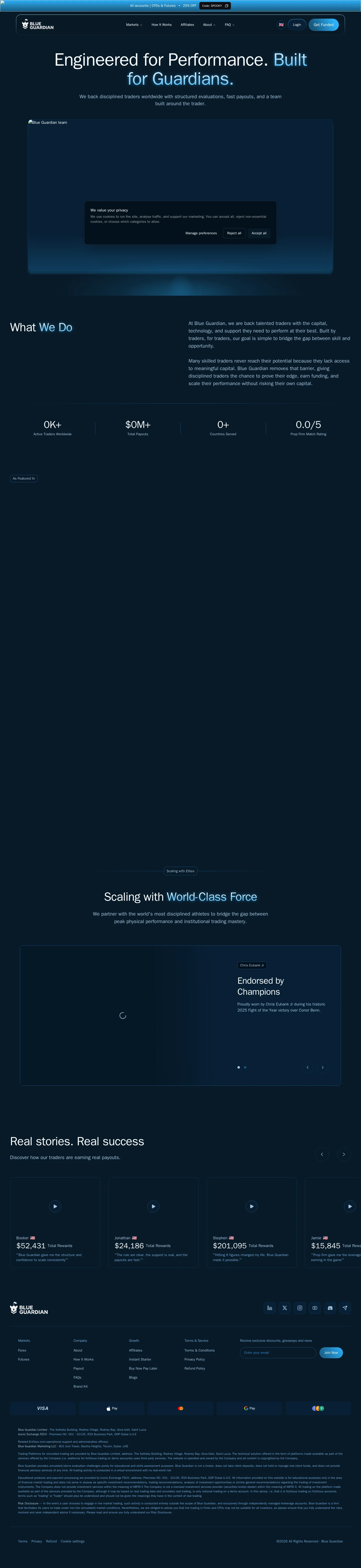
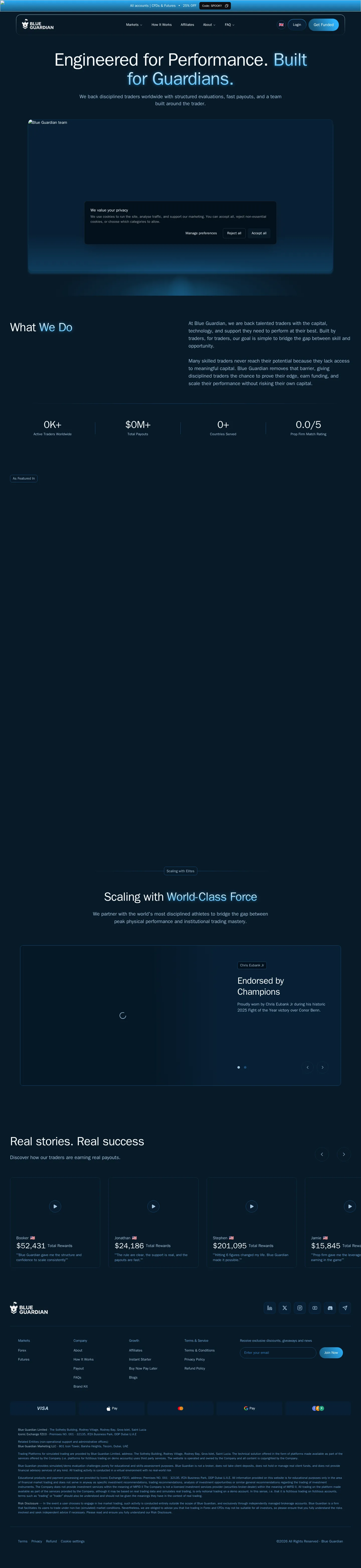
Pages captured from Blue Guardian’s own site when this review was written. Brokers change their terms; these are what we read.



FAQ
Is Blue Guardian regulated?
No. It holds no financial licence, which is usual for a prop firm. Blue Guardian Limited is on the Saint Lucia company register, and its contracting company, Iconic Exchange FZCO, is in Dubai’s IFZA free zone, which has no public register.
What does Blue Guardian charge to get a funded account?
Its cheapest 100K challenge is Futures Reserve at a USD 148 list price, a one time fee with no activation fee, shown at USD 111 with a discount code. CFD 100K challenges list from USD 239 (2 Step Nano) to USD 623 (Instant).
Which company do I actually deal with at Blue Guardian?
Its terms are with Iconic Exchange FZCO, trading as Blue Guardian, in Dubai. Blue Guardian Limited in Saint Lucia provides the trading platforms, Blue Guardian Marketing LLC handles marketing, and Odeonpay ALE S.R.L is the merchant of record for payments.
What trading platforms does Blue Guardian support?
MT5, Match-Trader, TradeLocker, TradingView, NinjaTrader, Tradovate and DeepCharts.
How can I contact Blue Guardian support?
By live chat, email at support@blueguardian.com, tickets or its Discord. It markets 24/7 support, but its contact page lists operational hours of Monday to Friday, 09:00 AM to 05:00 PM (GST).
Are Blue Guardian's reviews trustworthy?
Treat them with care. Trustpilot rates the profile 3.2 from 2,110 reviews and warns that it found fabricated reviews there. Blue Guardian publishes no app of its own.
How this review works
Track Blue Guardian live: score moves and red notices, in your pocket.