
PROP · CHECKED 25 OCT 2026
Upcomers review.
Prop trading firm running funded-account challenges through newly registered offshore entities
OK-ISH
OUT OF 10
Upcomers is a proprietary trading firm selling funded-account challenges. Its Saint Lucia and Cyprus entities are confirmed on their company registers, fees are low, and platform choice is wide, but no entity holds a financial licence, the Saint Lucia firm is barely two months old, and Trustpilot has flagged fabricated reviews on its profile.
Each criterion is scored 1 to 10 from primary sources. The overall score is their unweighted mean. How scoring works.
| Minimum deposit | Not stated |
|---|---|
| Platforms | MetaTrader 5, TradeLocker, Match-Trader, cTrader, Upcomers X |
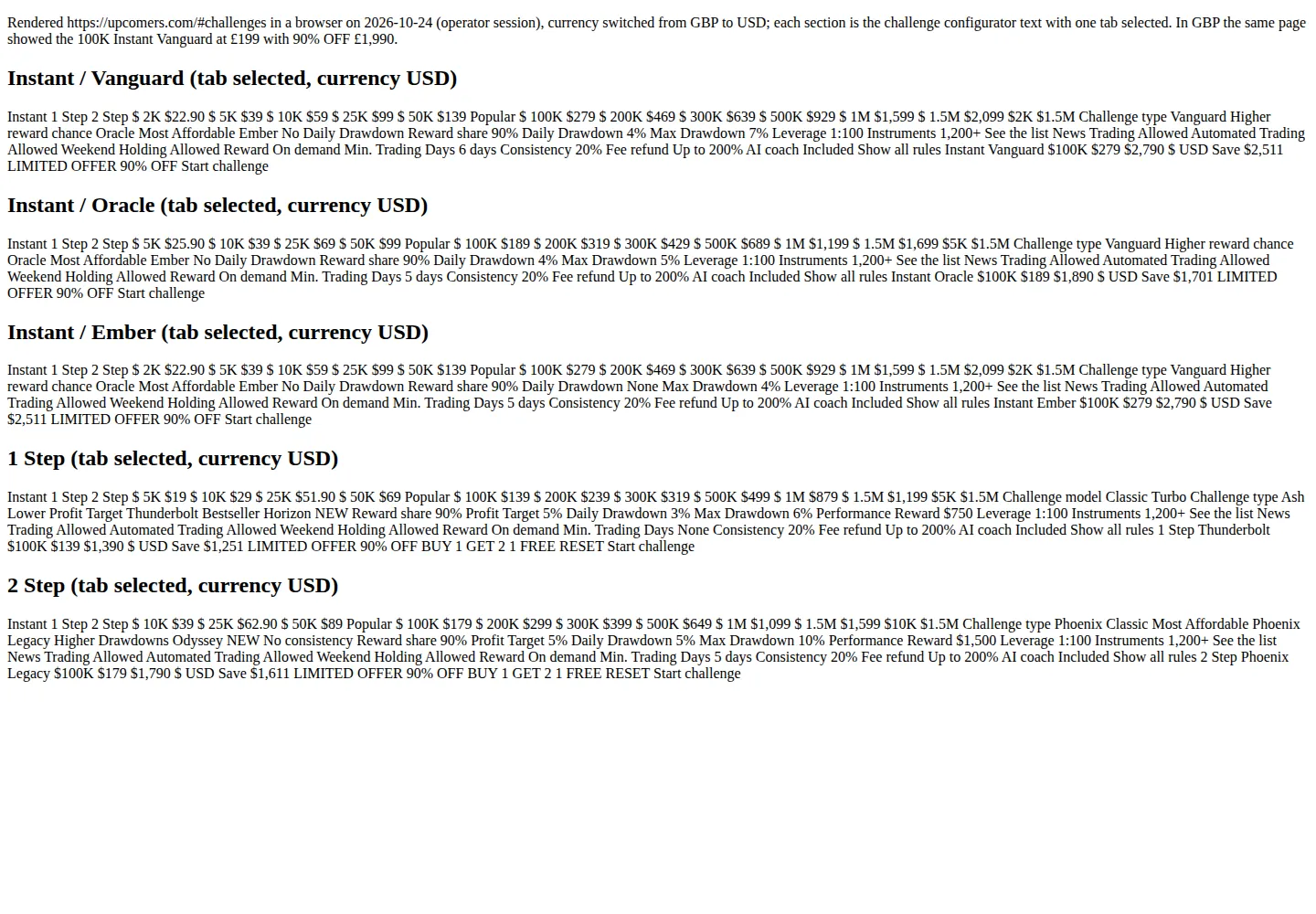
- The cheapest 100K challenge, 1 Step Thunderbolt, costs USD 139 at checkout with no code, and the pricing page offers a fee refund of up to 200%
- Upcomers Ltd is on the Saint Lucia company register and UPCOMERS LTD, its payment agent, on the official Cyprus register
- Platforms include MT5, cTrader, TradingView, TradeLocker, Match-Trader and its own web platform
- Support by email, live chat and a published phone number, stated as 24/7
- Its terms say rewards are not withheld for a negative review, a complaint or a good faith opinion
- No financial licence of any kind; its registrations are company filings only
- Royal Flow FZCO, which runs most of its platforms, sits in Dubai's IFZA free zone, which publishes no public register
- Every challenge is shown with a 90% off 'limited offer' beside a struck through price ten times the price charged, so the advertised savings do not reflect any price a buyer pays
- Its own pages disagree on which company runs which platform
- Trustpilot rates it 2.9 from 594 reviews and shows its own warning that it found fabricated reviews on the profile
- Its terms let it change fees and challenge parameters at any time
Overview
TrueBroker is a free broker safety checker, and this page is our review of Upcomers, scored 6.0 out of 10 across regulation, fees, platform, support and reviews. The single thing worth knowing before anything else: on its own Legal Disclaimer page, the firm states plainly that it “does not hold any brokerage, investment advisory, or financial services licenses,” does not accept deposits, does not hold client funds, and that all trading happens on virtual capital in a simulated environment. This is a funded-trader evaluation and education product, not a regulated brokerage, and none of the company registrations below function as a trading licence.
Which entity is actually Upcomers
The firm’s own pages name three separate corporate entities rather than one. Royal Flow, FZCO, registered in the IFZA Business Park DDP in Dubai Silicon Oasis, is described as the technology and education company that operates the trading platforms and provides access to the simulated accounts. Upcomers Ltd., incorporated in Saint Lucia, is described on the Terms & Conditions page as “the designated entity for operating additional trading platforms currently being integrated,” meaning not yet live, while the separate Legal Disclaimer page on the same site says the opposite: that Upcomers Ltd. operates Metaquotes ‘MT5’ trading platform and that “all Metaquotes trading platforms are operated exclusively by Upcomers Ltd.” A third entity, UPCOMERS LTD, registered in Nicosia, Cyprus, is named only as the Payment Agent for transactions on the website. A reader cannot tell from the firm’s own current pages which entity, and therefore whose jurisdiction, actually governs an MT5 account.
What the public registers show for Upcomers
We searched two public registers, the Saint Lucia Registry under the International Business Companies Act Cap 12.14 and the Cyprus Registrar of Companies. The Saint Lucia Registry’s free name search does list “Upcomers Ltd. (IBC),” marked as an International Business Company; that free search does not publish a registration number, incorporation date or status, and an IBC listing is a company registration, not a licence to deal in forex or CFDs, so the number 2025-00579 quoted on the firm’s Legal Disclaimer page is not something we were able to verify through the register itself. The official Cyprus Registrar of Companies lists UPCOMERS LTD, HE 490773, as a registered company (searched 24 Oct 2026); that is a company registration, not a financial licence. For Royal Flow, FZCO’s UAE registration, IFZA (International Free Zone Authority, Dubai Silicon Oasis) publishes no public searchable register at all; the firm’s number 35886 is unverifiable from outside for that reason, and a free-zone trade licence of this kind would not confer financial-services permission even if it were confirmed. No regulator licence appears anywhere in the material we reviewed.
What Upcomers actually offers
The firm’s own Accounts page lists evaluation products including Ash, Half Step (Classic), a single-phase 2% profit-target account at 1:100 leverage; Thunderbolt, 1 Step, a single-phase 5% target account; and Phoenix, 2 Step, a two-phase 4%-then-4% target account, all advertised with no minimum trading days and up to 100% profit split. The same page describes a cheaper “Turbo” entry model, paid half up front and half on becoming funded, against a “Legacy” model paid once with fixed, higher drawdown limits. The Terms & Conditions page (Terms 7.6) puts the maximum virtual capital allocation under the Upcomers Trader Program at USD 1,500,000 per user, scalable to USD 4,000,000 under a separate scaling plan, which is higher than the “up to $1.5M” figure used in the firm’s own marketing. A separate Upcomers X platform, described by the firm as “built and run in-house,” offers futures contracts on CME, CBOT, NYMEX and COMEX, and a 24/7 Perpetuals account offers crypto and US stocks at up to 10x leverage filled on Hyperliquid liquidity, per the firm’s own markets page.
Platform claims that do not line up
The Terms & Conditions body text states that Royal Flow, FZCO “operates the following trading platforms: TradeLocker,” naming only one platform, while the footer and Legal Disclaimer text on the same site say Royal Flow, FZCO operates “TradeLocker, Match-Trader, and cTrader.” Match-Trader and cTrader therefore appear on the Platforms page but are missing from the Terms & Conditions platform list, which is the same kind of mismatch as the MT5 operator conflict described above.
What this firm charges and what it keeps the right to change
The only specific fee in the material we reviewed is a USD 50 charge to resend a payout that was rejected by the receiving bank over a name mismatch or bad banking details, per the Terms & Conditions; the same clause (Terms 4.11) lets the Provider instead simply decline to resend and treat the payout as forfeited. Elsewhere in the Terms, the Provider can amend the agreement with seven days’ notice and treat silence as acceptance (Terms 11.4), can change fees or challenge-completion parameters at any time (Terms 4.3), can cut a trader’s leverage to 1:5 as a penalty for “Prohibited Trading Strategies” (Terms 5.6.4), and caps its own total liability at whatever fee the client paid in the prior 12 months (Terms 9.5). Terms 7.8 also states that passing a Challenge does not entitle a client to be offered the funded Trader Program, which remains “solely at our discretion.”
Overview Table
| Headquarters | No single HQ stated; firm’s own pages name Royal Flow, FZCO (IFZA Business Park DDP, Dubai Silicon Oasis, UAE), Upcomers Ltd. (Rodney Bay, Gros-Islet, Saint Lucia), and UPCOMERS LTD (Nicosia, Cyprus, as Payment Agent) |
| Established | Not stated; the firm’s own Legal Disclaimer page gives Upcomers Ltd.’s Saint Lucia IBC registration as dated 8 August 2025, a figure the Saint Lucia Registry’s free search does not itself publish |
| Countries Served | Not stated as a positive list; the firm’s own Legal Disclaimer page excludes residents of Afghanistan, Central African Republic, Crimea/Donetsk/Luhansk, Cuba, Iran, Iraq, Kosovo, Libya, Mali, Myanmar, North Korea, Palestine, Russia, Somalia, South Sudan, Sudan, Syria, Vanuatu and Venezuela |
| Regulated By | None; the firm’s own Legal Disclaimer page states it holds no brokerage, investment advisory or financial services licence. Registrations found are a UAE free-zone licence (IFZA, unverifiable), a Saint Lucia IBC listing (confirmed on the register as a company only), and a Cyprus company registration (confirmed on the official register) |
| Minimum Deposit | Not stated |
| Maximum Leverage | 1:100 on Classic evaluation accounts (Ash, Thunderbolt, Phoenix), per the firm’s own Accounts page; up to 10x on the 24/7 Perpetuals account, per the firm’s own markets page |
| Total Instruments | Not stated as a total count; categories per the firm’s own pages are forex/currencies, commodities, indices, cryptocurrencies, stocks and futures |
| Platforms | MetaTrader 5, TradeLocker, Match-Trader, cTrader, and the in-house Upcomers X futures platform |
| Customer Support | Email (help@upcomers.com, legal@upcomers.com, and support@upcomers.com on the Legal Disclaimer page), phone lines for the US and EU, live chat, and a Discord community |
| Languages | Not stated |
Facts List
- The firm’s own Legal Disclaimer page states it “does not hold any brokerage, investment advisory, or financial services licenses” and that trading occurs on virtual capital in a simulated environment.
- Three entities appear across the firm’s own pages: Royal Flow, FZCO (UAE), Upcomers Ltd. (Saint Lucia), and UPCOMERS LTD (Cyprus, Payment Agent).
- The Saint Lucia Registry’s free name search confirms “Upcomers Ltd. (IBC)” as an International Business Company, but does not publish a registration number, incorporation date or status.
- IFZA (Dubai Silicon Oasis) publishes no public searchable register, so Royal Flow, FZCO’s registration number 35886 is unverifiable from outside.
- The official Cyprus Registrar of Companies lists UPCOMERS LTD, HE 490773, as a registered company (searched 24 Oct 2026); that is a company registration, not a financial licence.
- The firm’s Terms & Conditions and its Legal Disclaimer page disagree on whether Upcomers Ltd. currently operates the MT5 platform.
- The Terms & Conditions body text names only TradeLocker among Royal Flow, FZCO’s platforms, while the footer text adds Match-Trader and cTrader.
- Terms 7.6 puts the maximum virtual capital allocation at USD 1,500,000 per user, scalable to USD 4,000,000 under a separate scaling plan.
- A returned payout can trigger a USD 50 resend fee or be forfeited outright, per Terms 4.11.
- Terms 7.8 states that passing an evaluation does not entitle a client to be offered the funded Trader Program, which remains at the firm’s sole discretion.
Key Takeaways
Upcomers brands itself as a prop trading challenge, and the firm’s own Legal Disclaimer page says it is not a broker, does not accept deposits, does not hold client funds and provides no investment or financial services, with all trading done on virtual capital. That self description is the reason the regulation score sits at 3: there is no brokerage licence to check because the firm says none applies to its model.
What the registers actually showed for Upcomers
- We searched the Saint Lucia Registry of International Business Companies directly and found “Upcomers Ltd. (IBC)” listed on the free name search (Pinnacle St. Lucia), marked as an International Business Company. That free search does not publish a registration number, incorporation date or status, those sit behind a paid account only search, so the 2025 00579 number quoted on the firm’s Legal Disclaimer page was not itself verified against the register.
- An IBC listing is a company registration, not a licence to deal in forex or CFDs, and the register entry does not say otherwise.
- We searched for HE 490773, the Cyprus registration the firm gives for UPCOMERS LTD, its Payment Agent entity. The official Cyprus Registrar of Companies lists UPCOMERS LTD, HE 490773, as a registered company (searched 24 Oct 2026); that is a company registration, not a financial licence.
- IFZA, the Dubai Silicon Oasis free zone where Royal Flow FZCO is registered under number 35886, publishes no public searchable register at all. A company registered there exists, but the registration confers no financial services permission and cannot be independently verified from outside. The firm’s own Legal Disclaimer page states Royal Flow FZCO “does not hold any brokerage, investment advisory, or financial services licenses.”
The structure behind Upcomers
Three entities share the business across the firm’s own pages: Royal Flow FZCO in Dubai, described as the technology and education company operating TradeLocker, Match Trader and cTrader; Upcomers Ltd. in Saint Lucia; and UPCOMERS LTD in Cyprus, named as Payment Agent for transactions on the site. The firm’s own documents do not agree on what Upcomers Ltd. actually does. The Terms and Conditions call it “the designated entity for operating additional trading platforms currently being integrated,” implying nothing is live yet, while the Legal Disclaimer page states Upcomers Ltd. operates Metaquotes ‘MT5’ trading platform and that “all Metaquotes trading platforms are operated exclusively by Upcomers Ltd.” The Terms and Conditions body text also lists Royal Flow FZCO as operating only TradeLocker, while the footer and Legal Disclaimer list it as running TradeLocker, Match Trader and cTrader. A client reading the firm’s own current pages cannot tell which entity, and which jurisdiction’s law, actually governs a given platform account.
What the contract does to a client
Fees score high at 9.5, and the published terms are genuinely light on charges, the one we found is a USD 50 fee to resend a payout that a bank returns for a name mismatch or bad details, and even then the Provider can instead simply decline to resend and treat the payout as forfeited under Terms 4.11. The contractual terms around that fee, and around the rest of the relationship, are where the real risk sits.
- Terms 9.5 caps aggregate liability for any harm at the fee the client paid in the preceding 12 months, not the actual loss suffered.
- Terms 7.8 states that passing a Challenge creates no right to be offered the Upcomers Trader Program, the funded paid stage: the decision is “solely at our discretion” with “no legal obligation” to proceed, so a client can meet every published target and still be refused a payout.
- Terms 4.2 and 7.2 to 7.3 tie the 14 day statutory withdrawal right to a first trade that is also required to “activate” the Challenge, so the cooling off period is effectively gone the moment the client uses what they bought.
- Terms 11.4 lets the Provider amend the Terms and Conditions at any time with 7 days’ notice, and treats a client’s silence as acceptance; Terms 4.3 lets fees and challenge completion parameters change the same way.
- Terms 5.6.4 lets the Provider cut a client’s leverage to 1:5 on any or all accounts as a penalty for what it calls Prohibited Trading Strategies, and Terms 2.9 lets it modify, replace or remove any part of the Service at any time with no refund or compensation owed.
- Terms 3.10 has the client consent to the Provider and its affiliates using all of that client’s virtual trading data at their sole discretion, automatically, with no compensation owed to the client.
- Terms 11.7 puts most disputes under UAE courts and UAE law, while Terms 12.2 to 12.7 route US residents into individual arbitration in New York via JAMS and have them waive class actions and jury trial.
- Terms 6.1 to 6.10 bar “knowingly false or materially misleading statements” about the firm and coordinated or bad faith review campaigns, and require confidentiality over internal investigation and complaint findings, with breach risking suspension, termination, forfeiture and an indemnification obligation. The clause nominally carves out “genuine” reviews and regulator complaints, but a client who discusses a dispute publicly is taking on that risk themselves.
Where support and platforms land
Support scores 7.5. The Contact page lists help@upcomers.com for general support, a US phone number, an EU phone number, 24/7 live chat replying “in seconds,” and a Discord community, while the Legal Disclaimer page gives a different address, support@upcomers.com, for the same kind of contact, a discrepancy worth knowing before filing a formal complaint by email.
Our reviews score of 2.4 comes from Trustpilot alone: the upcomers.com profile rates the firm 2.9 stars across 594 reviews, and Trustpilot shows its own warning on that profile that it found fabricated reviews, which costs 1.5 points under our rules (checked 24 Oct 2026). Upcomers’ Android app, published by Royal Flow FZCO, shows no rating yet, and it has no app on the App Store.
Platform scores 7.8, built on real range: MetaTrader 5, TradeLocker, Match Trader and cTrader for the Classic markets, plus Upcomers X, which the firm describes as built and run in house for exchange listed futures on CME, CBOT, NYMEX and COMEX, available as a web version only with no desktop or mobile app listed.
Reviews sits at 2.4, the weakest number here alongside regulation, and nothing in the evidence gathered for this review explains that score beyond the figure itself; it stands as given.
Licenses & Regulation
Upcomers’ own Legal Disclaimer states that it “does not hold any brokerage, investment advisory, or financial services licenses.” That self-description matters because it is the firm’s own explanation for why no financial regulator sits behind this product: the pages describe an evaluation and education business, not a regulated brokerage, and none of the entities involved holds a licence to deal in forex or CFDs.
Royal Flow, the UAE entity behind the platforms
The firm’s own pages name Royal Flow, FZCO, registered in IFZA Business Park DDP, Dubai Silicon Oasis, Dubai, as the technology and education company that provides access to the simulated trading accounts and operates the TradeLocker, Match Trader and cTrader platforms. Its registration number, 35886, is held with IFZA, the International Free Zone Authority in Dubai Silicon Oasis. We attempted to check this register directly and found that IFZA publishes no public searchable list, so the registration verdict is unverifiable: a company registered there does exist, but the registration confers no financial services permission and cannot be independently confirmed from outside. The firm’s own legal disclaimer backs this up in its own words, stating that it “does not hold any brokerage, investment advisory, or financial services licenses.”
Upcomers Ltd., the Saint Lucia entity
A second entity, Upcomers Ltd., is registered in Saint Lucia at the Sotheby Building, Rodney Village, Rodney Bay, Gros Islet. The firm’s own pages give conflicting accounts of what this entity actually does: the Terms and Conditions describe it as “the designated entity for operating additional trading platforms currently being integrated,” implying nothing is live yet, while the Legal Disclaimer states the opposite, that “Upcomers Ltd. operates Metaquotes MT5 trading platform” and that “all Metaquotes trading platforms are operated exclusively by Upcomers Ltd.” A client reading only one of these two in force pages would come away with a different understanding of whether MT5 is live and which entity, in which jurisdiction, actually stands behind it.
We searched the Saint Lucia Registry of International Business Companies, which operates under the International Business Companies Act Cap 12.14, using its free name search (Pinnacle St. Lucia). “Upcomers Ltd. (IBC)” came back confirmed on that name search, marked as an International Business Company. The free search does not publish a registration number, incorporation date or status; those sit behind a paid, account only search. So while the company’s existence as an IBC is confirmed by the Saint Lucia Registry, the number quoted on the firm’s own pages, 2025 00579, was not itself verified against the register. It is also worth being clear about what an IBC registration is: a company registration, not a licence to deal in forex or CFDs.
The Cyprus payment agent
A third entity, UPCOMERS LTD, is registered in Cyprus at Polyviou Dimitrakopoulou 3, ANELLI COURT, 2nd Floor, Flat/Office 201, 1090 Nicosia, and is named on the firm’s pages as the Payment Agent for transactions on the website, with company number HE 490773. The official Cyprus Registrar of Companies lists UPCOMERS LTD, HE 490773, as a registered company (searched 24 Oct 2026); that is a company registration, not a financial licence.
Across all three entities, the registrations found are a UAE free zone trade licence, an IBC company registration in Saint Lucia, and a Cyprus company number tied to payment processing, none of which is a financial services authorisation. No licence from a financial conduct regulator appears anywhere in the firm’s own pages. That gap lines up with the firm’s own repeated statements that it is not a broker and does not provide investment or financial services: on the firm’s own account of its business model, no deposit protection or client money segregation regime applies, because the firm says its product sits outside that model altogether. A client’s actual legal exposure is governed instead by the Terms and Conditions themselves, under United Arab Emirates law, with disputes falling to courts local to the Provider’s registered office in the UAE under clause 11.7, except for US residents, who are instead routed to individual arbitration in New York via JAMS under clauses 12.2 to 12.7, waiving class actions and a jury trial.
How to Trade
Upcomers sells access to simulated trading accounts, not brokerage accounts. The firm’s Legal Disclaimer page states plainly that it is “not a broker,” does not accept deposits, does not hold client funds, and that all trading happens on virtual capital in a simulated environment. Everything below describes how that simulation is structured and what the firm’s own Terms and Conditions say about the rules governing it.
Platforms, and who actually runs them
Upcomers’ Terms and Conditions page names Royal Flow, FZCO (registered in Dubai Silicon Oasis under UAE free zone licence number 35886) as the entity operating the trading platforms, but the two live pages disagree on which platforms that covers. The Terms and Conditions body text says Royal Flow, FZCO “operates the following trading platforms: TradeLocker,” naming only one. The footer and Legal Disclaimer text says Royal Flow, FZCO operates “TradeLocker, Match Trader, and cTrader.” MetaTrader 5 is handled separately again: the Legal Disclaimer states Upcomers Ltd. operates Metaquotes ‘MT5’ trading platform. All Metaquotes trading platforms are operated exclusively by Upcomers Ltd., the Saint Lucia incorporated entity (the registration quoted on the site, 2025 00579, was not independently verified; it was not among the numbers we could confirm on the Saint Lucia Registry’s free name search). Elsewhere in the Terms and Conditions, Upcomers Ltd. is instead described as “the designated entity for operating additional trading platforms currently being integrated,” which reads as not yet live. A client reading the firm’s own pages cannot establish from them which entity, and therefore which jurisdiction’s terms, actually governs an MT5 account.
The platforms themselves, per the firm’s own platform page: TradeLocker (TradingView charts built in, no install required, available on Windows, macOS, web, Google Play and the App Store), Match Trader (TradingView powered charts with built in risk management tools, available on web, desktop and mobile), and cTrader (three Depth of Market views, more than 70 indicators across 26 timeframes, and cBots written in C#, available on Windows, macOS, web, Google Play and the App Store). A fifth platform, Upcomers X, is described on the same page as a web based futures platform built in house for exchange listed contracts on CME, CBOT, NYMEX and COMEX, with the firm stating “we build and run our own platform, dashboard, and risk engine.” Upcomers X is listed as a web version only; no desktop or mobile app is named for it.
What can be traded
The firm’s root page groups instruments as “Classic markets,” covering gold, currencies, cryptocurrencies, indices, commodities and stocks, where a trader can go long or short. Separately, the same page describes a 24/7 Perpetuals account covering commodities, cryptocurrencies (up to 10x leverage, filled against Hyperliquid liquidity) and US stocks traded around the clock. A third category, Futures, covers standardized exchange listed contracts on indices, metals, energy and crypto, traded via CME, CBOT, NYMEX and COMEX through the Upcomers X platform rather than the Classic markets platforms.
Account structures on offer
Upcomers’ accounts page lists several programmes. Ash, Half Step (Classic) carries a 2% profit target, 1:100 leverage, no time limit, a profit split of up to 100%, and funding up to USD 1,000,000. Thunderbolt, 1 Step (Classic) is a single phase programme with a 5% profit target, the same 1:100 leverage and no time limit. Phoenix, 2 Step (Classic) runs two phases at a 4% target each (8% total), with no minimum trading days, 1:100 leverage and no time limit. Within the Ash, Thunderbolt and Horizon programmes, a cheaper “Turbo” entry model is offered: half the fee paid up front and the other half only once funded, with time limited phases and faster, lower drawdown limits, against a “Legacy” model (used by the Phoenix and Futures programmes) that charges once for a fixed rule set that never changes, runs with no time limit, and sets a higher, fixed drawdown ceiling. Elsewhere in the firm’s own Terms, the Upcomers Trader Program’s maximum virtual capital allocation is given as USD 1,500,000 per user, scalable to USD 4,000,000 per user under a separate scaling plan, a ceiling the accounts page’s “up to $1.5M” figure does not mention.
Rules that bind a position, and a funded payout
Several clauses in Upcomers’ Terms and Conditions act directly on open positions and on payouts, not just on marketing claims. Under clause 5.6.4, the firm may cut a client’s leverage to 1:5 across any or all of that client’s accounts as a penalty for what the Terms label “Prohibited Trading Strategies.” Under clause 2.9, the firm may modify, replace or remove any element of the service at any time with no refund or compensation owed. Passing a Challenge does not itself create an entitlement: clause 7.8 states that moving a client into the paid Upcomers Trader Program stage is “solely at our discretion” and that there is “no legal obligation” to do so, meaning a client who hits every published profit target can still be refused funded status with no recourse described. Under clause 3.10, the client consents that the Provider and its affiliated persons or entities may access and use the client’s virtual trading data “at its sole discretion,” automatically and with no compensation owed to the client.
Payouts depend on banking details matching the name on the account. Clause 4.11 states that where a payout is returned by the receiving bank over a name mismatch or incorrect banking details, the Provider may either resend it for a USD 50 fee or decline to resend it and treat the payout as forfeited outright. If a client suffers harm from any of this, clause 9.5 caps the firm’s total liability at whatever fee that client paid for the service in the 12 months before the claim, not the client’s actual loss. Disputes fall under UAE courts and UAE law per clause 11.7, except for US residents, who under clauses 12.2 to 12.7 must arbitrate individually in New York through JAMS and waive both class actions and a jury trial (this carve out does not apply to US residents of California or Georgia). The firm can also change the rules of a programme a client has already paid for: clause 11.4 allows amendments to the Terms with seven days’ notice, treating a client’s silence as acceptance, and clause 4.3 allows the Provider to modify fees and challenge completion parameters at any time.
Account Types
Upcomers sells staged “challenges” rather than funded brokerage accounts, and its own accounts page lists three core programmes plus two pricing structures layered across them.
The three challenge programmes
- Ash, Half Step (Classic). A single phase with a 2% profit target, 1:100 leverage, no time limit, a profit split of up to 100%, and funding of up to $1,000,000, according to the accounts page.
- Thunderbolt, 1 Step (Classic). Also one phase, with a 5% profit target, 1:100 leverage, no time limit, and a profit split of up to 100%.
- Phoenix, 2 Step (Classic). Two phases at a 4% target each, 8% in total, with no minimum trading days, 1:100 leverage, no time limit, and a profit split of up to 100%.
The accounts page also lists a Futures programme and a 24/7 Perpetuals account among the firm’s markets, and a notable claim in the terms and conditions (Terms 7.6) puts the real funding ceiling higher than the accounts page advertises: maximum virtual capital under the Upcomers Trader Program is $1,500,000 per user, scalable up to $4,000,000 under a separate scaling plan. The accounts page’s “up to $1,500,000” figure for the Turbo model understates that ceiling once scaling is applied.
Turbo versus Legacy, the two ways Upcomers prices the same challenge
The accounts page splits pricing into two models that sit across the Ash, Thunderbolt, Phoenix and Futures programmes:
- Turbo model. Cheaper entry, with 50% paid upfront and the remaining 50% due only once the account is funded. Phases are time limited, drawdown limits are lower and tighten faster, and the model is time boxed overall. Maximum funding runs up to $1.5 million.
- Legacy model. One fixed rule set that never changes, paid once, with unlimited time to complete the challenge, a higher and fixed drawdown allowance, and maximum funding up to $200,000.
Neither the accounts page nor any other page we fetched gives the actual dollar price of a challenge at any account size, so the entry cost itself is not something we can report.
What Upcomers is, and is not, selling
The firm’s own legal disclaimer states repeatedly that it is not a broker, not a brokerage firm, not an exchange, does not accept deposits, does not hold client funds and does not provide investment or financial services. All trading happens on virtual capital in a simulated environment. That framing matters for what “funding” and “profit split” mean here: a passed challenge does not create an automatic entitlement to a funded, paying account. Terms 7.8 states that passing a challenge does not oblige Upcomers to offer the Upcomers Trader Program, calling the decision “solely at our discretion” with “no legal obligation” to proceed. A trader who clears every published target can still be refused the funded stage with no recourse.
Rules that can change the product after purchase
Terms 4.3 lets the Provider modify fees and challenge completion parameters at any time, and Terms 11.4 lets it amend the terms and conditions generally on 7 days’ notice, treating a client’s silence before the effective date as acceptance. Terms 2.9 goes further, allowing the Provider to modify, replace or remove any element of the service at any time with no refund or compensation owed. Terms 5.6.4 adds a specific penalty: leverage on any or all of a client’s accounts can be cut to 1:5 for what the terms call “Prohibited Trading Strategies,” again at the firm’s discretion.
Refunds and the cost of a banking error
Terms 4.2 and 7.2 to 7.3 tie the statutory 14 day withdrawal right to first use: placing the first trade is required to “activate” the Challenge, and that same first trade extinguishes the cooling off refund right. After that point the challenge fee is non-refundable. Separately, Terms 4.11 covers payouts that bounce back from the receiving bank because of a name mismatch or bad banking details: Upcomers can either resend the payout for a $50 fee or decline to resend it and treat the payout as forfeited outright, which the fee material confirms as the only priced item we found on these pages.
Markets available once funded
Across the Classic programmes, the root page lists forex, commodities including gold and oil, indices, cryptocurrencies, and stocks. The separate Futures programme adds standardized, exchange listed contracts on indices, metals, energy and crypto via CME, CBOT, NYMEX and COMEX, traded through the firm’s own Upcomers X platform. A 24/7 Perpetuals account layers on top of that, offering commodities, cryptocurrencies at up to 10x leverage filled on Hyperliquid liquidity, and US stocks outside standard market hours.
Negative Balance Protection
Upcomers runs a prop style evaluation product, and the firm’s own Legal Disclaimer page states it is not a broker, does not accept deposits and does not hold client funds, with trading carried out on virtual capital in a simulated environment. That framing matters for this section: there is no client money sitting in an account that could go negative in the way a leveraged brokerage account can, because the capital being traded is not the client’s own.
What the terms say about drawdown and leverage
The evidence we have does not include a published table of per account drawdown percentages. What the Terms and Conditions do set out, at section 5.6.4, is a penalty power: Upcomers’ Terms and Conditions state the Provider may reduce a client’s leverage to 1:5 across any or all accounts as a penalty for what the terms call “Prohibited Trading Strategies.” The same document, at section 2.9, lets the Provider modify, replace or remove any element of the Service at any time with no refund or compensation owed. Read together, a client who trips the firm’s own definition of prohibited trading can have their leverage cut to 1:5 without warning, and has no contractual claim to compensation for that change.
Why “negative balance” means something different here
Because the funded capital is virtual rather than client deposited money, the usual negative balance protection question, whether a retail client can be made to owe a broker more than they deposited, does not map cleanly onto this product. The firm’s account pages describe profit targets and profit splits (for example the Phoenix 2 Step account’s two phase, 4% per phase target structure, and the Thunderbolt 1 Step account’s single 5% target, both at 1:100 leverage per the firm’s account page), but the evidence we read does not include the firm’s maximum loss or trailing drawdown rules that would actually breach a challenge or a funded account. We can report what the fee and account pages say about targets and leverage; we cannot report drawdown thresholds that were not in the pages we fetched.
What happens to the money, not the trade
Where the terms do bind the client financially is around fees already paid, not around losses on the simulated book. Upcomers’ Terms and Conditions, at section 7.8, state that passing a Challenge does not entitle the client to be offered the Upcomers Trader Program, the paid, funded stage: the decision is “solely at our discretion,” and there is “no legal obligation” to enter into it. A client can hit every published profit target, pay every fee, and still be refused funded status with no recourse under the terms as written. Separately, section 9.5 of the same terms caps the Provider’s aggregate liability for any harm at the fee the client paid for the Services related to that loss in the preceding 12 calendar months, not at the client’s actual loss. So even where a client could point to real financial harm arising from the firm’s conduct, the terms themselves put a ceiling on what the firm owes back, and that ceiling is pegged to the client’s own fee, not to anything resembling a trading loss.
Payout risk sits on banking details, not on drawdown
The clearest financial exposure we found in the terms is not a drawdown breach at all. Upcomers’ Terms and Conditions, at section 4.11, state that where a payout is returned by the receiving bank due to a name mismatch or incorrect, incomplete or incompatible banking details, the Provider may either charge a USD 50 fee to resend it, per the same fee schedule referenced on the terms page, or decline to resend it and treat the payout as forfeited outright. An administrative banking error, not a loss limit breach, is therefore the one scenario in the evidence where a client stands to lose the entire payout rather than a processing charge.
What we did not find
We read Upcomers’ own Terms and Conditions and Legal Disclaimer pages along with its account pages for this section. Those pages describe profit targets, leverage figures, the 1:5 leverage penalty, the discretionary funded status decision, the liability cap and the payout forfeiture clause set out above. They do not, in the material we fetched, set out a maximum drawdown percentage, a daily loss limit, or a defined breach to account closure process of the kind that governs most prop style evaluation products. Where that is the case, the honest position is to say the pages we read did not cover it, rather than to describe rules the firm did not publish on the pages checked.
Trading Instruments
Upcomers runs on simulated capital, not live brokerage accounts. The firm’s own Legal Disclaimer states it “does not hold any brokerage, investment advisory, or financial services licenses,” and the evidence collected for this review records the firm stating repeatedly that it is not a broker, not an exchange, does not accept deposits, and does not hold client funds. Everything described below is traded on virtual capital inside what the firm calls a simulated environment.
What Upcomers lists as tradable
The root marketing page groups assets under “Classic markets”: gold, currencies, crypto, indices, commodities and stocks, described as available to go long or short. The same page lists Futures separately, as standardized contracts tracking real exchange liquidity across indices, metals, energy and crypto, executed on the CME, CBOT, NYMEX and COMEX through the firm’s own Upcomers X platform. Cryptocurrencies and US stocks also appear on a 24/7 Perpetuals account, which the root page says fills crypto positions at up to 10x leverage using Hyperliquid liquidity.
None of the fetched pages break these categories down into a specific instrument list, a symbol count, or a spread table by asset class. The evidence available for this review is the category-level marketing copy on the root page; it does not include a contract specification sheet or a per-symbol fee schedule.
Where the asset list is traded: four platforms, three entities, two conflicting accounts
Upcomers routes its markets through four platforms, and the firm’s own pages disagree on who runs which one. The Legal Disclaimer page states that Upcomers Ltd. operates Metaquotes ‘MT5’ trading platform and that “all Metaquotes trading platforms are operated exclusively by Upcomers Ltd.,” the Saint Lucia entity. The Terms and Conditions body text, by contrast, calls Upcomers Ltd. “the designated entity for operating additional trading platforms currently being integrated,” meaning not yet live. A client reading only one of those two documents would reach a different conclusion about whether an MT5 account is even available yet, and which entity, in which jurisdiction, stands behind it.
The same split affects TradeLocker, Match-Trader and cTrader. The Terms and Conditions page states that Royal Flow, the UAE entity, “operates the following trading platforms: TradeLocker,” naming only one. The Legal Disclaimer and footer text on a separate page instead say Royal Flow operates “TradeLocker, Match-Trader, and cTrader,” naming three. Match-Trader itself only turns up in the platforms page footer attributing it to Royal Flow; it is absent from the Terms and Conditions platform list entirely. The practical effect for a trader is that the two legal documents the firm itself publishes cannot be reconciled on which entity is contractually responsible for which platform, which matters if a dispute over execution or a technical fault on one of these platforms needs to be raised against the correct corporate party.
Each platform brings its own asset access. TradeLocker is described as having TradingView charts built in, with no install required. Match-Trader offers TradingView powered charts and built in risk management. cTrader is listed with three Depth of Market views, more than 70 indicators across 26 timeframes, and cBots written in C#. MT5 is described as carrying 21 timeframes and 38 built in indicators. Upcomers X, the firm’s fifth platform, is described on the platforms page as “engineered in house: we build and run our own platform, dashboard, and risk engine,” and is the only route to the futures contracts on CME, CBOT, NYMEX and COMEX; the platforms page lists it as a web version only, with no desktop or mobile app alongside it.
Funding caps tied to the asset classes
The account structures sit on top of these asset classes rather than beside them. The Ash, Thunderbolt and Phoenix account pages advertise funding up to $1,000,000 and profit splits up to 100%, at 1:100 leverage with no time limit on the Classic model. Terms and Conditions clause 7.6 sets the maximum virtual capital allocation under the Upcomers Trader Program at $1,500,000 per user, but states this can be scaled up to $4,000,000 per user under a separate scaling plan, a ceiling the account pages’ “up to $1.5M” language does not mention. Separately, Terms and Conditions clause 5.6.4 gives the firm the right to cut a client’s leverage to 1:5 across any or all accounts as a penalty for what it calls Prohibited Trading Strategies, which applies across whichever asset class and platform the account is trading on.
Terms and Conditions clause 2.9 also gives the firm the right to modify, replace or remove any element of the Service at any time, with no refund or compensation owed. Since the tradable asset list, the platform it runs on and the leverage attached to it are all elements of the Service, a client has no contractual asset list that the firm is bound to keep open; what is tradable today can be changed unilaterally.
Education & Analysis
Upcomers runs its simulated accounts across four separate platforms, and the firm’s own pages cannot agree on which entity runs which one.
What platforms Upcomers actually offers
The platforms pages list MetaTrader 5, TradeLocker, Match Trader and cTrader. MetaTrader 5 is described there as supporting 21 timeframes and 38 built in indicators, with apps for Windows, macOS, Linux, Google Play and the App Store. TradeLocker is advertised with TradingView charts built in, “zero install” and fast execution, across Windows, macOS, Web, Google Play and the App Store. Match Trader is described as TradingView powered with built in risk management, available on web, desktop and mobile. cTrader is listed with 3 Depth of Market views, more than 70 indicators across 26 timeframes, and cBots written in C#, on Windows, macOS, Web, Google Play and the App Store.
A fifth platform, Upcomers X, is described separately as a web based platform for exchange listed futures contracts on CME, CBOT, NYMEX and COMEX. The platforms page states it is “engineered in house” and that the firm builds and runs its own platform, dashboard and risk engine. The page lists a Web Version only; no desktop or mobile app is listed for it.
Which entity runs which platform, and why that is unclear
The firm’s Terms and Conditions page says Royal Flow, FZCO, the UAE entity, “operates the following trading platforms: TradeLocker,” naming only that one platform. The Legal Disclaimer and footer text on a different page say Royal Flow, FZCO operates “TradeLocker, Match Trader, and cTrader,” naming three. Those two in force pages do not describe the same scope of what Royal Flow, FZCO runs.
MetaTrader 5 sits outside that disagreement entirely. The Legal Disclaimer page states that Upcomers Ltd. operates Metaquotes ‘MT5’ trading platform. All Metaquotes trading platforms are operated exclusively by Upcomers Ltd. Upcomers Ltd. is the Saint Lucia entity. But the Terms and Conditions describe Upcomers Ltd.’s role differently again, as “the designated entity for operating additional trading platforms currently being integrated,” which reads as a platform not yet live, not one already running exclusively. The firm’s own documents do not agree on whether MT5 is live, or which entity’s terms and which jurisdiction’s law would actually govern an account on it.
Market access across the platforms
The firm’s marketing describes “Classic markets” spanning gold, currencies, crypto, indices, commodities and stocks, traded long or short. Separately, a 24/7 Perpetuals account is described covering commodities, cryptocurrencies (up to 10x leverage, filled on Hyperliquid liquidity) and US stocks. Futures, meaning standardized exchange listed contracts on indices, metals, energy and crypto via CME, CBOT, NYMEX and COMEX, are routed through the Upcomers X platform specifically, separate from the Classic markets instruments traded on the other four platforms.
What the account tiers add on top of the platforms
The account structure itself layers on top of whichever platform a client is using. The accounts page lists Ash, Half Step (Classic) at a 2% profit target with 1:100 leverage, no time limit and funding up to $1,000,000; Thunderbolt, 1 Step (Classic) at a 5% target, one phase, 1:100 leverage and no time limit; and Phoenix, 2 Step (Classic) at 4% per phase (8% total), no minimum trading days and 1:100 leverage. A separate Turbo model cuts the entry cost by splitting payment 50% up front and 50% once funded, but imposes time limited phases and lower, faster drawdown limits, with maximum funding up to $1.5M. A Legacy model, applied to the Phoenix and Futures programmes, charges once for a fixed rule set that never changes, with unlimited time but a higher, fixed drawdown ceiling, capped at $200K. Terms 7.6 separately states the maximum virtual capital allocation under the Upcomers Trader Program is $1,500,000 per user, scalable to $4,000,000 under a scaling plan, a ceiling the “up to $1.5M” marketing figure does not convey.
No brokerage sits underneath any of this
The Legal Disclaimer page states repeatedly that the firm is not a broker, not a brokerage firm and not an exchange, does not accept deposits, does not hold client funds and does not provide investment or financial services, and that all trading happens on virtual capital in a simulated environment. Whatever charting tools and order types TradeLocker, Match Trader, cTrader, MT5 or Upcomers X offer, none of them sits on top of a live brokerage connection for these accounts; the firm’s own wording is that there is no such connection to describe.
Special Offers
Every challenge on Upcomers’ pricing configurator is shown with the same “LIMITED OFFER” of 90% off, beside a struck through price exactly ten times the price charged: the 100K 1 Step Thunderbolt costs $139 against a shown $1,390, and the 100K Instant Vanguard $279 against $2,790 (read 24 Oct 2026). No code is needed for the lower price, so the struck through prices are not prices any buyer pays, and our fees score uses the $139 actually charged. We did not find a separate page of promotions or discount codes. What the pricing configurator, the UK affiliate terms and the Terms & Conditions do show are a cheaper upfront Turbo tier, a referral commission programme and a stated no fees claim on reward withdrawals. We report those, in the firm’s own terms where we can, rather than treat the absence of a promotions page as evidence that no promotion runs.
Upcomers’ Turbo entry price
The accounts page sets out two different ways to pay for the same evaluation programs. A “Turbo” model, applied to the Ash, Thunderbolt and Horizon programmes, is described as a cheaper entry: half the fee is paid upfront and the other half only once the account is funded, and the phases carry a time limit along with a lower and faster-moving drawdown limit. A separate “Legacy” model, applied to the Phoenix and Futures programmes, charges the full fee once, in exchange for a rule set the firm says never changes, no time limit, and a higher fixed drawdown. The Terms and Conditions cap the Upcomers Trader Program at USD 1,500,000 per User, which a scaling plan can raise to USD 4,000,000. Whichever model a client picks, the Terms and Conditions also give Upcomers the right to change fees and challenge-completion parameters “at any time” (Terms 4.3), so the discounted-entry structure a client buys into today is not contractually fixed for the life of the challenge.
The Reward Split affiliate program
A second terms page aimed at UK users sets out a “Reward Split” commission structure for people who refer customers to Upcomers. The commission is paid as a percentage of a referred customer’s own payouts, stepping down across that customer’s payout sequence: 15% on the fourth payout, 5% on the fifth, 3% on the sixth, and 1% on the seventh and all subsequent payouts. The condition that matters here sits earlier in the sequence: commissions only start from a referred customer’s fourth global payout, so an affiliate earns nothing on that customer’s first three payouts no matter how large they are. That is a gap that is easy to miss in a program otherwise pitched as generous, and it is a condition on the reward, not the reward itself.
What “no fees” covers on a payout
The accounts page says rewards can be withdrawn by bank transfer or crypto with no fees, and that most are approved in under an hour. That statement sits on a marketing page, not in the Terms and Conditions, and it describes the withdrawal method, not the challenge fee itself. The Terms and Conditions describe a separate charge that can apply on the payout side: if a bank rejects a payout because the receiving name does not match the account or the banking details are wrong, Upcomers can charge a USD 50 fee to resend it, or simply decline to resend it and treat the payout as forfeited (Terms 4.11). A client reading the “no fees” line on the marketing page would not see that condition sitting in the contract.
Opening an Account
Opening an account with Upcomers means buying a simulated trading challenge, not depositing money into a brokerage account. The firm’s own Legal Disclaimer page states plainly that it does not accept deposits, does not hold client funds, and is not a broker, a brokerage firm, or an exchange; all trading happens on virtual capital in a simulated environment. That framing matters for everything below: there is no client money to protect and no deposit to verify, because none of that applies to the product being sold.
Choosing a challenge and paying for it
The account types we read on Upcomers’ accounts page are Ash, Half Step (Classic), which carries a 2% profit target, 1:100 leverage and funding up to $1,000,000; Thunderbolt, 1 Step (Classic), a single phase with a 5% profit target and the same leverage; and Phoenix, 2 Step (Classic), two phases with a 4% target each, no minimum trading days and no time limit. Each of those also comes in a cheaper Turbo variant, where half the fee is paid up front and half only once the client is funded, phases are time limited and drawdown limits are lower and faster, and a Legacy variant with one fixed rule set, a single payment, unlimited time and higher, fixed drawdown.
Payment, per the Terms and Conditions page, can be made by credit card, where payment is due immediately and amounts in currencies other than USD are converted at the Provider’s prevailing exchange rate, or by bank transfer, where a proforma invoice is issued and payment is deemed complete only once the funds are fully credited to the Provider’s account.
What activates the Upcomers account, and what it costs the client
Buying the challenge is not the same as activating it. Under Terms 4.2 and 7.2 to 7.3, the client must place their first trade to activate the Challenge, and that same first trade is what extinguishes the statutory 14 day withdrawal and refund right: once the purchased product has actually been used, the fee is non refundable. The Provider can also change the Challenge’s fees or completion parameters at any time under Terms 4.3, and can amend the Terms and Conditions themselves with 7 days’ notice under Terms 11.4; failing to expressly reject a change before it takes effect counts as accepting it.
Passing a Challenge is not itself an entitlement to real payouts. Terms 7.8 states that whether a client who passes is offered a place in the Upcomers Trader Program is “solely at our discretion,” with “no legal obligation” to admit them. Terms 7.6 sets the Trader Program’s virtual capital allocation at up to $1,500,000 per User, scalable to $4,000,000 under a separate scaling plan, so the cap advertised elsewhere on the site understates what the full programme allows.
Who the firm will not open an account for
The Legal Disclaimer page lists residents and nationals of Afghanistan, the Central African Republic, the Crimea, Donetsk and Luhansk regions of Ukraine, Cuba, Iran, Iraq, Kosovo, Libya, Mali, Myanmar, North Korea, Palestine, Russia, Somalia, South Sudan, Sudan, Syria, Vanuatu and Venezuela as excluded from the service. The Terms and Conditions set a minimum age of 18. They also carve out an exception to the arbitration, class action waiver and jury trial waiver clauses that otherwise bind US users: those specific provisions do not apply to US residents in California or Georgia.
Which entity, and which platform, a new account actually sits on
Once an account is opened, which company and which platform it runs on depends on which of the firm’s own pages is read. The Legal Disclaimer page states that MetaTrader 5 is operated exclusively by Upcomers Ltd., the Saint Lucia entity, while the Terms and Conditions describe that same Upcomers Ltd. as “the designated entity for operating additional trading platforms currently being integrated,” meaning not yet live. The Terms and Conditions body text separately says Royal Flow, FZCO “operates the following trading platforms: TradeLocker,” naming only one platform, while the footer and Legal Disclaimer text credit Royal Flow, FZCO with operating TradeLocker, Match Trader and cTrader together. A client opening an account cannot tell from the firm’s current pages which entity, and so which jurisdiction’s terms, actually govern the platform they end up trading on.
We read these conflicts in the firm’s own in force terms and legal disclaimer pages, and because both pages are live at once, neither can be treated as superseded; the contradiction stands as published.
Deposits & Withdrawals
Upcomers does not call itself a broker and says so on its own Legal Disclaimer page: it states it does not accept deposits, does not hold client funds and provides no investment or financial service, with all trading run on virtual capital in a simulated environment. What a client actually pays and receives therefore runs through two separate channels, the Challenge fee going in and, if a payout is earned, a transfer coming back out, and the terms we read on the firm’s UAE terms page set different rules for each.
What Upcomers charges to pay in
The firm’s terms and conditions describe two inbound payment routes. A credit card payment requires immediate payment, with USD treated as the primary currency and any other currency converted at the Provider’s prevailing exchange rate. A bank transfer instead works by proforma invoice, and the terms state payment is deemed complete only once the funds are fully credited to the Provider’s account, not when the client sends them. Neither route is paired with a disclosed processing fee in the pages we read.
Once a Challenge fee is paid, the cooling off period that would normally let a client cancel for a refund is narrow in practice. Terms 4.2 and 7.2 to 7.3 tie the statutory 14 day withdrawal right to the client not having placed a trade, and placing a trade is what “activates” the Challenge. Because using the product at all means trading, the refund right is effectively gone as soon as the client does the thing they bought the product to do.
What Upcomers charges to withdraw
The accounts marketing page states that rewards can be withdrawn “by bank transfer or crypto, no fees, most approved in under an hour.” That is a marketing claim about speed and cost, not a fee schedule, and it sits alongside a specific charge written into the terms rather than the marketing copy. Terms 4.11 sets a USD 50 fee to resend a payout that was rejected or returned by the receiving bank because of a name mismatch or because the banking details given were incorrect, incomplete or incompatible. The same clause gives the Provider the alternative of simply declining to resend the payout at all and treating it as forfeited instead. So a client who mistypes an IBAN, or whose bank account name does not exactly match the name on file in what the terms call the User Section, faces a binary choice set entirely by the Provider: pay USD 50 to try again, or lose the payout outright. Payouts themselves are sent only to an account held in the name matching the User Section, in USD or in the client’s local currency where the Provider’s banking partners support it.
The cap behind every payout
Terms 9.5 caps the Provider’s total liability for any harm at the fee the client paid for the Services related to that loss in the 12 calendar months before the claim. That clause does not govern payout amounts directly, but it sets the ceiling on everything downstream of a withdrawal dispute: if a payout is wrongly withheld or miscalculated, the client’s maximum recovery is bounded by what they paid in fees that year, not by the payout they were owed.
Why the funded stage is not guaranteed even after a payout is earned
Terms 7.8 states that passing a Challenge does not entitle a client to be offered the Upcomers Trader Program, the paid, funded stage that produces payouts in the first place. Entry into that program is, in the terms’ own words, “solely at our discretion,” with “no legal obligation” to grant it. A client can hit every published profit target, follow every rule and still be refused the stage that lets them withdraw anything at all.
Platform scaling and the headline funding figure
The accounts page advertises funding “up to $1,000,000” on some account types and “up to $1.5M” via the Turbo model. Terms 7.6 gives a higher figure for the Upcomers Trader Program itself: a maximum virtual capital allocation of USD 1,500,000 per user, scalable up to USD 4,000,000 per user under a separate scaling plan. The marketing pages a client sees first understate the real ceiling once that scaling plan is applied, and the plan’s own terms for reaching it are not in the evidence we read.
Changes the firm can make without the client’s agreement
Terms 4.3 lets the Provider modify fees and challenge completion parameters at any time, and Terms 11.4 lets it amend the wider terms and conditions on 7 days’ notice, with a client’s silence before the effective date treated as acceptance. Terms 5.6.4 separately lets the Provider cut a client’s leverage to 1:5 across any or all accounts as a penalty for what it calls Prohibited Trading Strategies, and Terms 2.9 lets it modify, replace or remove any part of the Service at any time with no refund or compensation owed. Taken together, the fee a client pays in, the rules that decide whether they ever get a payout, and the leverage they trade with to earn one can all be changed by the Provider after the client has already paid.
Entities behind the money
The firm’s own Legal Disclaimer page names UPCOMERS LTD, a Cyprus registered company, as the Payment Agent handling transactions on the website, while Royal Flow, FZCO, registered under IFZA in Dubai Silicon Oasis, provides the trading platforms. The Saint Lucia Registry of International Business Companies’ free name search confirms “Upcomers Ltd. (IBC)” as an International Business Company, though that free search publishes no registration number, incorporation date or status, those sit behind a paid search we did not run, so the 2025-00579 figure quoted on the firm’s own page was not independently verified by us. The official Cyprus Registrar of Companies lists UPCOMERS LTD, HE 490773, as a registered company (searched 24 Oct 2026); that is a company registration, not a financial licence. None of these filings is a financial services licence, and IFZA itself publishes no public searchable register at all, so the Dubai Silicon Oasis registration behind Royal Flow cannot be independently checked from outside. No money moving between a client and Upcomers runs through an entity whose handling of client funds we were able to confirm against a financial regulator.
Customer Support
Upcomers lists two sets of contact details across its own pages. The contact page gives a general support address, help@upcomers.com, a separate address for legal, partnerships and press, legal@upcomers.com, a US phone number, +1 (844) 803 0830, and an EU phone number, +31 970 102 38515. The contact page also lists live chat, described as replying in seconds and available 24/7, and a Discord server for talking with traders and the team. Separately, the Legal Disclaimer page gives a different support address, support@upcomers.com, while the contact page gives help@upcomers.com for general enquiries. The firm’s own current pages do not agree on which address a client should use for support or for a formal complaint.
What Upcomers offers for day to day contact
For routine questions, the fastest channel on the firm’s own account is live chat, which the contact page advertises as answering in seconds, 24/7. Phone support is split by region rather than offered as a single global number: a US line and an EU line. Discord sits alongside these as a community channel for talking with traders and the team, rather than a formal support queue.
Where a complaint actually has to go, and what binds a client who raises one
Because the two support addresses conflict, a client with a dispute cannot be certain from Upcomers’ own site whether help@upcomers.com or support@upcomers.com is the address of record for a formal complaint, and the terms and conditions we read do not resolve that conflict themselves.
Once a complaint is raised, several clauses in those terms shape what happens next. Article 6, clauses 6.1 to 6.10, prohibits “knowingly false or materially misleading statements” about the firm and coordinated or bad faith review or reporting campaigns, and requires confidentiality over non public information from internal investigations, complaints, or account review findings; breach can mean suspension, termination, forfeiture, and indemnification obligations. The clause nominally carves out genuine reviews and regulator complaints, but a client who discusses a dispute or an internal review publicly still risks termination of their account and having to indemnify the firm.
Terms 9.5 caps what a complaint can ultimately recover: aggregate liability for any harm is limited to the fee paid for the services related to the incurred loss within the 12 calendar months preceding the claim. A client who escalates a complaint about a large loss is still capped at whatever fee they paid in the prior year, not the actual loss claimed.
Where a complaint ends up being heard also depends on where the client lives. Terms 11.7 puts governing law as the United Arab Emirates, with disputes falling under the jurisdiction of courts local to the Provider’s registered office in the UAE. Terms 12.2 to 12.7 carve out US residents, who must instead arbitrate individually in New York via JAMS, and who waive class actions and a jury trial. Most clients raising a dispute therefore have to pursue it in UAE courts under UAE law, while US clients lose the right to sue in court, join a class action, or get a jury trial at all.
A complaint over a rejected payout has its own specific term: Terms 4.11 lets the Provider decline to resend a payout that bounces back from a bank over a name mismatch or bad banking details, treating it as forfeited, or alternatively charge a USD 50 resend fee to try again. A client whose bank details were simply entered wrong can lose the entire payout, not just face a processing charge.
None of what we read describes an internal complaints procedure, an escalation timeline, or an external ombudsman or dispute resolution body a client could turn to if the firm’s own answer is unsatisfactory. The firm states elsewhere that it does not provide investment or financial services and does not hold client funds, which is consistent with there being no financial regulator’s complaints process standing behind this product.
Prohibited Countries
The firm states the service is “not offered” to residents or nationals of: Afghanistan, the Central African Republic, the Crimea, Donetsk and Luhansk regions of Ukraine, Cuba, Iran, Iraq, Kosovo, Libya, Mali, Myanmar, North Korea, Palestine, Russia, Somalia, South Sudan, Sudan, Syria, Vanuatu and Venezuela.
- Afghanistan
- Central African Republic
- Crimea, Donetsk and Luhansk regions of Ukraine
- Cuba
- Iran
- Iraq
- Kosovo
- Libya
- Mali
- Myanmar
- North Korea
- Palestine
- Russia
- Somalia
- South Sudan
- Sudan
- Syria
- Vanuatu
- Venezuela
That list sits on the Legal Disclaimer page, and it carries no explanation of which entity in the group enforces it or how residency is checked at sign-up; the page states the exclusion and nothing about the mechanics behind it.
Age restriction
Upcomers’ Terms and Conditions set a minimum age of 18 for anyone using the service. The terms do not add any additional age threshold for specific countries beyond that single, flat requirement.
How Upcomers treats US residents differently
The same Terms and Conditions carve US customers out of the arbitration regime that applies to everyone else, and then carve two states out of that carve-out. Clauses 12.2 through 12.7 require US users to arbitrate disputes individually through JAMS in New York and to waive any class action or jury trial, while the terms state this arbitration requirement does not apply to US users residing in California or Georgia. Nothing in the evidence here says what dispute process applies to those two states instead, only that the New York arbitration clause does not reach them.
For users outside the US, clause 11.7 routes disputes to the courts local to the Provider’s registered office, with the United Arab Emirates as the governing law. Read together, the two clauses mean a UK or EU trader and a US trader are funneled into entirely different dispute paths by the same contract: one toward UAE courts under UAE law, the other toward individual arbitration in New York, with California and Georgia residents sitting outside both as the terms are drafted.
What this does not cover
The Legal Disclaimer’s country list and the Terms and Conditions’ age and arbitration clauses are the only nationality- or residency-based restrictions in the pages fetched for this review. Nothing in those pages addresses KYC documentation, verification steps, or how a resident of an excluded country would be identified and refused if they attempted to sign up.
Conclusion
Upcomers scores 6 out of 10 overall, pulled down almost entirely by two numbers: regulation at 3 and reviews at 2.4. Those are not small print issues, they are the two things a reader actually needs before paying for a challenge.
What the registers actually show for Upcomers
We searched the Saint Lucia Registry of International Business Companies directly and found “Upcomers Ltd. (IBC)” listed as an International Business Company. That free name search does not publish a registration number, incorporation date or status, those sit behind a paid account only search, so the 2025 00579 number the firm quotes was not verified against the register. More importantly, an IBC registration is a company registration, not a licence to deal in forex or CFDs. The official Cyprus Registrar of Companies lists the payment agent, UPCOMERS LTD, HE 490773, as a registered company. The UAE registration under IFZA, Dubai Silicon Oasis, publishes no public searchable list at all, so the 35886 number for Royal Flow, FZCO is unverifiable from outside. None of the three numbers the firm cites for its three named entities is a financial services licence, and the firm’s own legal disclaimer states plainly that it “does not hold any brokerage, investment advisory, or financial services licenses.” That line is consistent with the register picture: there is no licence to find because the firm is not claiming to hold one.
What that means for a client’s money
Because Upcomers states it does not accept deposits or hold client funds and that trading happens on virtual capital in a simulated environment, the usual broker questions about segregation or deposit protection do not apply the way they would to a regulated brokerage, by the firm’s own description of its model. What does apply is the contract. The terms and conditions cap the firm’s total liability for any harm at the fee the client paid in the 12 months before a claim (clause 9.5), so a client who suffers real loss cannot recover more than that fee regardless of the size of the harm. Clause 7.8 states that passing a challenge creates no entitlement to the funded Trader Program, since the decision to offer it is “solely at our discretion” with “no legal obligation.” Clause 4.2 and 7.2 to 7.3 tie the 14 day statutory refund right to a first trade, which is required to activate the challenge, so the cooling off period is effectively gone as soon as the product is used. Clause 11.4 lets the firm amend the terms with 7 days’ notice and treats a client’s silence as acceptance. Clause 3.10 lets the firm and its affiliates use a client’s virtual trading data at their sole discretion with no compensation owed. None of this is unusual phrasing for the category, but it is worth reading before paying, and it is why the regulation score sits at 3.
Fees and platform access
The fee score of 9.5 reflects the published fee material: the only charge we found in the terms is a USD 50 fee for resending a payout that bounces back from the receiving bank over a name mismatch or bad banking details, and the firm’s own terms note it may instead simply decline to resend and treat the payout as forfeited. The accounts page describes profit splits up to 100% and funding up to $1,000,000 on some tiers. Platform access is broad on paper, Upcomers lists MetaTrader 5, TradeLocker, Match Trader, cTrader and its own in house Upcomers X for futures, which earns the 7.8 platform score, but the firm’s own pages disagree with each other on who runs what: the legal disclaimer page says Upcomers Ltd. operates MT5 “exclusively,” while the terms and conditions call Upcomers Ltd. the entity for platforms “currently being integrated,” and the terms list only TradeLocker under Royal Flow, FZCO’s remit while the platforms and legal pages add Match Trader and cTrader to that same entity. A client cannot tell from the firm’s current pages which entity, and so whose jurisdiction, actually sits behind the platform they trade on.
Support and reviews
Support channels are generous and we found no inconsistency there: two support emails, a US and an EU phone number, 24/7 live chat and a Discord community, all listed on the contact page, which supports the 7.5 support score. The reviews score of 2.4 is the lowest figure on the card and it is the one a reader should weigh most heavily given everything above: a low reviews score alongside an unverifiable UAE registration and a Saint Lucia IBC search that could not confirm the quoted number is a combination worth sitting with before funding a challenge.
Upcomers runs a simulated trading challenge through Royal Flow, FZCO under a Dubai free zone licence that carries no financial authorisation, with a Saint Lucia company we could confirm by name but not by registration number, and terms that cap the firm’s liability to a year’s fees; TrueBroker scores it 6 out of 10.
What we saw
Pages captured from Upcomers’s own site when this review was written. Brokers change their terms; these are what we read.
FAQ
Is Upcomers regulated?
No. It holds no financial licence. Upcomers Ltd is registered in Saint Lucia, UPCOMERS LTD in Cyprus and Royal Flow FZCO in Dubai’s IFZA free zone; all three are company registrations, not licences.
How much does it cost to get a funded account with Upcomers?
The cheapest 100K challenge, 1 Step Thunderbolt, costs USD 139 with no code needed. Every price is shown beside a struck through price ten times higher (USD 1,390 here) that no buyer actually pays.
What trading platforms does Upcomers support?
MT5, cTrader, TradingView, TradeLocker, Match-Trader, its own web platform and, for futures only, Upcomers X.
How can I contact Upcomers support?
By email, live chat or a published phone number, which its contact page says are available 24/7. The legal page and the contact page give different support addresses.
Are Upcomers reviews trustworthy?
Treat them with care. Trustpilot rates the profile 2.9 from 594 reviews and warns that it found fabricated reviews there. Its Android app has no rating yet.
Which companies are behind Upcomers?
Royal Flow FZCO in Dubai provides most of the platforms, Upcomers Ltd in Saint Lucia is named for MT5 and further platforms, and UPCOMERS LTD in Cyprus is the payment agent.
How this review works
Track Upcomers live: score moves and red notices, in your pocket.