
PROP · CHECKED 26 OCT 2026
Tradeify review.
Prop-trading firm offering funded accounts, regulatory status unconfirmed beyond a Cyprus entity
OK-ISH
OUT OF 10
Tradeify is a proprietary trading firm selling futures evaluations through several related companies. The company that takes the fee, Tradeify Holdings, holds no registration; its affiliate Slay Markets is a confirmed NFA member and CFTC registered introducing broker, which only matters for live accounts. Fees, platform choice, support and reviews all score reasonably well.
Each criterion is scored 1 to 10 from primary sources. The overall score is their unweighted mean. How scoring works.
| Minimum deposit | Not stated |
|---|---|
| Platforms | Tradovate, Rithmic, WealthCharts, NinjaTrader |
- The cheapest 100K challenge, Growth, lists at USD 255 as a one time fee with no activation fee (USD 179 with a code)
- Its affiliate Slay Markets is a confirmed NFA member and CFTC registered introducing broker (NFA ID 0575972), with no regulatory actions
- Eight platform options including TradingView, Tradovate, NinjaTrader, Rithmic, Quantower and WealthCharts
- Trustpilot rates it 4.5 from 6,088 reviews, with no Trustpilot warning on the profile
- It publishes its own trader statistics, including how many funded traders are paid
- Support by email and Discord, advertised as 24/7 human support in any language
- No financial licence for its own business; its agreement says Tradeify Holdings is not registered with any US futures regulator
- By its own statistics, only 28.5% of funded participants received a payout and 3.0% reached a live account
- Florida's register gives Tradeify Holdings' principal address as Cedar City, Utah, not the Boca Raton address in its agreement
- The NFA registered affiliate only matters if Tradeify moves you to a live account, which is solely its decision
- Its terms name three guarantors for the affiliate; the NFA record lists only NinjaTrader Clearing
- Its contract lets it hold approved payouts during an open ended review
- No phone line or in dashboard live chat; support is email and Discord
Overview
TrueBroker is a free broker safety checker, and this page is our review of Tradeify, scored 6.4 out of 10 across regulation, fees, platform, support and reviews. Tradeify is a futures-trading evaluation and funded-account program: a trader pays for an evaluation, trades a simulated account against drawdown and consistency rules, and if the firm approves it, becomes eligible for payouts from a simulated funded account or, at Tradeify’s discretion, a transition to a live account held with a third-party broker.
The selling entity is Tradeify Holdings, Corp., based at 1700 S. Dixie Highway, Suite 305, Boca Raton, FL 33432, which governs the relationship through its Evaluation Services Agreement under Florida law. Florida’s Division of Corporations lists TRADEIFY HOLDINGS, CORP (document P25000043724) as an active Florida profit corporation, but gives its principal address as 1883 W Royal Hunte Dr., Cedar City, Utah, changed on 9 Jan 2026, rather than the Boca Raton address in the agreement; the same record shows four merger filings dated 10 Sep 2026 (read 24 Oct 2026). A separate Terms of Use document, which covers the Tradeify website generally, sets a different venue, state or federal court in Dallas, Texas, and adds a jury-trial waiver and a class-action waiver. The two documents point to two different forums for a dispute.
Overview Table
| Headquarters | 1700 S. Dixie Highway, Suite 305, Boca Raton, FL 33432 (Evaluation Services Agreement) |
|---|---|
| Established | Not stated |
| Countries Served | Not stated (the Evaluation Services Agreement refers to a restricted-jurisdictions list kept at the firm’s Help Center, but does not name the countries on this page) |
| Regulated By | Tradeify Holdings, Corp. states in its own Evaluation Services Agreement that it is not registered with any US futures regulator in any capacity and takes no orders in commodity interests. Its affiliate Tradeify Brokerage LLC d/b/a Slay Markets is an approved NFA member and CFTC registered introducing broker (NFA ID 0575972), confirmed on the NFA BASIC register on 24 Oct 2026, with NinjaTrader Clearing LLC as its listed guarantor |
| Minimum Deposit | Not stated |
| Maximum Leverage | Not stated |
| Total Instruments | Not stated as a count; the homepage lists futures (stock indices, metals, energy, currencies, bonds, crops), forex, security futures, forex futures and virtual currency derivatives as traded products |
| Platforms | Tradovate, Rithmic, WealthCharts, and NinjaTrader (connects through Tradovate only), per the account pages |
| Customer Support | Email (support@tradeify.co) and a Discord community described on the homepage as “Live chat, quick answers, and direct access to the team” |
| Languages | Not stated |
Facts List
- Tradeify Holdings, Corp. operates the evaluation programs, simulated funded accounts and live funded accounts out of Boca Raton, Florida, per its Evaluation Services Agreement.
- That same agreement states plainly that Tradeify Holdings, Corp. is not registered with any US futures regulator in any capacity and takes no orders in commodity interests.
- Tradeify’s Terms of Use instead point to an affiliate, Tradeify Brokerage LLC d/b/a Slay Markets, as the NFA member (NFA ID 0575972) and CFTC-registered introducing broker, guaranteed by NinjaTrader Clearing, Kraken Derivatives US and Tradovate. The NFA BASIC register confirms the membership and the introducing broker registration, and lists NinjaTrader Clearing LLC as the only guarantor.
- Payments are processed by Novaflame LTD of Limassol, Cyprus; the Cyprus Registrar of Companies, via a point-in-time CyprusRegistry.com mirror of the official register, confirms Novaflame LTD as company HE 480295, a Limited Company registered 06/09/25 with status Active. That is a company registration, not a financial licence.
- The account lineup, per Tradeify’s account pages, runs from Growth and Select evaluations through Growth and Select funded accounts, Lightning Funded (which skips the evaluation entirely), and Tradeify Elite Live.
- Elite Live accounts are, in the Evaluation Services Agreement’s own words, “issued through and facilitated by NinjaTrader and GFF Brokers, third-party regulated brokerages,” because Tradeify itself “does not hold a broker-dealer license.”
- Tradeify’s pricing and plans page lists a Reset Fee that varies by plan and account size, for example $60 (cut from $70) for a Growth 25K Evaluation and $239 for a Select 150K Evaluation, and states there is no activation fee to move a passed evaluation into a funded account.
- The homepage advertises “Crypto payments” and a 5% discount for buying five accounts in one purchase.
- Support runs through email (support@tradeify.co) and a Discord server, with no phone line stated anywhere in our evidence.
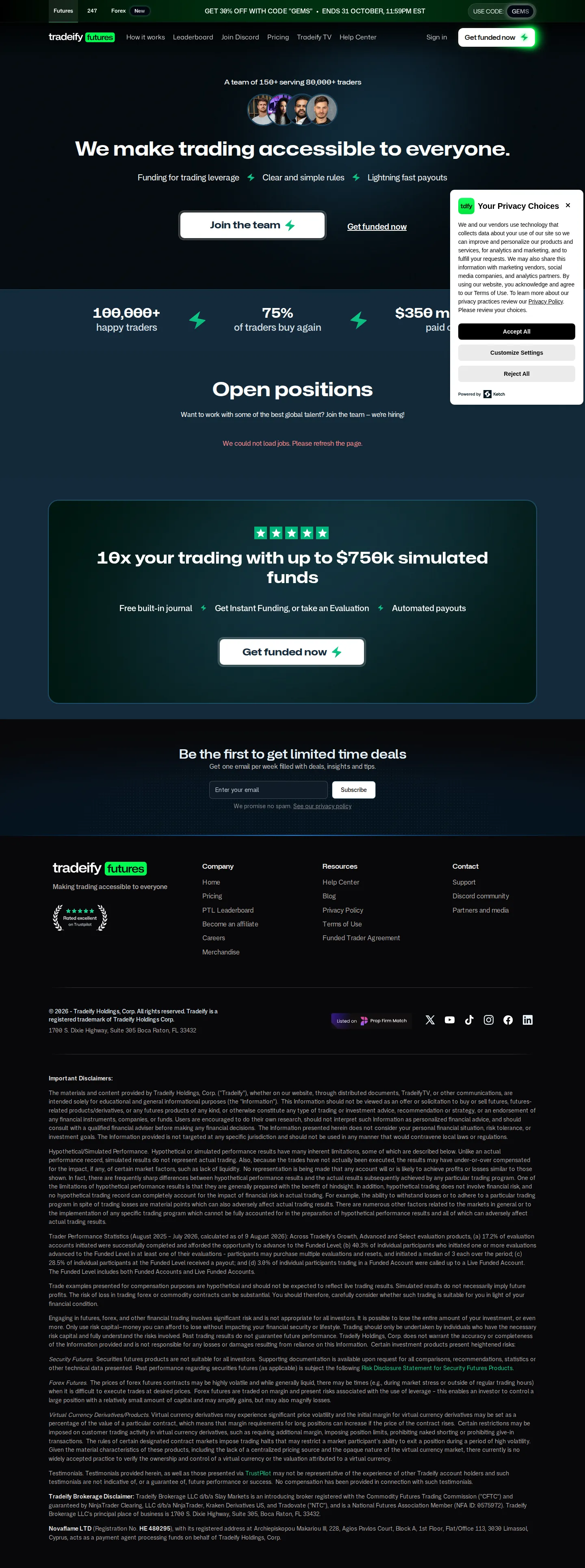
- Tradeify’s own homepage statistics, covering August 2025 to July 2026, report that only 17.2% of evaluation accounts were completed successfully and that 28.5% of participants who reached Funded Level ever received a payout.
Who actually stands behind Tradeify
The entity collecting evaluation fees, Tradeify Holdings, Corp., is not the entity that would ever hold a trader’s live money. Its Evaluation Services Agreement says so directly: the Company “does not hold a broker-dealer license and does not provide brokerage services,” and Elite Live accounts are “issued through and facilitated by NinjaTrader and GFF Brokers, third-party regulated brokerages.” A separate affiliate, Tradeify Brokerage LLC d/b/a Slay Markets, is the entity the Terms of Use describe as the NFA member and CFTC-registered introducing broker, guaranteed by NinjaTrader Clearing, Kraken Derivatives US and Tradovate. The NFA BASIC record for NFA ID 0575972 confirms it: on 24 Oct 2026 it showed Tradeify Brokerage LLC, doing business as Slay Markets, as an approved NFA member and a CFTC registered introducing broker since 20 Apr 2026, with no NFA, CFTC or exchange actions on file. It lists NinjaTrader Clearing LLC as the only guarantor, and Tradeify Holdings Corp as a principal holding 10% or more. On the payment side, Novaflame LTD of Limassol, Cyprus, processes funds on Tradeify’s behalf; the Cyprus Registrar of Companies, via a CyprusRegistry.com mirror of the register, shows Novaflame LTD as an active Cyprus company (HE 480295), which confirms the company exists and says nothing about any financial licence.
What Tradeify charges once a trader has signed up
Evaluation fees are, in the Evaluation Services Agreement’s own words, strictly non-refundable… regardless of the Trader’s progress or completion of the evaluation program. Failing an evaluation means paying a Reset Fee to try again; the firm’s pricing and plans page prices that reset per plan and account size, for example $60 (down from $70) on a Growth 25K Evaluation and $239 on a Select 150K Evaluation, with the Select plan allowing up to 10 resets a month. Moving a passed Growth or Select evaluation into a funded account carries no stated activation fee. A trader who disputes a card charge through their own bank, rather than through Tradeify, triggers a separate clause in Section 7.6 of the agreement: a permanent ban from the service and forfeiture of “any pending or unpaid payouts,” regardless of whether the dispute has merit.
The single most important thing to know before paying for an evaluation
Section 1.5 of the Evaluation Services Agreement states that “all funds in the trading account remain the sole property of the Company” and that the Trader has “no ownership or claim over these funds, which are exclusively demo funds unless otherwise stated.” A trader’s claim is to a payout the Company chooses to approve, not to the account balance itself, and Section 4.4 lets the Company “suspend the processing of any payout request” and “withhold payment of any payout that has been approved but not yet paid” during an open-ended internal review, with the normal payout clock paused for as long as that review runs. Set against that discretion, Tradeify’s own homepage reports that just 28.5% of traders who reached Funded Level ever received a payout, and only 3.0% of funded traders were ever moved to a live account, figures that sit alongside the same homepage’s “0% Payout Denials” claim.
Key Takeaways
What the register shows, and what it does not
- The firm’s own Terms of Use name Tradeify Brokerage LLC d/b/a Slay Markets as a registered introducing broker holding NFA ID 0575972, guaranteed by NinjaTrader Clearing, LLC, Kraken Derivatives US, and Tradovate. The NFA BASIC register confirms the membership and the registration (approved 20 Apr 2026, no regulatory actions), but lists only NinjaTrader Clearing LLC as guarantor (checked 24 Oct 2026).
- Tradeify Holdings, Corp., the entity that collects evaluation and funded account fees, says in its own Evaluation Services Agreement that it is not registered with any US futures regulator in any capacity and takes no orders in commodity interests. The company a trader actually pays holds no financial services licence of its own.
- Where a trader is moved to a live funded account, that account is “issued through and facilitated by NinjaTrader and GFF Brokers, third party regulated brokerages,” because, in the Agreement’s own words, “the Company does not hold a broker dealer license and does not provide brokerage services.”
- The Cyprus Registrar of Companies, checked via the CyprusRegistry.com mirror of the official register, confirms that Novaflame LTD, the payment agent that processes funds on Tradeify’s behalf, is registered in Cyprus as HE 480295, a Limited Company registered 06/09/25, status Active. That is a company registry entry, not a financial regulator’s licence, and it confirms the company exists; it grants Novaflame no permission to hold client money or provide financial services.
Tradeify’s own numbers on payouts
- The root page advertises “0% Payout Denials” and a “0% payout denial rate.” The same site’s Trader Performance Statistics, covering August 2025 to July 2026, state that only 28.5% of individual participants at the Funded Level received a payout at all. A 0% denial rate and a 28.5% payout rate are not the same measure, and the root page does not explain how the two sit together.
- The Trader Performance Statistics also report that only 17.2% of evaluation accounts initiated were successfully completed, that 40.3% of participants advanced to Funded Level in at least one evaluation after a median of 3 purchased evaluations or resets each, and that only 3.0% of funded traders were ever moved to a Live Funded Account. These are the firm’s own published figures, set against marketing elsewhere on the root page of “$350M+ Verified Payouts” and “100,000+ happy traders.”
What Tradeify charges, and what it keeps
- The pricing plans page lists a Reset Fee to restart a failed evaluation, for example $70 reduced to $60 on the Growth 25K Evaluation and $239 on the Select 150K Evaluation, with figures varying by account size and plan; the Select plan allows up to 10 resets a month. The same page states there is no Activation Fee for moving a passed Growth or Select evaluation into a funded account.
- The pricing page also advertises a multi account bundle discount: “Buy 5 accounts, save 5%,” applied at checkout, and lists crypto payments as an accepted method.
- The Evaluation Services Agreement, section 7.1 to 7.4, states that “all fees paid to the Company for evaluation programs, funded accounts, or any other services are strictly non-refundable,” regardless of “the Trader’s progress or completion of the evaluation program” or “any failure to meet the requirements for program qualification.” A trader who fails an evaluation, for any reason, does not get the fee back.
- Section 7.6 of the same Agreement states that a trader who initiates “any chargeback, payment dispute, reversal, or similar claim” is “permanently banned from all Tradeify services,” has every account “immediately and permanently terminated,” and forfeits “any pending or unpaid payouts,” regardless of whether the dispute has merit.
Terms that bind a trader once money is on the table
- Section 1.5 of the Agreement states that “all funds in the trading account remain the sole property of the Company,” and that the trader has “no ownership or claim over these funds, which are exclusively demo funds unless otherwise stated.” A trader’s claim runs only to a payout the Company chooses to approve, not to the account balance itself.
- Section 4.4 lets the Company “suspend the processing of any payout request” and “withhold payment of any payout that has been approved but not yet paid, pending completion of a review or investigation,” and states that normal payout time limits “do not run during any such suspension.” An approved payout can sit withheld for as long as an internal review stays open.
- Sections 6.7(c) and 6.7(i) treat hedging between a trader’s Tradeify account and “any External Account,” including an account at a different prop firm, as a breach “regardless of intent,” and allow the Company to rely on NinjaTrader as a monitoring source for evidence of positions held elsewhere.
- Section 6.11(h) lets the Company act on a rule breach “at any time after the relevant conduct” occurred, since determinations “are not made in real time,” and states that delay “does not waive that right,” meaning a clawback can land after an account has already passed, been funded, or paid out.
- Sections 5.1 to 5.2 state plainly that moving a trader to a live account is “solely Tradeify’s” decision and that its internal benchmarks, 10 approved payouts or 3 on a single account, “do not create any right or obligation to be transitioned to Live.” Hitting the numbers creates no entitlement.
- Section 10 sets Florida arbitration under American Arbitration Association rules for disputes under the Agreement. The separately incorporated Terms of Use instead names courts in Dallas, Texas as the exclusive venue for site related claims, and adds a jury trial waiver and a class action waiver. The two documents that govern the same relationship point to two different forums.
Weighing it against the score
- Regulation sits at 4.5. The entity collecting the fee, Tradeify Holdings, Corp., states outright that it holds no CFTC or NFA registration, which keeps the score low. The confirmed NFA registration of its introducing broker affiliate, with no actions on file, adds a little, though that affiliate only comes into play if Tradeify moves a trader to a live account, a step its agreement leaves solely to Tradeify.
- Fees sit at 7.4 on the strength of published, itemized numbers, a stated $0 activation fee, and a named discount, set against a non-refundable fee structure and a chargeback clause that bans a trader and forfeits payouts before any dispute is resolved on the merits.
- Reviews sit at 7.7 even though the firm’s own Trader Performance Statistics show only 28.5% of Funded Level traders ever received a payout and only 3.0% of funded traders reached a live account, figures that sit awkwardly next to the “0% Payout Denials” claim on the same root page.
Our reviews score of 7.7 comes from Trustpilot alone: the tradeify.co profile, listed as Tradeify Funding, rates the firm 4.5 stars across 6,088 reviews, with no Trustpilot warning on the profile (checked 24 Oct 2026). Tradeify publishes no app of its own.
Licenses & Regulation
Tradeify Holdings, Corp. is the entity that sells evaluation programs and simulated funded accounts, and its own Evaluation Services Agreement states plainly that the company is not registered with any US futures regulator in any capacity and takes no orders in commodity interests. The selling entity holds no financial services licence at all. Regulatory status in this structure sits elsewhere, with affiliates and third parties, and only comes into play if a trader is ever moved to a live account.
Where the NFA registration actually sits
The firm’s terms name Tradeify Brokerage LLC, doing business as Slay Markets, as a registered introducing broker guaranteed by NinjaTrader Clearing LLC, Kraken Derivatives US and Tradovate, and list an NFA ID of 0575972 for that entity with status “NFA Member.” We checked that ID on the NFA BASIC register on 24 Oct 2026. It shows Tradeify Brokerage LLC, doing business as Slay Markets, as an approved NFA member and a CFTC registered introducing broker since 20 Apr 2026, with a Boca Raton, Florida business address and no NFA, CFTC or exchange actions or arbitration decisions on file. The record lists one guarantor, NinjaTrader Clearing LLC; Kraken Derivatives US and Tradovate, named in the terms, do not appear on it. Tradeify Holdings Corp is listed among the principals with a stake of 10% or more.
The practical point for a trader is that this NFA registration does not cover Tradeify Holdings, Corp. itself. It covers a separate introducing broker entity that only enters the picture if and when a trader is moved onto a live account. Tradeify’s own agreement is explicit that this transition is “solely Tradeify’s” decision, that the internal benchmarks it publishes “do not create any right or obligation to be transitioned to Live,” and that even a trader who hits those benchmarks (10 approved payouts, or 3 on a single simulated funded account) has no contractual claim to ever reach a brokerage account at all.
The live account path, when it exists
For the minority of traders who do get moved to a Tradeify Elite Live account, the agreement states that this account is issued through and facilitated by NinjaTrader and GFF Brokers, third party regulated brokerages, because “the Company does not hold a broker dealer license and does not provide brokerage services.” So regulatory coverage on the live side, where it exists, belongs to NinjaTrader and GFF Brokers, not to Tradeify. We were not able to verify either firm’s licensing status directly as part of this check.
The one register entry we could confirm
The only registry hit we could directly confirm concerns Novaflame LTD, named in the terms as the payment agent that processes funds on Tradeify’s behalf from Limassol, Cyprus. The Cyprus Registrar of Companies, via the CyprusRegistry.com mirror, a point in time copy of the official register, shows Novaflame LTD registered as HE 480295, a Limited Company, registered 06/09/25, with status Active. This is a company registry entry, not a financial regulator’s licence record. It confirms that a company by this name exists and is active in Cyprus. It says nothing about what permissions, if any, that company holds to process client funds, and it is not a substitute for a financial services licence check on the payment agent itself.
What sits underneath the client relationship
Because the selling entity holds no licence, the contract terms carry most of the weight of what a client can actually rely on. Tradeify’s agreement states that “all funds in the trading account remain the sole property of the Company” and that the trader has “no ownership or claim over these funds, which are exclusively demo funds unless otherwise stated.” The same agreement sets governing law as Florida with disputes resolved “through binding arbitration in Florida in accordance with the rules of the American Arbitration Association,” while the separate Terms of Use instead fix “exclusive” venue in “state or federal court located in Dallas, Texas,” paired with a jury trial waiver and a class action waiver. These are two different dispute forums named in two documents that both govern the same client relationship.
The firm’s own Trader Performance Statistics, covering August 2025 to July 2026, state that only 3.0% of funded traders were ever moved to a Live Funded Account, the point at which any outside regulatory coverage, through NinjaTrader or GFF Brokers, would apply to a client’s trading at all. For the remaining 97%, the relationship stays inside Tradeify’s own simulated accounts, governed by the Evaluation Services Agreement rather than by any licensed brokerage relationship.
How to Trade
Tradeify sells access to futures trading through evaluation accounts and simulated funded accounts, not through a broker it owns. Tradeify Holdings, Corp. states in its own Evaluation Services Agreement that it is not registered with any US futures regulator in any capacity and takes no orders in commodity interests. The product a client actually pays for, the evaluation and the simulated funded account, runs on demo funds inside Tradeify’s own system. Section 1.5 of that agreement says plainly: “All funds in the trading account remain the sole property of the Company. The Trader acknowledges they have no ownership or claim over these funds, which are exclusively demo funds unless otherwise stated.”
What is actually tradable
The firm’s root page lists futures as the primary product, with a site navigation toggle for “Futures 247” and a separate “Forex New” toggle. A FAQ on that page, answering “What’s tradable on the futures market?”, names stock indices such as the S&P 500 and Nasdaq, metals including gold and silver, energy products including crude oil and natural gas, currencies, bonds, and crops. The firm’s own terms and conditions separately flag security futures, forex futures, and virtual currency derivatives as heightened risk product categories, with the forex futures language describing trading on margin with leverage.
Evaluation accounts and the rules that bind them
Two main evaluation tracks are described in the accounts pages: Growth Evaluation and Select Evaluation, each offered in 25K, 50K, 100K and 150K sizes. Growth can be passed in as few as one trading day and carries no evaluation consistency requirement, but applies a soft breach Daily Loss Limit. Select requires at least three trading days because of a consistency rule shown elsewhere on the site as 40% or 50%, and does not apply a Daily Loss Limit during the evaluation itself. A third track, Lightning Funded, skips the evaluation step entirely and starts a trader directly on a simulated funded account; it carries a 20% consistency rule for the first payout, rising to 25% on the second and 30% on the third and later payouts for accounts purchased after 12 September 2025, while accounts bought before that date stay at 20%. Lightning also requires a minimum of five trading days between payout requests.
Under Section 11 of the Evaluation Services Agreement, these trading parameters are not fixed by the signed contract. The agreement itself states: In the event of any conflict or inconsistency between a provision of this Agreement and a rule published at the Help Center… the Help Center rule shall prevail with respect to trading rules, account parameters, product classifications and groupings, and the definition of prohibited trading conduct. The binding version of the rules that govern a position sits on a separate webpage the firm can edit, not in the agreement a trader signs. Section 16 of the same agreement reinforces this: Tradeify can modify terms, payout requirements, and Help Center rules “at its sole discretion and at any time,” and continued use of the service after a change is posted counts as acceptance of it.
Moving from simulated to live, and what governs each
Once funded, Select Flex and Select Daily Funded accounts require the trader to pick a payout policy, a choice the agreement calls “permanent and irrevocable for the specific funded account in question,” with no refund or exchange if the trader later prefers the other policy. Funded Select accounts do not enforce a consistency rule on payouts, and Select Flex carries no Daily Loss Limit at all.
A trader who reaches certain internal benchmards, 10 approved payouts, or 3 approved payouts on a single simulated funded account, may be moved to a Tradeify Elite Live account. That account is not issued by Tradeify itself: the agreement states Tradeify “does not hold a broker-dealer license and does not provide brokerage services,” and Elite Live accounts are “issued through and facilitated by NinjaTrader and GFF Brokers, third party regulated brokerages.” Even hitting the stated benchmarks creates no entitlement to this move: Section 5.1 to 5.2 says “the decision to transition a Trader to Live is solely Tradeify’s” and that the thresholds “do not create any right or obligation to be transitioned to Live.” While on Elite Live, a trader and any member of their household may not hold any other Tradeify account of any kind.
Cross account conduct that can void a position
Section 6.7(c) and 6.7(i) of the agreement treat hedging, described as holding “Opposing Positions” between a Tradeify controlled account and any external account, including one at another prop firm, as a breach of the agreement regardless of the trader’s intent. To check for this, the firm states it may rely on NinjaTrader as a monitoring source for evidence of positions a trader holds elsewhere. Section 6.11(h) adds that findings under this kind of review are “made on review of the Company’s records and are not made in real time,” and that Tradeify “may exercise any right under Section 6.11(e) at any time after the relevant conduct,” with delay not waiving that right, meaning a contract selection breach can be acted on well after an account has since passed an evaluation, gone live, or paid out.
Platform connections
At checkout, a trader can connect an account through Tradovate, Rithmic, or WealthCharts. Tradovate credentials can also support TradingView, and Rithmic credentials can support platforms such as Tradesea, Quantower, and R|Trader, according to the accounts page. NinjaTrader is listed as a connection option too, but only by routing through Tradovate first.
What the firm’s own numbers say about reaching a funded, paid position
Tradeify’s Trader Performance Statistics, covering August 2025 to July 2026 and published on its own root page, give figures for how far paying clients actually get: 17.2% of evaluation accounts initiated were completed successfully; 40.3% of participants advanced to Funded Level in at least one evaluation, after a median of three purchased evaluations or resets each; 28.5% of Funded Level participants received a payout; and only 3.0% of funded traders were ever moved to a Live Funded Account.
Account Types
Tradeify sells evaluation accounts in two tracks, Growth and Select, each offered in 25K, 50K, 100K and 150K sizes, plus a third track, Lightning Funded, that skips the evaluation step entirely and starts a trader as a simulated funded account on day one.
Growth and Select evaluations
The firm’s accounts page describes the Growth Evaluation as passable in as few as one trading day, with no evaluation consistency requirement and a soft-breach Daily Loss Limit. The Select Evaluation imposes a 40% consistency rule (the pricing plans page shows this elsewhere as 40%/50%, depending on plan) and requires at least three trading days to pass, but it carries no Daily Loss Limit at all during the evaluation itself.
After a Tradeify evaluation is passed and all evaluation conditions are met, Tradeify’s Help Center says there is no activation fee and no waiting period for Growth or Select. The funded accounts that follow differ in how they pay out: the Growth Simulated Funded account pays on a 5-day cycle, applies a 35% consistency rule and a fixed payout policy, caps a trader at 5 funded accounts, and requires at least 5 profitable trading days between payout requests plus one trade a week to keep the account active. The Select funded account lets a trader choose, after passing, between a Flex or a Daily payout policy, a choice the accounts page describes as permanent and irrevocable per account, with no refund or exchange if the trader later wants to switch. Funded Select accounts carry no consistency rule on payouts, and Select Flex drops the Daily Loss Limit entirely.
Lightning Funded: no evaluation, a rising consistency bar
Lightning Funded accounts go straight to simulated funded status, with no evaluation step. Tradeify’s accounts page sets the consistency rule at 20% for a trader’s first payout, then 25% for the second payout and 30% for the third and later payouts; accounts bought before 12 September 2025 keep the flat 20% rule instead. A trader must wait a minimum of 5 trading days between payout requests.
What Tradeify charges to reset or activate an account
The pricing plans page lists a Reset Fee for traders who fail an evaluation and want another attempt: the example given is $70, discounted to $60, for a Growth 25K Evaluation, against $239 for a Select 150K Evaluation, with figures varying by account size and plan; the Select plan allows up to 10 resets a month. The same page states the Activation Fee for moving a passed Growth or Select evaluation into a funded account is none. Separately, the root page advertises a 5% discount for buying 5 accounts at once, applied at checkout.
All of these fees sit inside a non-refundable framework. The Evaluation Services Agreement, sections 7.1 to 7.4, states that “all fees paid to the Company for evaluation programs, funded accounts, or any other services are strictly non-refundable” and that “refunds will not be provided regardless of… the Trader’s progress or completion of the evaluation program; or any failure to meet the requirements for program qualification.” A reset or activation purchase is final whatever happens afterward.
Tradeify Elite Live: the one account tied to a real broker
Every account above trades on a simulated balance; Tradeify Holdings, Corp. states in its own terms that “all funds in the trading account remain the sole property of the Company” and are “exclusively demo funds unless otherwise stated.” The one path to a real-money account is Tradeify Elite Live, issued through and facilitated by NinjaTrader and GFF Brokers, described in the terms as third-party regulated brokerages, because, as the agreement puts it, “the Company does not hold a broker-dealer license and does not provide brokerage services.” The same terms (sections 5.1 to 5.2) set out internal, non-binding benchmarks for moving to Elite Live, 10 approved payouts or 3 approved payouts on a single simulated funded account, but add that “the decision to transition a Trader to Live is solely Tradeify’s” and that these thresholds “do not create any right or obligation to be transitioned to Live.” While an Elite Live account is active, the trader may hold no other Tradeify account, and the terms extend that restriction to any member of the trader’s household.
Platform connections
At checkout, the accounts page offers a connection to Tradovate, Rithmic, or WealthCharts; NinjaTrader is reachable only by connecting through Tradovate. Tradovate credentials can also support TradingView, and Rithmic credentials can support platforms such as Tradesea, Quantower, and R|Trader.
How often an account actually reaches a payout
Tradeify’s own Trader Performance Statistics, covering August 2025 to July 2026 and published on its root page, give a sense of how far a purchased account typically gets: 17.2% of evaluation accounts initiated were completed successfully, 40.3% of participants reached Funded Level in at least one evaluation after a median of 3 purchased evaluations or resets each, 28.5% of Funded-Level participants received a payout, and only 3.0% of funded traders were ever moved to a Live Funded Account.
Negative Balance Protection
Tradeify does not call its account rules a “loss limit” section, but the Evaluation Services Agreement and the plan pages describe several of them in different terms: a Daily Loss Limit on some account types, a consistency rule tied to payouts, and a set of discretionary suspension and forfeiture powers that sit on top of both.
Daily Loss Limit varies by plan, and some plans skip it entirely
The firm’s own account pages describe the Daily Loss Limit differently across its own products. The Growth Evaluation carries what the account page calls a “soft breach Daily Loss Limit.” The Select Evaluation has no Daily Loss Limit during the evaluation stage at all, and once a Select account is funded and the trader has picked the Flex payout policy, that account has no Daily Loss Limit whatsoever. The evidence gathered does not give the dollar or percentage figures behind the Daily Loss Limit on any plan, so none is stated here.
Consistency rules, not a single drawdown number
Tradeify’s loss and risk controls are bound up with consistency rules rather than a flat drawdown figure. The Select Evaluation account page cites a 40% consistency rule (shown elsewhere on the same page as 40%/50%) and requires at least 3 trading days before an evaluation can be passed. The Growth Simulated Funded account carries a 35% consistency rule and requires at least 5 profitable trading days between payout requests. The Lightning Funded account, which skips the evaluation and starts live as a simulated funded account, runs a 20% consistency rule on the first payout, scaling to 25% on the second and 30% on the third and later payouts, for accounts purchased after 12 September 2025; accounts bought before that date stay at 20%. Funded Select accounts, once a payout policy is chosen, do not enforce a consistency rule for payouts at all. None of the plan pages supplied define, in dollars, what “consistency” measures against, so that mechanism is reported here only as the firm’s own pages describe it.
What happens when a limit is breached
Failing an evaluation under these rules does not end the relationship, it starts a fee. The pricing page lists a Reset Fee to restart a failed evaluation, for example $60 (reduced from $70) for the Growth 25K Evaluation and $239 for the Select 150K Evaluation, with figures varying by account size and plan; the Select plan allows up to 10 resets per month. There is no activation fee stated for moving a passed Growth or Select evaluation into a funded account.
The Company’s discretion once a payout is in motion
Beyond the stated loss limits, the Evaluation Services Agreement gives Tradeify Holdings, Corp. open ended power over money that has already cleared the stated rules. Section 4.4 states: The Company may suspend the processing of any payout request, and may withhold payment of any payout that has been approved but not yet paid, pending completion of a review or investigation… The time limits stated in this Section 4.4 do not run during any such suspension. In practice this means a payout already approved can be held indefinitely while an internal review is open, and the normal payout clock the firm advertises does not run during that hold.
Section 1.5 of the same agreement states: “All funds in the trading account remain the sole property of the Company. The Trader acknowledges they have no ownership or claim over these funds, which are exclusively demo funds unless otherwise stated.” A trader’s claim is to a payout the Company chooses to approve, not to the balance shown in the account.
Section 6.7(c) and 6.7(i) treat hedging against positions at other firms, described as “Opposing Positions” between a Trader Controlled Account and any External Account, as a breach of this Agreement regardless of intent, and the agreement states the Company may rely on NinjaTrader as a monitoring source for evidence of positions held elsewhere. Section 6.11(h) adds that findings under its contract selection rule are “made on review of the Company’s records and are not made in real time,” and that the Company may act on them “at any time after the relevant conduct,” with delay not waiving that right. So a breach finding tied to a loss or trading rule can surface well after an account has since passed an evaluation, gone live, or already paid out.
Marketing claims against the firm’s own numbers
The root page advertises “0% Payout Denials” and a “0% payout denial rate.” Set against that, the same site’s Trader Performance Statistics (for the period August 2025 to July 2026, as published on the root page) report that only 28.5% of participants who reached the Funded Level ever received a payout, and only 17.2% of evaluation accounts initiated were successfully completed. The Evaluation Services Agreement’s suspension, withholding, and forfeiture powers under Sections 4.4, 6.7(h), 6.11(e), and 7.6 sit alongside that 0% denial claim and that 28.5% payout figure; reconciling a 0% denial rate with a payout rate under a third is left to the reader.
Chargebacks end the relationship outright
Section 7.6 states: The Trader expressly waives the right to initiate, pursue, or maintain any chargeback, payment dispute, reversal, or similar claim… In the event that the Trader… initiates a chargeback… the Trader will be permanently banned from all Tradeify services… all of the Trader’s accounts… will be immediately and permanently terminated, and any pending or unpaid payouts will be forfeited. A client who disputes a card charge through their own bank forfeits every pending payout and is banned outright, with no stated step for investigating the dispute’s merits first.
Trading Instruments
Tradeify’s own navigation splits what it offers into two toggles, “Futures 247” and “Forex New”. The firm’s FAQ, answering “What’s tradable on the futures market?”, lists stock indices such as the S&P 500 and Nasdaq, metals including gold and silver, energy products such as crude oil and natural gas, currencies, bonds, and crops. That FAQ answer is the only place in the evidence we gathered that names specific instruments; the forex toggle itself is not expanded on the same page.
Platform connections at checkout
Tradeify’s account signup page lists three ways to connect an account: Tradovate, whose credentials can also support TradingView; Rithmic, whose credentials can support platforms such as Tradesea, Quantower, and R|Trader; and WealthCharts. NinjaTrader connects through Tradovate only rather than as a direct option. None of these names appear in the instrument list from the FAQ, so the pages we fetched describe the connection method separately from the products traded on it, and say nothing about which specific contracts each connection supports.
What Tradeify’s accounts actually hold
Every account that isn’t an Elite Live account is a simulated account, and Tradeify’s own Evaluation Services Agreement is explicit about what that means for the trader: “All funds in the trading account remain the sole property of the Company. The Trader acknowledges they have no ownership or claim over these funds, which are exclusively demo funds unless otherwise stated” (section 1.5, the firm’s UK terms page). That clause applies to the Growth Evaluation, Growth Simulated Funded, Select Evaluation, Select Flex/Daily Funded, and Lightning Funded accounts named in the evidence we reviewed. The crops, metals, energy, and index futures named in the FAQ are, for all of these accounts, traded on a simulated balance rather than through a live market position.
The one account type that moves off simulated funds is Tradeify Elite Live, and Tradeify’s terms are specific about who actually provides it: Elite Live accounts are “issued through and facilitated by NinjaTrader and GFF Brokers, third-party regulated brokerages,” because “the Company does not hold a broker-dealer license and does not provide brokerage services” (section 5, Tradeify Brokerage Disclaimer, the firm’s UK terms page). The same terms state that the decision to move a trader onto Elite Live is “solely Tradeify’s” discretion, that the internal benchmarks used to consider it (10 approved payouts, or 3 approved payouts on a single simulated funded account) “do not create any right or obligation to be transitioned to Live” (sections 5.1 to 5.2, the firm’s UK terms page), and that a trader on Elite Live, along with any member of that trader’s household, may not hold any other Tradeify account while it is active. Tradeify’s Trader Performance Statistics, covering August 2025 to July 2026, give the share of funded traders who were ever moved to a Live Funded Account as 3.0%. For the large majority of paying customers, in other words, the futures, metals, energy, and currency instruments named on Tradeify’s own FAQ page are never actually held as live positions.
Forex, security futures, and virtual currency products flagged as higher risk
Tradeify’s terms separately name three product categories under heightened risk disclaimers: Security Futures; Forex Futures, which the terms describe as traded on margin with leverage; and Virtual Currency Derivatives/Products, for which the terms carry specific margin and trading-halt risk language. The evidence we gathered gives the existence and the risk framing of these three categories but not a product list, minimum contract size, or margin schedule for any of them, so we can report that Tradeify’s own risk disclosures single them out without being able to say what trading in each one actually looks like on the account.
Registration status behind the products on offer
Tradeify Holdings, Corp., the entity that sells the evaluations and runs the simulated funded accounts, states in its own terms that it is not registered with any US futures regulator in any capacity and takes no orders in commodity interests. The registered introducing broker named in the evidence is a separate affiliate, Tradeify Brokerage LLC d/b/a Slay Markets, guaranteed by NinjaTrader Clearing, LLC, Kraken Derivatives US, and Tradovate, with an NFA ID of 0575972 given in Tradeify’s own terms. The NFA BASIC register confirms that affiliate as an approved NFA member and CFTC registered introducing broker, though it lists only NinjaTrader Clearing LLC as guarantor.
Education & Analysis
Tradeify does not operate a trading platform of its own. Tradeify’s accounts page lists four connection options at checkout: Tradovate, Rithmic, WealthCharts, and NinjaTrader, with NinjaTrader connecting only through Tradovate rather than as a direct, standalone option. The same page notes that Tradovate credentials can also support TradingView, and that Rithmic credentials can carry through to platforms such as Tradesea, Quantower, and R|Trader. In practice, a trader buying an evaluation is choosing a data and order-routing relationship, not a chart package built by Tradeify, and the charting, order entry, and analysis tools on offer are whatever Tradovate, Rithmic, WealthCharts, or the downstream platforms they support happen to provide.
What Tradeify’s accounts page actually covers
The accounts page names the four connection options and the platforms reachable through two of them, and says nothing beyond that about order types, charting features, indicators, or data feed quality on any of the four. It does not describe a demo or practice mode for the platforms themselves, separate from the evaluation and funded-account structure. Where Tradeify’s marketing elsewhere promotes “Futures 247” and a separate “Forex New” toggle in the site navigation, the accounts page itself is silent on which of the four connection options carries forex pricing versus futures-only data, and on which platform, if any, is positioned as the default for a new trader rather than a power-user choice.
Instruments traded through the connected platforms
Tradeify’s own FAQ, answering “What’s tradable on the futures market?”, lists stock indices (S&P 500, Nasdaq), metals (gold, silver), energy (crude oil, natural gas), currencies, bonds, and crops as the instrument groups available. The firm’s terms of use separately name Security Futures, Forex Futures, and Virtual Currency Derivatives/Products as heightened-risk product categories, with the Forex Futures entry specifically flagged as traded on margin with leverage. None of these risk-disclosure entries describes a charting or analysis feature; they set out margin and trading-halt risk language rather than platform functionality, and we are reporting them here only because they are the instrument categories the terms of use attach extra risk warnings to.
NinjaTrader’s role runs past charting
NinjaTrader Clearing, LLC d/b/a NinjaTrader shows up in Tradeify’s terms in three separate capacities: as a connection option for charting and order entry (routed through Tradovate), as one of three guarantors of Tradeify Brokerage LLC’s introducing-broker business alongside Kraken Derivatives US and Tradovate, and as a monitoring service the Company can rely on for evidence of positions a trader holds at other firms. Section 6.7(c) and 6.7(i) of the Evaluation Services Agreement treat “Opposing Positions” between a Trader-Controlled Account and any External Account, including accounts at other prop firms, as hedging and a breach of the agreement regardless of intent, and the agreement states the Company may use NinjaTrader as a source of evidence for that determination. A trader connecting through NinjaTrader for its charts and order routing is, by the same terms, also connecting through a channel Tradeify can use to see what that trader is doing at other firms.
Tradeify Elite Live sits on a different platform stack
Tradeify’s terms describe the Tradeify Elite Live account as issued through and facilitated by NinjaTrader and GFF Brokers, described as third-party regulated brokerages, because, in the terms’ own words, “the Company does not hold a broker-dealer license and does not provide brokerage services.” That means the platform and execution relationship a trader has during the evaluation and simulated-funded stages, built on Tradovate, Rithmic, WealthCharts, or NinjaTrader, is not necessarily the same relationship they end up with if and when Tradeify moves them to a live account; the terms state that the transition decision is Tradeify’s alone, and that internal benchmarks such as 10 approved payouts (or 3 on a single account) create no right to be transitioned. We have no page in evidence describing what charting or order-entry setup an Elite Live account actually runs on once GFF Brokers is the broker of record, only that GFF Brokers and NinjaTrader are named as the facilitators.
What the pricing and accounts pages leave unaddressed
Tradeify’s pricing page advertises crypto payments and a 5% discount for buying five accounts at once, and separately sets out Reset Fees that vary by plan and account size, for example $60 (reduced from $70) to reset a Growth 25K Evaluation versus $239 to reset a Select 150K Evaluation, plus an Activation Fee stated as None for moving a passed Growth or Select evaluation into funded status. None of that pricing material addresses platform fees, data-feed costs, or whether a trader pays Tradovate, Rithmic, or WealthCharts directly for their use of those systems on top of the evaluation and reset fees Tradeify itself charges. The pages we fetched describe the four connection options and say nothing about who bills for the underlying platform subscription or market data, so that remains outside what we can confirm from the material in hand.
Special Offers
Promotions are thin on the ground at Tradeify. Across the pages we fetched, the only discount mechanisms that turn up are a volume discount on the root page and a reduced reset fee shown on one evaluation tier of the pricing page. There is no promotions page, seasonal offer, or referral bonus in the material we read.
The discount Tradeify advertises
Tradeify’s root page advertises a bundle discount: “Buy 5 accounts, save 5%”, applied at checkout. The Evaluation Services Agreement caps a trader at five simulated funded accounts per individual and per household across Growth, Select and Lightning combined, so a five-account bundle bought under this discount would appear to use up that entire allowance in one purchase.
Reset fee pricing on the Tradeify pricing page
Tradeify’s pricing page lists a Reset Fee for restarting a failed evaluation, and shows it as a discounted figure on at least one tier: the Growth 25K Evaluation lists a reset price of $70 struck through against a lower price of $60. The Select 150K Evaluation lists its reset fee as $239, shown as a flat figure rather than a discounted one on the same page. The page states that reset fees vary by account size and plan, and that the Select plan allows up to 10 resets per month. The pricing page separately states the Activation Fee for moving a passed Growth or Select evaluation into a funded account is “None”.
Conditions that apply regardless of any discount
Whatever the checkout price, the Evaluation Services Agreement’s refund language applies to it without exception. Sections 7.1 to 7.4 state that “all fees paid to the Company for evaluation programs, funded accounts, or any other services are strictly non-refundable” and that “refunds will not be provided regardless of… the Trader’s progress or completion of the evaluation program; or any failure to meet the requirements for program qualification.” A discounted reset fee or a bundled account bought at 5% off is covered by the same clause as a full-price purchase: once paid, it is not coming back, pass or fail.
The pricing page also lists crypto payments as an available payment method, alongside the reset and activation fee figures, but does not tie that option to any price reduction.
Opening an Account
Signing up starts with picking an evaluation size on Tradeify’s pricing page: the Growth Evaluation and Select Evaluation both come in 25K, 50K, 100K and 150K sizes. At checkout the trader also picks a platform connection, Tradovate, Rithmic or WealthCharts, with NinjaTrader available only by connecting through Tradovate. Tradeify’s pricing page advertises crypto payments as a funding method, and a 5% discount for buying five accounts at once. There is no deposit in the conventional sense: the trader pays a one time evaluation fee, and Tradeify’s pricing page states no activation fee applies when a Growth or Select evaluation is passed and moved to a funded account.
What Tradeify demands before it will let money move
The Evaluation Services Agreement does not describe a single upfront identity check at signup. Instead, Section 1.6 ties verification to the back end of the relationship: “The Company will not process or complete an account closure or deletion request until the identity of the requesting account holder has been successfully verified.” In practice this means a trader who wants out has to clear identity verification first, on Tradeify’s own schedule, not on request.
Payouts run through a separate payment agent, Novaflame LTD, a Cyprus registered company (HE 480295, Limited Company, registered 06/09/25, status Active, confirmed on the Cyprus Registrar of Companies via the CyprusRegistry.com mirror). That register confirms Novaflame exists as a company; it is not a financial regulator and the registration is not a licence to hold client money.
Who Tradeify will not open an account for
The Evaluation Services Agreement bars citizens, residents, or persons located in countries on Tradeify’s restricted jurisdictions list, though that list itself is kept at the Help Center rather than named in the agreement. Separately, the Terms of Use repeat the standard U.S. sanctions bar: anyone on the Treasury Department’s Specially Designated Nationals list or the Commerce Department’s Table of Deny Orders may not use the site’s products or services.
Tradeify also caps how many accounts one person, or one household, can hold at once. Section covering account limits allows only one Tradeify dashboard account per individual, with no running a personal account alongside a business one, and a maximum of five simulated funded accounts per individual or household across Growth, Select and Lightning combined. A trader moved onto a Tradeify Elite Live account loses that flexibility entirely while it is active: neither that trader nor anyone in their household may hold any other Tradeify evaluation, funded, or straight to sim account for as long as the Elite Live account runs.
Getting from evaluation to a funded, or live, account
Passing an evaluation does not hand a trader a live brokerage account. Tradeify Holdings, Corp. states plainly in its own terms that it is not registered with any US futures regulator in any capacity and takes no orders in commodity interests, and that it “does not hold a broker-dealer license and does not provide brokerage services.” Live, real money trading instead runs through Tradeify Elite Live accounts, “issued through and facilitated by NinjaTrader and GFF Brokers, third party regulated brokerages.” Moving to that stage is not a right a trader earns by hitting a number. Sections 5.1 to 5.2 describe internal benchmarks, 10 approved payouts, or 3 approved payouts on a single simulated funded account, but state outright: The decision to transition a Trader to Live is solely Tradeify’s… These thresholds are internal benchmarks used by Tradeify’s risk management team and do not create any right or obligation to be transitioned to Live. The same terms note that traders in certain jurisdictions can buy an evaluation and reach Simulated Funded status but remain ineligible for the live program for the full length of their contract, with no live path at all.
A related affiliate structure sits behind that live stage: Tradeify Brokerage LLC, doing business as Slay Markets, is guaranteed as an introducing broker by NinjaTrader Clearing, LLC, Kraken Derivatives US and Tradovate. None of that affiliate detail changes who a trader is contracting with at signup, which remains Tradeify Holdings, Corp. itself, an unlicensed entity under its own description.
What locks in once the account is open
A few choices made at or shortly after signup cannot be undone. Where an evaluation path lets the trader choose between payout policies after passing, Section 4.5 makes that choice “permanent and irrevocable for the specific funded account in question,” with no refunds or exchanges if the trader later prefers the other policy. Section 7.1 to 7.4 makes the evaluation fee itself non refundable “regardless of… the Trader’s progress or completion of the evaluation program,” and Section 7.6 adds that a trader who initiates a chargeback or payment dispute, through their own bank, on the original charge, is “permanently banned from all Tradeify services” with all accounts terminated and any unpaid payouts forfeited.
Deposits & Withdrawals
Tradeify’s own fee material and the Evaluation Services Agreement cover what a client pays to start, what gets taken back on a failed attempt, and what happens once money is actually owed to the client. The two are not symmetrical: entry fees are described as flowing one way, and payout mechanics give the Company wide room to pause or forfeit what it owes.
What Tradeify charges to get in and reset
The pricing page sets a Reset Fee for restarting a failed evaluation account, with figures that vary by plan and account size: the page gives the Growth 25K Evaluation reset at $70, discounted to $60, and the Select 150K Evaluation reset at $239. The Select plan allows up to 10 resets per month, so a trader who keeps failing can keep paying to restart up to that monthly cap. The same page lists the Activation Fee for moving a passed Growth or Select evaluation into a funded account as None. Tradeify’s root page also advertises a multi-account bundle discount of 5% off for buying five accounts at checkout, and lists crypto payments as an accepted method on the pricing page.
The Evaluation Services Agreement is explicit that none of this is refundable: Section 7.1 to 7.4 states that “all fees paid to the Company for evaluation programs, funded accounts, or any other services are strictly non-refundable,” and that this holds “regardless of” the trader’s progress or completion of the evaluation, or any failure to meet qualification requirements. A client who buys an evaluation and fails on day one, and a client who fails on the last day, are both treated the same way: the fee is gone either way, and a reset or a new purchase is the only way back in.
Payout cycles and the conditions attached to them
The account pages describe payout frequency and eligibility rather than a flat withdrawal fee. The Growth Simulated Funded account sets a payout frequency of 5 days, caps a trader at 5 funded accounts, applies a 35% consistency rule, and requires at least 5 profitable trading days between payout requests, on top of a fixed payout policy and a minimum of 1 trade per week to stay active. Lightning Funded accounts run a tiered consistency rule instead: 20% for a first payout, 25% for a second, and 30% for a third or later payout, for accounts purchased after 12 September 2025 (legacy accounts stay at 20%), with a minimum 5 trading days between requests. Select Flex and Select Daily Funded accounts drop the consistency rule entirely once funded, but Section 4.5 of the Agreement makes the choice between Flex and Daily “permanent and irrevocable” for that specific account, with no refund or exchange if the trader later prefers the other policy.
Where an approved payout can still be held back
Section 4.4 of the Agreement gives the Company the right to suspend processing of any payout request, and to withhold payment of a payout already approved but not yet paid, “pending completion of a review or investigation.” The same clause states that the normal processing time limits “do not run during any such suspension,” so the clock that would otherwise bound how long a payout takes simply stops while the review is open, with no stated outer limit on how long that can last. Section 6.11(h) adds that the Company’s determinations on contract-selection rule breaches are “made on review of the Company’s records and are not made in real time,” and that the Company may act on a breach “at any time after the relevant conduct,” with delay not waiving that right. Read together, these two clauses mean a payout can be approved, then paused, and a funded account can be clawed back for conduct discovered well after the fact, even after it has already been funded or paid.
Section 7.6 attaches a separate penalty to disputing a charge through a card issuer rather than through Tradeify directly: the Trader “expressly waives the right to initiate, pursue, or maintain any chargeback, payment dispute, reversal, or similar claim,” and if one is filed anyway, “the Trader will be permanently banned from all Tradeify services,” every account is “immediately and permanently terminated,” and “any pending or unpaid payouts will be forfeited.” The same section also makes the Trader liable for the Company’s reasonable attorneys’ fees plus any costs, fees, or losses associated with the chargeback. That forfeiture is triggered by filing the dispute, not by its outcome.
Who the money belongs to before a payout is approved
Section 1.5 of the Agreement states that “all funds in the trading account remain the sole property of the Company,” and that the Trader acknowledge[s] they have no ownership or claim over these funds, which are exclusively demo funds unless otherwise stated. Combined with Section 4.4’s suspension power, the account balance itself is not something a client has a claim on; the claim only exists once a specific payout is approved and processed. On exit, Section 1.6 states that the Company “will not process or complete an account closure or deletion request until the identity of the requesting account holder has been successfully verified,” so closing an account is conditioned on completing whatever identity checks the Company asks for first, rather than available on request.
The firm’s Cyprus-incorporated payment agent, Novaflame LTD, processes funds on the Company’s behalf; the Cyprus Registrar of Companies confirms Novaflame LTD is registered there under HE 480295, status Active, which confirms the company exists but is a company registry entry, not a financial licence and no indication that Novaflame is permitted to hold client money.
Customer Support
Tradeify’s published contact details are thin. Its Terms of Use names a single support inbox, support@tradeify.co, and lists a business address at 1700 S. Dixie Highway, Suite 305, Boca Raton, FL 33432. The root page advertises a Discord server for live chat, quick answers and direct access to the team. The pages we read name email and Discord as the ways to reach the firm.
Which document actually governs a complaint
We read Tradeify’s Evaluation Services Agreement, and even working out which rule applies to a dispute takes checking two sources. Section 11 states that where the Agreement conflicts with a rule published at the Help Center, “the Help Center rule shall prevail with respect to trading rules, account parameters, product classifications and groupings, and the definition of prohibited trading conduct.” A client who emails support about a trading-rule dispute is arguing against whichever version of the rule sits on the Help Center page that day, not only the signed contract.
What happens when a Tradeify client disputes a charge
The same agreement’s clause on disputed card payments is unusually severe. Section 7.6 states: The Trader expressly waives the right to initiate, pursue, or maintain any chargeback, payment dispute, reversal, or similar claim… In the event that the Trader… initiates a chargeback… the Trader will be permanently banned from all Tradeify services… all of the Trader’s accounts… will be immediately and permanently terminated, and any pending or unpaid payouts will be forfeited. A client who goes to their own bank to dispute a charge, instead of to Tradeify’s support inbox, triggers a permanent ban and forfeits whatever payouts were pending, before any investigation of the complaint’s merits.
Closing an account or chasing an approved payout
The agreement conditions even an account closure request on identity checks. Section 1.6 says “The Company will not process or complete an account closure or deletion request until the identity of the requesting account holder has been successfully verified.” A client who wants out cannot simply stop paying or send a cancellation email; the request waits on whatever verification steps Tradeify asks for first.
A payout already approved is not necessarily final either. Section 4.4 gives the Company the right to suspend the processing of any payout request, and… withhold payment of any payout that has been approved but not yet paid, pending completion of a review or investigation, and adds that “the time limits stated in this Section 4.4 do not run during any such suspension.” The standard payout clock stops the moment Tradeify opens an internal review, though the clause requires that review to be completed within a commercially reasonable period.
Where a dispute with Tradeify actually gets heard
The two documents that together govern the relationship point to two different forums. The Evaluation Services Agreement’s Section 10 sends disputes to “binding arbitration in Florida in accordance with the rules of the American Arbitration Association (AAA)” under Florida law. The separate Terms of Use instead sets venue in “state or federal court located in Dallas, Texas,” and in the same clause has the client “IRREVOCABLY WAIVE THE RIGHT TO TRIAL BY JURY” and “IRREVOCABLY WAIVE ANY RIGHT TO BRING ANY CLAIM HEREUNDER AS A CLASS OR COLLECTIVE ACTION.” A client trying to work out where to take a complaint about Tradeify is reading two contracts naming two different cities and two different procedures.
The Terms of Use also puts a clock on bringing any claim at all: “any causes of action by you related in any way to these Terms of Use or your utilization of the Site must be brought within one (1) year after the cause of action accrues or shall be permanently barred.” A client who sits on a grievance for longer than a year loses the right to raise it, regardless of its merits.
Feedback sent to Tradeify stops being the client’s
The Terms of Use’ User Contributions clause covers anything a client submits to the firm, including complaints and reviews: Any and all comments, posts, messages, reviews, feedback, information or other materials submitted to Tradeify… shall be considered non-confidential and Tradeify’s property, and the client irrevocably assign[s]… all worldwide rights… and irrevocably waive[s] any rights of attribution and other moral rights. Anything written into a support ticket, a review box, or a message to the Discord team becomes Tradeify’s to use, with no credit owed back to the person who wrote it.
A separate clause narrows how a client can complain in public while naming the firm. The Intellectual Property section bars Tradeify’s marks from being used “in any manner that is likely to cause confusion among consumers, or to disparage or discredit Tradeify.” Criticism that uses Tradeify’s own name or logo risks being treated as a trademark issue rather than simply a review.
Prohibited Countries
Tradeify’s own Evaluation Services Agreement restricts the countries that can take part, but the agreement itself defers the actual list to a separate page. Section 1 of that agreement bars citizens, residents, or persons located in countries on Tradeify’s restricted jurisdictions list, and states that the list is maintained at the Help Center rather than printed in the agreement. The copy of the agreement we read does not name a single country on that list.
What Tradeify’s Terms of Use add on sanctions
The separate Terms of Use document adds a named sanctions restriction rather than a geographic list. It states that persons on the U.S. Treasury Department’s list of Specially Designated Nationals, or on the U.S. Commerce Department’s Table of Deny Orders, may not use or receive the Site’s products or services. That is a sanctions screen tied to two specific U.S. government lists, not a broker specific country ban, and the Terms of Use do not name any additional countries beyond those two lists.
Where Tradeify draws a line between simulated and live accounts
The Evaluation Services Agreement treats eligibility for a live funded account separately from eligibility to buy an evaluation at all. It states that traders in certain jurisdictions may purchase an evaluation but will remain on Simulated Funded status for the duration of their contract, ineligible for the Tradeify Elite Live program even if they otherwise qualify on trading performance. The agreement does not name which jurisdictions this applies to on the page we read, and the move to Elite Live is described elsewhere in the same agreement as being “solely Tradeify’s” discretion in any case, not something a qualifying trader can claim as a right.
Account limits that apply regardless of country
Separate from geography, the Evaluation Services Agreement caps how many Tradeify accounts one person, or one household, can hold at the same time. It limits each individual to a single Tradeify dashboard account, with no running a personal account alongside a business one, and that cap is written to apply per individual and per household. The same agreement caps simulated funded accounts at five per individual or household, counted across the Growth, Select and Lightning account types combined. Once a trader is moved to Tradeify Elite Live, the agreement bars that trader, and any member of their household, from holding any other Tradeify challenge, funded, or straight to simulation account while the Elite Live account stays active.
Access methods the Terms of Use rule out
The Terms of Use also prohibit a method of access rather than a location: they bar any user of the site, platform, accounts, or services from using a VPS or other virtualized access that obscures identity. The clause does not set out what Tradeify treats as sufficient obscuring, so the practical reach of the rule is not stated on the page we read.
Regulatory status behind these restrictions
None of this sits behind a trading licence held by the contracting entity itself. The Evaluation Services Agreement states plainly that the company is not registered with any US futures regulator in any capacity and takes no orders in commodity interests, and that it “does not hold a broker-dealer license and does not provide brokerage services.” The registered status sits with an affiliate, Tradeify Brokerage LLC d/b/a Slay Markets, which the agreement lists as a CFTC registered introducing broker carrying NFA ID 0575972, guaranteed by NinjaTrader Clearing, LLC, Kraken Derivatives US, and Tradovate. The NFA BASIC register, which covers both NFA membership and CFTC registration, confirms the affiliate under that ID as an approved NFA member and introducing broker, with NinjaTrader Clearing LLC as its only listed guarantor.
Taken together, the restrictions a trader can actually read before signing are a sanctions screen against two named U.S. lists, a VPS and virtualization ban, and account count limits by individual and household. The country level restricted jurisdictions list, and the list of countries excluded from Tradeify Elite Live specifically, are both referenced in the agreement by name but published elsewhere, on the Help Center, which the same agreement (Section 11) says overrides the agreement’s own text on trading rules, account parameters, and prohibited conduct whenever the two conflict.
Conclusion
Tradeify scores 6.4 overall, held down by a regulation score of 4.5. The entity that actually takes a trader’s money, Tradeify Holdings, Corp., states its own terms that it is not registered with any US futures regulator in any capacity and takes no orders in commodity interests. The NFA registration (NFA ID: 0575972) and CFTC registration sit with a different, affiliated entity, Tradeify Brokerage LLC d/b/a Slay Markets, and the NFA BASIC register confirms both for that affiliate. That registration only matters if Tradeify moves a trader to a live account. The other register entry we confirmed, HE 480295 for Novaflame LTD at the Cyprus Registrar of Companies, is a company record for the payment agent that processes funds, not a financial regulator, so it confirms a company exists and nothing about a trading licence.
What Tradeify’s own numbers say about reaching a payout
The firm’s own Trader Performance Statistics, covering August 2025 to July 2026, put the odds in plain figures: 17.2% of evaluation accounts initiated were completed successfully, 28.5% of participants who reached Funded Level ever received a payout, and only 3.0% of funded traders were ever moved to a Live Funded Account. Those figures sit beside marketing language on the root page claiming “0% Payout Denials” and “$350M+ Verified Payouts.” The two things are not the same claim, a payout that is approved and a payout that is ever reached are different stages, but a reader weighing “0% denial” against 28.5% of funded traders paid is weighing two figures the firm published itself.
What Tradeify’s contract lets it do with a payout
The Evaluation Services Agreement gives the Company room to sit on money it has already approved. Section 4.4 states the Company “may suspend the processing of any payout request, and may withhold payment of any payout that has been approved but not yet paid, pending completion of a review or investigation,” and that “the time limits stated in this Section 4.4 do not run during any such suspension.” Section 1.5 states that “all funds in the trading account remain the sole property of the Company” and that the trader has “no ownership or claim over these funds.” Section 7.6 states that a trader who initiates a chargeback or payment dispute, even through their own bank, faces a permanent ban from all Tradeify services and forfeits “any pending or unpaid payouts.” None of these clauses is unusual by itself in a prop firm agreement, but together they describe a payout as something the Company controls up to the point it chooses to release it.
Fees, platforms, and where the two contracts disagree
The fee and platform pages read straightforwardly: a Growth 25K Evaluation reset is listed at $70, reduced to $60, a Select 150K Evaluation reset at $239, and activation into a funded account after passing Growth or Select is listed as free. Platform choice spans Tradovate, Rithmic, WealthCharts, and NinjaTrader (the last connecting only through Tradovate), which is a reasonable spread for a futures prop firm, consistent with the 6.6 platform score. Support runs through email and a Discord community rather than live chat or phone, consistent with the 6 support score.
Where the paperwork gets harder to follow is the dispute forum. The Evaluation Services Agreement sets Section 10’s governing law as Florida with disputes going to binding arbitration in Florida under American Arbitration Association rules. The separately incorporated Terms of Use instead sets exclusive venue in state or federal court in Dallas, Texas, with an irrevocable jury trial waiver and an irrevocable class action waiver. A trader bound by both documents is pointed at two different forums for a claim, and gives up a jury trial and class action rights in the Terms of Use regardless of which forum applies. Section 16 also lets the Company amend any term, including payout and drawdown rules, “at its sole discretion and at any time,” with continued use counting as acceptance, and Section 11 gives a separate, more frequently editable Help Center page priority over the signed Agreement for trading rules and product definitions.
Tradeify sells clearly priced futures evaluations, but by its own statistics only 28.5% of funded traders are ever paid and 3.0% reach a live account. TrueBroker scores Tradeify 6.4 out of 10.
What we saw
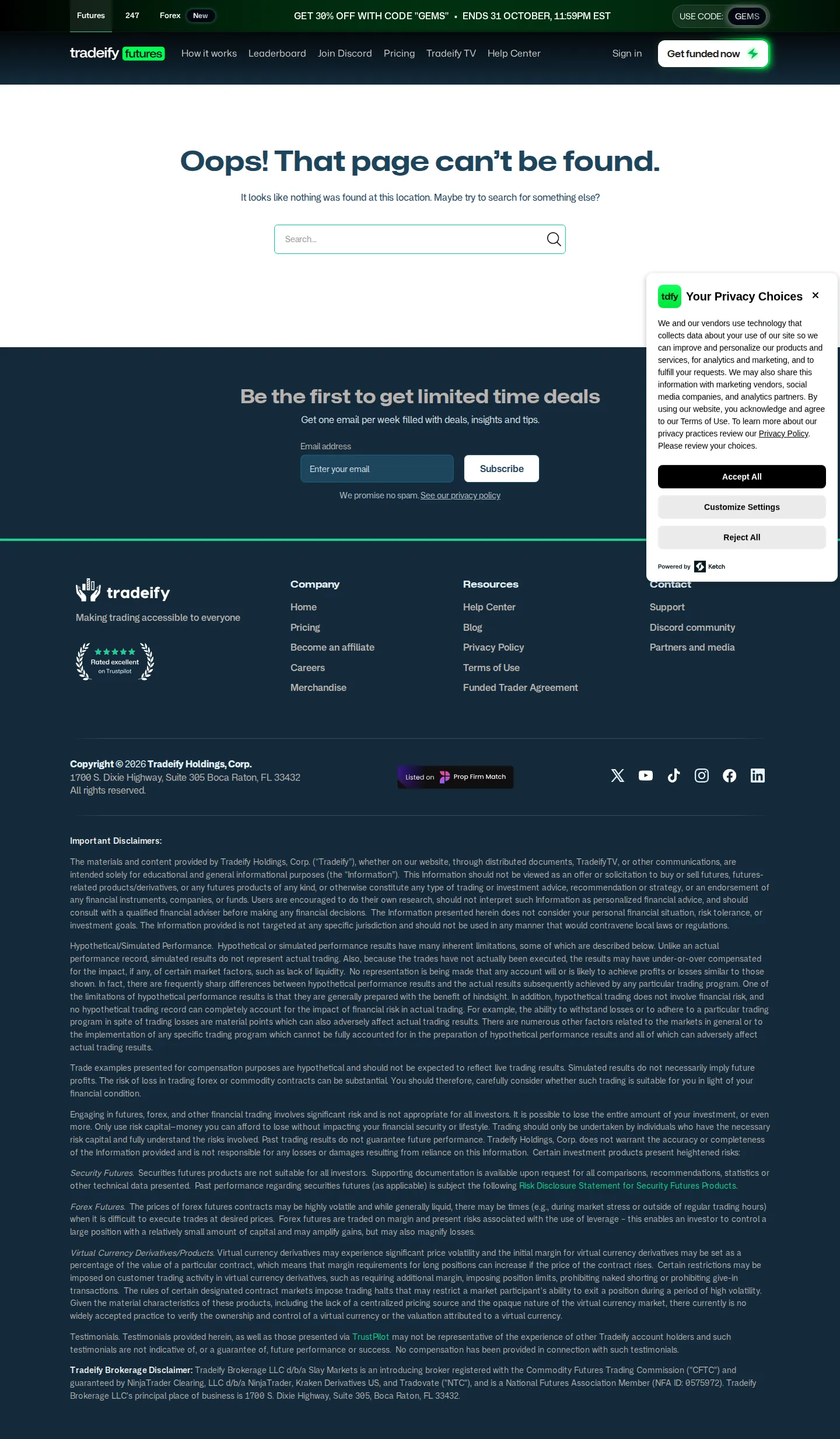
Pages captured from Tradeify’s own site when this review was written. Brokers change their terms; these are what we read.



FAQ
Is Tradeify regulated?
Not the company that sells the challenges: its agreement says Tradeify Holdings is not registered with any US futures regulator in any capacity. Its affiliate Tradeify Brokerage LLC, trading as Slay Markets, is an NFA member and CFTC registered introducing broker (NFA ID 0575972), confirmed on NFA’s BASIC register, but it only comes in if Tradeify moves a trader to a live account.
Is Tradeify a registered company?
Yes. Florida’s Division of Corporations lists Tradeify Holdings, Corp (P25000043724) as active, with its principal address in Cedar City, Utah. Its payment agent, Novaflame LTD, is a registered Cyprus company (HE 480295).
How much does it cost to get a funded account with Tradeify?
The cheapest 100K challenge is Growth at a USD 255 list price, a one time fee with no activation fee, shown at USD 179 with a code. Select lists at USD 265 and the instant Lightning account at USD 660.
How many Tradeify traders get paid?
Its own Trader Performance Statistics say 28.5% of individual participants at the funded level received a payout, and 3.0% reached a live account.
What platforms does Tradeify support?
TradingView, Tradovate, WealthCharts, Rithmic, Tradesea, Quantower, R|Trader and NinjaTrader.
What do traders say about Tradeify?
Trustpilot rates it 4.5 from 6,088 reviews, with no Trustpilot warning on the profile. Tradeify publishes no app of its own.
How this review works
Track Tradeify live: score moves and red notices, in your pocket.