
PROP · CHECKED 25 OCT 2026
Lucid Trading review.
US-based proprietary trading firm offering funded-account challenges, unlicensed by any regulator
OK-ISH
OUT OF 10
Lucid Trading is a US prop trading firm, registered as Lucid Trading Group LLC in Delaware with a Dover address. No financial regulator licenses this kind of simulated-futures activity, so the missing licence isn't unusual for the category. The main concern: its terms restrict use to US persons, yet the firm serves localized pages to ten other countries, leaving non-US clients' legal standing unclear.
Each criterion is scored 1 to 10 from primary sources. The overall score is their unweighted mean. How scoring works.
| Minimum deposit | Not stated |
|---|---|
| Platforms | TradingView, NinjaTrader, Tradovate, Quantower, Tradesea, MotiveWave, Sierra Chart, Jigsaw |
- The cheapest 100K challenge, the Daily Eval, lists at USD 200 as a one time fee, with no monthly subscription or funded account activation fee (USD 120 with a code)
- Twelve platforms through CQG and Rithmic, including NinjaTrader, Tradovate, TradingView, Quantower and Sierra Chart
- Trustpilot rates it 4.5 from 7,753 reviews with no Trustpilot warning, and its own app averages about 4.6 on the App Store and Google Play
- Its terms say plainly that trading is simulated and the funds are fictitious
- Support by email and live chat, 24 hours a day on weekdays
- No financial licence of any kind; its terms say it is not a broker dealer and does not offer financial advice
- Its terms say the website is for use only by persons located in the United States, yet it serves localized pages to the UAE, UK, Australia, Germany, Japan, Singapore, Thailand, Vietnam, Indonesia and South Africa
- Reset fees after a failed evaluation run from USD 45 to USD 255 depending on plan and size
- Its terms bar named trading styles, including hedging, microscalping and high frequency trading, at Lucid's sole discretion, and let it remove offending trades
- Support covers five days a week, not weekends
- Disputes go to arbitration under American Arbitration Association rules applying Delaware law
Overview
TrueBroker is a free broker safety checker, and this page is our review of Lucid Trading, scored 6.2 out of 10 across regulation, fees, platform, support and reviews. Lucid Trading is a simulated trading and futures “prop firm,” meaning clients pay to trade an evaluation account and, if they pass, are funded with the firm’s capital rather than their own. The operating entity named in its own terms is Lucid Trading Group LLC, which the terms describe as based in Delaware, with an address given as 3500 S Dupont Hwy, Dover, DE 19901.
Overview Table
| Headquarters | Dover, Delaware, United States (3500 S Dupont Hwy Dover DE 19901), per the firm’s terms and conditions |
| Established | Not stated |
| Countries Served | The site serves localized pages for Indonesia, Thailand, Vietnam, Singapore, Japan, the UAE, South Africa, the UK, Germany and Australia, while its own terms and conditions state the Website is “for use only by persons located in the United States” |
| Regulated By | Not stated |
| Minimum Deposit | Not stated |
| Maximum Leverage | Not stated |
| Total Instruments | Futures only, per the firm’s own marketing; no instrument count is stated |
| Platforms | TradingView, NinjaTrader, Tradovate, Quantower, Tradesea, MotiveWave, Sierra Chart, Jigsaw, Bookmap, ATAS, R|Trader Pro and MultiCharts |
| Customer Support | Live chat (usual response time 2 to 4 hours) and email at support@lucidtrading.com, with “24 Hour Support, 5 Days a Week” running Monday through Friday |
| Languages | Not stated |
Facts List
- The operator named in the firm’s terms and conditions is Lucid Trading Group LLC, based in Delaware.
- The firm’s own terms restrict the Website to “persons located in the United States,” even though localized pages are served for Indonesia, Thailand, Vietnam, Singapore, Japan, the UAE, South Africa, the UK, Germany and Australia.
- The account types pages list four evaluation types: Pro Eval, Flex Eval, Daily Eval and Direct (instant funding, no evaluation).
- Pro Eval’s account activation fee is listed as “FREE,” and the site FAQ states accounts are “a one time fee” with “no monthly subscriptions.”
- Reset fees for a failed Pro Eval range from $75 on the 25K account up to $255 on the 150K account, varying by account size.
- Supported platforms include TradingView, NinjaTrader and Tradovate through CQG, and Quantower, Tradesea, MotiveWave, Sierra Chart, Jigsaw, Bookmap, ATAS, R|Trader Pro and MultiCharts through Rithmic.
- The terms and conditions cap Lucid’s total liability for any claim at the greater of one month’s fees paid or $100.
- The terms give Lucid sole discretion to force a client into binding arbitration, while the client has no equivalent right.
- The terms state fees become non-refundable once trading begins, with refunds considered only “at Lucid’s discretion” in “exceptional circumstances.”
- The site’s own homepage advertises “$700M+ earned by traders” and “500K+ traders,” figures given with no methodology or date range on the page itself.
What Lucid Trading charges to trade and to reset an evaluation
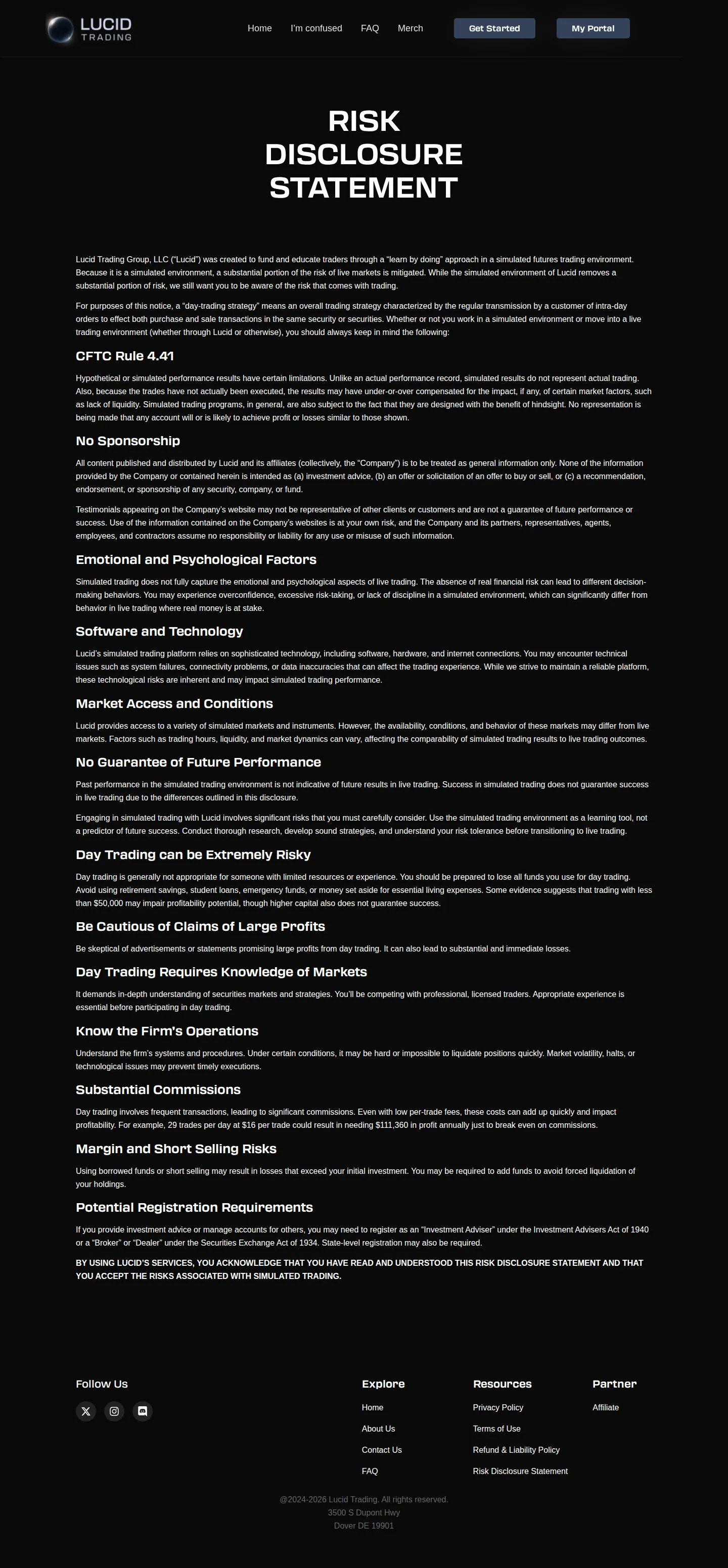
Lucid Trading’s own account type pages list the Pro Eval activation fee as “FREE,” and the site’s FAQ states: “No monthly subscription or funded account activation fees,” adding “All of our accounts are a one time fee, we do not have monthly subscriptions for trading accounts.” Where the evaluation itself fails, the published reset fees differ by plan and by account size. For Pro Eval, the reset fee runs from $75 on the 25K account to $120 on the 50K account, $190 on the 100K account and $255 on the 150K account. For Flex Eval, the fee runs from $45 to $225 across the same four sizes, and for Daily Eval, from $60 to $200. The firm’s risk disclosure statement also carries a worked example of how day trading commissions compound, citing 29 trades a day at $16 per trade and concluding this “could result in needing $111,360 in profit annually just to break even on commissions.” That example illustrates commission risk generally; it is not presented as Lucid’s own commission schedule.
What Lucid Trading’s terms say if a dispute arises
The terms and conditions set a liability cap under the heading “Limitation on Liability”: Lucid’s total liability for any claim is capped at the greater of (A) the amount paid by you to us in the immediately preceding month for our products or services, or (B) $100.00. The “Governing Law and Jurisdiction” clause requires disputes to be brought in Delaware courts, while Lucid retain[s] the right to bring any suit, action, or proceeding against you… in your country of residence or any other relevant country. Under “Arbitration,” Lucid may, “at Company’s sole discretion,” force a dispute into binding arbitration under American Arbitration Association rules applying Delaware law, a right the client does not hold in reverse. The “Wavier of Class Action Rights” clause has both sides waive class actions and jury trials, and “Limitation on Time to File Claims” bars any claim not brought within one year of when it accrued. Separately, under “Prohibited Uses,” Lucid can treat trading it judges “disruptive” (its examples include spoofing, microscalping, hedging and high frequency trading) as grounds to “remove the transactions that violate the prohibition from your trading history and/or not count their results in the profits and/or losses.”
How Lucid Trading describes the funds in an evaluation account
Under the “Commodity Futures Trading Commission Disclaimer,” Lucid’s terms state that evaluation and simulated-funded trading uses “fictitious” funds, that the client has no right to possess those fictitious funds, and that “you will not be paid any remuneration or profits based on the results of your fictitious trading, nor will you be required to pay any losses” unless Lucid separately agrees otherwise. The terms also disclaim regulatory status outright under “Not a Broker-Dealer,” stating Lucid is not a broker-dealer, does not trade securities on anyone’s behalf and does not offer financial advice. Separately, the terms allow Lucid to withdraw or amend the Website, or disable a client’s account access, “in our sole discretion… for any or no reason,” including termination “without any compensation or refunds.”
Key Takeaways
The regulation score sits at 3 out of 10. Lucid Trading Group LLC is a Delaware company trading simulated funds, and nothing in the evidence shows a licence or registration with any regulator. Fees score 8.3 and platform 6.6, both of which hold up against the detail below, but the contract terms carry real weight against a trader signing up anywhere outside the United States.
What Lucid Trading charges
- The homepage lists the Account Activation Fee as “FREE” on the Pro Eval plan cards, and the site-wide FAQ states “No monthly subscription or funded account activation fees.”
- The same FAQ answers “Do I have to pay monthly for my accounts?” with “No. All of our accounts are a one-time fee, we do not have monthly subscriptions for trading accounts.”
- Reset fees on a failed Pro Eval account run $75 for the 25K size, $120 for 50K, $190 for 100K and $255 for 150K, per its homepage pricing table.
- Reset fees on a failed Flex Eval account run $45 (25K), $80 (50K), $150 (100K) and $225 (150K), per its homepage pricing table.
- Reset fees on a failed Daily Eval account run $60 (25K), $85 (50K), $140 (100K) and $200 (150K), per its homepage pricing table.
- The firm’s own Risk Disclosure Statement, read directly, gives an illustrative example of 29 trades a day at $16 per trade, noting this “could result in needing $111,360 in profit annually just to break even on commissions.” That is a generic worked example in the risk disclosure, not Lucid’s own commission schedule, and should not be read as what Lucid actually charges per trade.
- Once an account is purchased and trading, simulated or otherwise, has started, the terms we read state plainly “you are not entitled to a refund of any fees paid to Lucid”; any refund after that point is granted at Lucid’s discretion… under exceptional circumstances rather than as a matter of right.
Accounts and what they trade
The evaluation lineup runs Pro Eval, Flex Eval, Daily Eval and Direct (instant funding), each offered at 25K, 50K, 100K and 150K sizes, trading futures sized in Mini and Micro contracts. Flex Eval and Daily Eval carry a stated consistency rule of 40% or 50% depending on size; Direct carries a 20% consistency rule, a minimum of 5 days to payout, and a maximum of 5 accounts, with a tiered “LucidScale DLL” drawdown structure. A footer notice on accounts using the Rithmic feed states those accounts “are activated on Sunday prior to 5PM CST.”
Platform access
Its help centre lists a wide platform roster across the firm’s two data routes: TradingView, NinjaTrader and Tradovate on the CQG side, and Quantower, Tradesea, MotiveWave, Sierra Chart, Jigsaw, Bookmap, ATAS, R|Trader Pro and MultiCharts on the Rithmic side. That breadth is reflected in the 6.6 platform score. It is worth noting that this full pricing and platform detail was only recoverable from a rendered browser capture of the GB page; the equivalent AU, DE, ID, JP, SG, TH and VN root pages show only plan names with no prices in their plain static HTML.
Support channels
The AE contact page offers live chat, described as “Real humans ready to help” with a Quick Response, Usually 2 to 4 hours turnaround, plus an email address, support@lucidtrading.com, named in the terms for technical support and other correspondence. The same contact page also describes 24 Hour Support, 5 Days a Week… available Monday through Friday, two claims about availability that sit oddly next to each other on the page we read. A 5.8 support score reflects a channel set that exists but comes with that unresolved contradiction.
The terms every trader is bound by
- The terms state the firm serves US persons only: “We provide this Website for use only by persons located in the United States.” Yet the same company serves fully localized, geo-targeted pages for the UAE, Australia, the UK, South Africa, Germany, Japan, Singapore, Thailand, Indonesia and Vietnam. A trader onboarding through any of those pages is agreeing to terms that describe a service meant only for a country they may not be in.
- Liability is capped, in the terms we read, at the greater of (A) the amount paid by you to us in the immediately preceding month for our products or services, or (B) $100.00, regardless of the size of an actual loss or how clearly Lucid was at fault.
- Disputes are governed by Delaware law and must be filed in US federal court or Delaware state court, while Lucid retain[s] the right to bring any suit, action, or proceeding against you… in your country of residence or any other relevant country, an arrangement that only runs one way.
- Lucid alone decides whether to force a dispute into binding arbitration under American Arbitration Association rules; both sides waive class actions and jury trials.
- Any claim against Lucid “must be commenced within one (1) year after the cause of action accrues,” after which it is “permanently barred,” regardless of when the trader actually discovers the problem.
- Lucid can disable a trader’s account access “at any time in our sole discretion for any or no reason,” including termination “without any compensation or refunds.”
- Under “Prohibited Uses,” Lucid can judge a trade pattern, such as microscalping, hedging or high frequency trading, as disruptive “in Lucid’s sole discretion” and then remove the transactions… from your trading history and/or not count their results in the profits and/or losses, after the fact.
- Lucid can bar a trader from an earned reward for publicly disparaging “Lucid or its products or services, Lucid’s competitors or their products or services, or any other person or party affiliated with Lucid,” and can alter or cancel any Reward earned by you… for no consideration and without any notice.
- Material a trader posts to the Website or Discord is treated as “non-confidential and non-proprietary,” with Lucid granted the right to “use, reproduce, modify, perform, display, distribute, and otherwise disclose to third parties any such material for any purpose.”
- Before a trader reaches live funding, the terms describe evaluation and sim-funded trading funds as “fictitious,” stating the trader has no right to possess those fictitious funds and will not be paid on simulated results unless Lucid separately agrees otherwise.
- The terms state outright that Lucid is “not a ‘Broker-Dealer’” and does not offer financial advice, meaning none of the protections tied to a registered broker-dealer or adviser relationship apply here.
- Our reviews score of 7.5 blends Trustpilot with ratings of the firm’s own app. Trustpilot rates lucidtrading.com 4.5 stars across 7,753 reviews, with no Trustpilot warning on the profile. The Lucid Trading App, published by Lucid Trading Group LLC, averages 4.51 across 172 App Store ratings and 4.71 across 92 Google Play ratings (checked 24 Oct 2026).
Where this leaves a trader
No licence or registration for Lucid Trading Group LLC turned up in the material we reviewed, and the regulation score of 3 reflects that plainly. The fee structure, read directly from the firm’s own pages, is comparatively straightforward: one time payment, no subscription, published reset fees by account size, and discretionary rather than guaranteed refunds. The platform list is genuinely broad. The part that should give a prospective trader pause is contractual: a US-only terms of service wrapped around a globally marketed product, a liability cap pinned to one month’s fees or $100, a one year filing deadline, and several clauses, on prohibited trading styles, on rewards, on account termination, that leave Lucid with sole discretion and the trader with little recourse.
Licenses & Regulation
Lucid Trading is run by Lucid Trading Group LLC, with an address given as 3500 S Dupont Hwy, Dover, DE 19901. That is the only entity named in the material we read. We have no register verdict on this firm to report. What follows is what the firm’s own terms and fee pages say about who it is and what a client is agreeing to, read directly rather than summarized.
Lucid’s terms state plainly that it is “not a Broker Dealer” and that it does “not trade securities on our or another party’s behalf,” nor does it offer financial advice. The site also carries a Commodity Futures Trading Commission disclaimer that the funds used in evaluation and simulated trading are “fictitious,” that the client has no right to possess those fictitious funds, and that no remuneration is owed on simulated results unless Lucid separately agrees otherwise. Read together, this is a firm that is explicit about operating a simulated evaluation product rather than claiming any brokerage, investment adviser, or futures commission merchant status, and a client gets none of the protections that would come with dealing with a registered broker dealer or adviser, because Lucid’s own terms rule that status out.
Who Lucid Trading says it will serve, and who it actually markets to
The terms we read contain a “Geographic Restrictions” clause stating: “The owner of the Website is based in the State of Delaware in the United States… We provide this Website for use only by persons located in the United States. We make no claims that the Website or any of its content is accessible or appropriate outside of the United States.” The same terms require a live trading client to warrant, via a W8 BEN, that all of their trading activity is being performed and will be performed from outside the United States. Against that, the site itself serves localized pages for Indonesia, Thailand, Vietnam, Singapore, Japan, the UAE, South Africa, the UK, Germany and Australia. A client who signs up through one of those localized pages is agreeing to terms that say the website is for US persons only and disclaims any responsibility for its legality where that client actually lives, while the live account terms separately require the client to confirm their trading is being done from outside the US. That is a direct tension in the firm’s own documents between whom it says it operates for and whom it visibly sells to, and it leaves a non-US client’s contractual footing unclear.
What the terms let Lucid Trading do once a client has paid
The liability clause in Lucid’s terms caps its total exposure for any claim, however based, at the greater of (A) the amount paid by you to us in the immediately preceding month for our products or services, or (B) $100.00. Disputes are governed by Delaware law and must be brought in federal courts of the United States or Delaware state courts, though the terms add that Lucid retain[s] the right to bring any suit, action, or proceeding against you for breach of these Terms of Use in your country of residence or any other relevant country. That is a one way street: the client goes to Delaware, Lucid can come to the client. The Arbitration clause gives Lucid, “at Company’s sole discretion,” the right to force any dispute into binding arbitration under American Arbitration Association rules applying Delaware law, a right the client does not hold in reverse. A separate clause waives both parties’ right to a class action and to a jury trial, and a time bar clause requires that any cause of action or claim… must be commenced within one (1) year after the cause of action accrues, after which it is “permanently barred.”
On refunds, the terms state that once an account is purchased and trading, simulated or otherwise, has begun, “you are not entitled to a refund of any fees paid to Lucid,” with any refund left to “Lucid’s discretion… under exceptional circumstances.” On account access, the terms give Lucid the right to withdraw or amend this Website… in our sole discretion without notice and to disable any username, password, or other identifier… at any time in our sole discretion for any or no reason, including termination “without any compensation or refunds.” The Prohibited Uses clause lets Lucid judge, at its “sole discretion,” what counts as a disruptive trading practice, naming spoofing, microscalping, hedging and high frequency trading as examples, and for a violation it may “remove the transactions that violate the prohibition from your trading history and/or not count their results in the profits and/or losses.” Under the Rewards clause, Lucid can bar a client from an earned reward for disparaging “Lucid or its products or services, Lucid’s competitors or their products or services, or any other person or party affiliated with Lucid,” and may alter or cancel any Reward earned by you… for no consideration and without any notice. The User Contributions clause treats anything a client posts to the website or Discord as “non confidential and non proprietary,” with Lucid granted the right “to use, reproduce, modify, perform, display, distribute, and otherwise disclose to third parties any such material for any purpose,” and feedback sent to support@lucidtrading.com is “irrevocably assign[ed]” to Lucid outright.
None of this is a licensing or registration question, since Lucid’s terms do not claim any licence for us to check against a register. It is a question of what a client signs up to once they hand over the evaluation fee: a one sided forum and arbitration arrangement, a liability cap set at a month’s fees or $100, a non refundable purchase, and broad, Lucid controlled discretion over account access, trade results and earned rewards.
How to Trade
Lucid Trading markets itself as a futures prop firm. The site’s own root page bills it as “The Best Prop Firm For Futures,” and account sizing throughout is expressed in futures contract units, “Mini” and “Micro,” rather than lots or units of currency.
Evaluation structure
Lucid’s pricing page sets out four evaluation paths, each sold in 25K, 50K, 100K and 150K account sizes. The Pro Eval gives a trader one day pass and three days to payout, with no consistency rule mentioned and an end of day drawdown type; maximum size runs from 2 to 10 Mini contracts or 20 to 100 Micro contracts depending on account size, per the firm’s own root page. The Flex Eval, per the firm’s homepage pricing table, gives two or three day passes, five days to payout, and a consistency requirement of 40% or 50%, also on an end of day drawdown type. The Daily Eval adds daily payouts, two or three days to payout, the same 40% or 50% consistency rule, and a choice between end of day or intraday drawdown during the evaluation. A fourth option, Direct, skips the evaluation stage entirely for instant funding, with five days to payout, a 20% consistency rule, a minimum of five days to payout, and a cap of five accounts; it runs what the pricing page calls a “LucidScale DLL” tiered drawdown that sits above the initial trail, set at 60% of peak end of day balance on the 50K, 100K and 150K sizes and none on the 25K size.
What it costs to open and reset an account
The Pro Eval plan cards state the account activation fee is free, and the site’s own FAQ says the same thing more broadly: “No monthly subscription or funded account activation fees.” The FAQ also answers a direct question on recurring charges: “Do I have to pay monthly for my accounts? No. All of our accounts are a one time fee, we do not have monthly subscriptions for trading accounts.” That one time structure cuts the other way when an evaluation is failed. The root page lists Pro Eval reset fees of $75 on the 25K size, $120 on 50K, $190 on 100K and $255 on 150K. Its homepage pricing table lists separate reset fee schedules for the other two evaluation types: Flex Eval resets run $45, $80, $150 and $225 across the same four sizes, and Daily Eval resets run $60, $85, $140 and $200. A trader who fails repeatedly pays each time, on a schedule that rises with account size.
The firm’s risk disclosure statement, read separately from the pricing pages, includes an illustrative example of how per-trade commissions can compound in live trading: 29 trades a day at $16 per trade, which the disclosure says “could result in needing $111,360 in profit annually just to break even on commissions.” That figure is the risk disclosure’s own worked example of commission drag in general, not a schedule of what Lucid itself charges per trade.
Platforms available to trade on
Lucid’s help centre lists platform support split across two data feed providers. On the CQG side, it names TradingView, NinjaTrader and Tradovate as compatible with all Lucid account types. On the Rithmic side, it lists Quantower, labeled a “Lucid Partner,” alongside Tradesea, MotiveWave, Sierra Chart, Jigsaw, Bookmap, ATAS, R|Trader Pro, described as the “official Rithmic platform,” and MultiCharts. The firm’s footer notice on account activation ties funding timing to the data feed itself: “Accounts using Rithmic are activated on Sunday prior to 5PM CST.”
Rules that bind a position
Lucid’s own terms of use, which we read directly, place real limits on how a position or an account can be traded once it is open. The “Prohibited Uses” clause lets Lucid flag “disruptive practices… as determined in Lucid’s sole discretion, including but not limited to spoofing strategies, microscalping, hedging, and high frequency trading,” and for any such violation the firm may “remove the transactions that violate the prohibition from your trading history and/or not count their results in the profits and/or losses.” That means a trade Lucid later decides falls into one of those categories, categories it does not tightly define, can be stripped from the account’s results after the fact.
The terms also cap exposure to one account per trader “unless expressly authorized,” with violation risking “termination of all associated accounts and forfeiture of funds or profits,” and separately cap funded traders at five accounts per household, per the root page. Before a trader reaches live funding, the terms’ Commodity Futures Trading Commission disclaimer states that evaluation and simulated funds are “fictitious,” that the trader has no right to possess those fictitious funds, and that “you will not be paid any remuneration or profits based on the results of your fictitious trading, nor will you be required to pay any losses” unless Lucid separately agrees otherwise. In practice, nothing earned during an evaluation has value until Lucid chooses to move a trader onto a live funded account.
Lucid also reserves broad, one sided discretion over account access itself. The terms state Lucid can disable any username, password, or other identifier… at any time in our sole discretion for any or no reason, and that it can terminate account access “without any compensation or refunds.” Once trading, simulated or otherwise, has begun on a purchased account, the terms say “you are not entitled to a refund of any fees paid to Lucid,” with any refund left to “Lucid’s discretion… under exceptional circumstances.”
Account Types
Lucid Trading sells four account types, all under the same pricing logic: a one-time fee to buy in, no recurring charge after that. The firm’s FAQ puts it plainly: “Do I have to pay monthly for my accounts? No. All of our accounts are a one-time fee, we do not have monthly subscriptions for trading accounts.” The same page lists the Account Activation Fee on the Pro Eval cards as “FREE,” and repeats site-wide that there are “No monthly subscription or funded account activation fees.”
The four Lucid Trading account types
Pro Eval, sized at 25K, 50K, 100K and 150K, gives a trader one day pass and three days to payout, runs an end-of-day drawdown type, and caps position size between 2 and 10 Mini contracts or 20 to 100 Micro contracts depending on account size, according to the firm’s own account pages.
Flex Eval, in the same four sizes, runs a two or three day pass with five days to payout, an end-of-day drawdown type, and a consistency rule set at 40% or 50% depending on size, per the firm’s pricing page.
Daily Eval also comes in 25K, 50K, 100K and 150K, pays out daily with a two or three day minimum to payout, a consistency rule of 40% or 50%, and a drawdown type the pricing page lists as either end-of-day or intraday depending on the plan.
Direct skips the evaluation stage entirely for instant funding, with five days to payout, a 20% consistency rule, a minimum of five days to payout and a cap of five funded accounts. Above the initial trailing drawdown, Direct accounts move onto what the pricing page calls the “LucidScale DLL” tiered drawdown, locking in 60% of the peak end-of-day balance on the 50K, 100K and 150K sizes; the pricing page states the 25K Direct size carries no such tier.
What a failed evaluation costs to redo
None of the four account types above are a one-shot purchase if a trader fails: Lucid Trading charges a separate reset fee to restart a failed evaluation, and the amount scales with account size. The firm’s root pricing page lists Pro Eval resets at $75 for 25K, $120 for 50K, $190 for 100K and $255 for 150K. The pricing page for Flex Eval lists resets at $45, $80, $150 and $225 across the same four sizes, and Daily Eval resets at $60, $85, $140 and $200. Direct, being instant-funded rather than an evaluation, is not listed with a reset fee on either page.
How Lucid Trading takes payment, and what happens to the fee
Lucid Trading’s terms of use state that it accepts “payments via personal credit cards and personal debit cards through our Website,” worked through third-party payment processors, and require that the cardholder be an authorized signatory and that the payment method belong personally to the person using it.
We read the terms and conditions directly, and the refund language there cuts against the “free to activate” framing on the pricing pages: once an account is purchased and trading, simulated or otherwise, begins, the terms state “you are not entitled to a refund of any fees paid to Lucid.” A refund is only considered at Lucid’s discretion… under exceptional circumstances. So the eval fee itself is non-refundable as a matter of course once a trader starts; refund is a discretionary exception rather than a right written into the purchase.
The same terms frame what a trader is actually buying before reaching a funded, live-paying stage. Under the Commodity Futures Trading Commission disclaimer, evaluation and simulated-funded trading uses “fictitious” funds, the trader has no right to possess those fictitious funds, and “you will not be paid any remuneration or profits based on the results of your fictitious trading, nor will you be required to pay any losses” unless Lucid separately agrees otherwise. The eval fee buys access to a simulated account and the chance to be funded live, not a claim on whatever the simulated account shows as profit.
Account limits that sit alongside the price
The terms also cap how many of these accounts a trader can hold at once: “Unless expressly authorized, you are restricted to one account. Violation of this policy may result in termination of all associated accounts and forfeiture of funds or profits.” Separately, the root pricing page caps funded traders at five funded accounts per household, which matches the Max Accounts figure of 5 listed against the Direct plan.
One pricing detail is worth flagging for anyone comparing plans across country pages: the localized root page we fetched for the UAE renders numeric pricing directly in its static HTML, for instance listing the 25K Pro Eval as a one-time fee of $108. The equivalent root page fetched for other country variants showed only plan names with no prices in the plain HTML; the detailed reset-fee and consistency-rule figures used above came from a separately rendered pricing page rather than from those country roots. Anyone relying on a quick fetch of those other country pages would see no numbers at all.
Negative Balance Protection
What governs loss limits here is the drawdown rule attached to each evaluation and funded account, and the Commodity Futures Trading Commission Disclaimer in the firm’s own terms, which we read in full.
Drawdown rules by account type
The accounts we found on Lucid’s pricing pages use an end of day drawdown type on the Pro Eval tier, with no consistency rule mentioned for that tier. The Flex Eval and Daily Eval tiers add a consistency requirement of 40% or 50%, and the Daily Eval’s drawdown can run on an end of day or intraday basis depending on the plan chosen. The Direct accounts, which skip the evaluation step for instant funding, carry their own structure: a 20% consistency rule, a minimum of 5 days to payout, a cap of 5 accounts per trader, and what the pricing page calls a “LucidScale DLL” tiered drawdown that sits above an initial trail. On the 50K, 100K and 150K Direct accounts that trail is set at 60% of the peak end of day balance; the 25K Direct account carries none of that tiered mechanism. We are reporting the labels and numbers as the pricing page states them; the page does not spell out, in the material we pulled, exactly how a breach of each rule is processed account by account.
What breaching an evaluation costs: Lucid’s reset fees
Failing an evaluation does not end a trader’s attempt outright. Lucid’s own pricing pages list a reset fee for each eval type and size, and the fee scales with account size. For the Pro Eval, a reset costs $75 on the 25K account, $120 on 50K, $190 on 100K and $255 on 150K. The Flex Eval reset is cheaper: $45 on 25K, $80 on 50K, $150 on 100K and $225 on 150K. The Daily Eval reset runs $60 on 25K, $85 on 50K, $140 on 100K and $200 on 150K. In other words, breaching the drawdown or consistency rule on a given evaluation is not free: it is a paid restart, priced per account tier, and the fee is separate from whatever the trader paid to enter the evaluation in the first place.
The Commodity Futures Trading Commission Disclaimer
Lucid’s own terms, which we read directly, state plainly that evaluation and simulated funded trading involves “fictitious” funds and that the trader has no right to possess those fictitious funds. The same clause goes on to say the trader “will not be paid any remuneration or profits based on the results of your fictitious trading, nor will you be required to pay any losses” unless Lucid has expressly agreed otherwise. Read against the drawdown and consistency rules above, this means the loss limits attached to an eval or Direct account are not protecting real capital in the way a margin call protects a funded brokerage account. There is no money at risk for the trader in the simulated stage beyond the fee paid to enter or reset it, and no money owed back to Lucid if a simulated account runs its balance to zero. The drawdown rule’s function, on the evidence we have, is to end that attempt and trigger a reset fee rather than to limit a client’s real-money loss.
Refunds once trading has started
Lucid’s terms also address what happens to the money already paid for an account once trading begins, simulated or otherwise: the terms state a trader is not entitled to a refund of any fees paid to Lucid once trading has started, and that any refund thereafter is considered only at Lucid’s discretion… under exceptional circumstances. So a trader who breaches a drawdown rule early in an evaluation has no contractual right to get the entry fee back; the reset fee schedule above is the paid path forward, not a refund.
What we could not find in this material
The pages we pulled give the drawdown type, the consistency percentage, and the reset fee for each eval tier, and they name the “LucidScale DLL” trail mechanism for Direct accounts. They do not, in the material we fetched, state a maximum daily loss figure in dollar terms for each tier, nor do they describe the mechanics of how a breach is detected or enforced intraday versus at end of day beyond the drawdown type label itself. We are reporting what the pricing pages and terms say, not filling in the mechanics they leave out.
Trading Instruments
Lucid sells access to simulated futures accounts, not to a broker book of instruments. The firm’s own account pages market plan sizes in “Mini” and “Micro” contracts, and describe itself as “The Best Prop Firm For Futures,” per the firm’s UAE home page. The product on offer is futures contracts, sized by account tier, traded through third-party platforms connected via CQG or Rithmic data feeds.
The account tiers themselves set the trading limits rather than any instrument list. The 25K, 50K, 100K and 150K Pro Eval accounts carry a maximum size of 2 to 10 Mini contracts or 20 to 100 Micro contracts depending on the tier, per the firm’s UAE home page. The Flex Eval and Daily Eval tiers at the same four sizes add a consistency rule of 40% or 50% and an end of day or intraday drawdown type, per the firm’s UK pricing plans page. The Direct accounts skip the evaluation step entirely and move straight to instant funding, with a consistency rule of 20%, a minimum of 5 days to payout, a cap of 5 funded accounts, and what the pricing page calls a “LucidScale DLL” tiered drawdown sitting at 60% of peak end of day balance on the 50K, 100K and 150K sizes, with none applied on the 25K size, per the firm’s UK pricing plans page.
How Lucid Trading connects traders to the market
Lucid does not run its own trading terminal. Its help centre lists platform access as the mechanism by which traders reach the futures market, split by data feed. Through CQG, the page lists TradingView, NinjaTrader and Tradovate as compatible across all account types. Through Rithmic, it lists Quantower (flagged on the page as a “Lucid Partner”), Tradesea, MotiveWave, Sierra Chart, Jigsaw, Bookmap, ATAS and R|Trader Pro, the last described on the page as the “official Rithmic platform,” per the firm’s UK pricing plans page. MultiCharts also appears on the Rithmic list, linked to multicharts.com rather than to Lucid’s own domain. A footer notice on the root page adds an operational detail that matters for anyone timing a weekend trade: “Accounts using Rithmic are activated on Sunday prior to 5PM CST,” per the firm’s UAE home page.
That is a wide spread of platform names for a single firm to support, and the pages we fetched draw a line of responsibility between Lucid and the data vendor rather than between Lucid and the trader: the platforms sit under either the CQG or the Rithmic banner, with Lucid adding only the “Partner” label to Quantower. We did not fetch a page explaining what happens if a chosen platform goes down, or whether support for any of the twelve listed applications differs in practice.
What the evaluation actually funds
The contractual language behind these account tiers is worth reading alongside the marketing copy, because the two describe different things. Lucid’s own terms, under the heading “Commodity Futures Trading Commission Disclaimer,” state that evaluation and simulated-funded trading uses funds that are “fictitious,” that the client has no right to possess those fictitious funds, and that “you will not be paid any remuneration or profits based on the results of your fictitious trading, nor will you be required to pay any losses” unless Lucid separately agrees otherwise, per the firm’s terms. So the asset being purchased at the Pro Eval, Flex Eval and Daily Eval stage is not exposure to futures prices in any financial sense; it is a seat in a simulation that may or may not convert to a funded, live arrangement.
The same terms add a “Not a Broker-Dealer” clause stating we are not a ‘Broker-Dealer’… and that we do not trade securities on our or another party’s behalf… nor do we directly offer any financial advice of our own, per the firm’s terms. Read together with the Mini and Micro contract sizing, the picture the evidence supports is a performance-and-rules product layered on top of futures data and execution infrastructure supplied by CQG and Rithmic, rather than Lucid itself acting as the counterparty or broker on the trades.
A further restriction shapes what a funded trader can actually do with that access. The terms list “Prohibited Uses” that bar, at Lucid’s “sole discretion,” a set of named trading styles including “spoofing strategies, microscalping, hedging, and high frequency trading,” and state that for a violation Lucid may “remove the transactions that violate the prohibition from your trading history and/or not count their results in the profits and/or losses,” per the firm’s terms. That clause reaches past the choice of instrument and into the choice of strategy, so the asset on offer comes with conditions on how it can be traded, decided unilaterally and after the fact.
No minimum deposit figure appears in the account data we pulled for any of the twelve tiers (four sizes across Pro Eval, Flex Eval, Daily Eval and Direct), and the fee schedule we read covers activation, reset and monthly charges rather than a deposit requirement, so we are not stating one.
Education & Analysis
Lucid Trading sells itself as a futures platform, not a broker, so this section is about the data feeds and charting software a trader is routed to, not execution quality on a dealing desk. The firm’s own pricing page lists two data backbones, CQG and Rithmic, and names the third-party platforms that connect to each.
The platforms Lucid Trading connects to
On the CQG side, the firm’s pricing page names TradingView, NinjaTrader and Tradovate as compatible with all Lucid account types. On the Rithmic side it names Quantower (tagged “Lucid Partner” on the page), Tradesea, MotiveWave, Sierra Chart, Jigsaw, Bookmap, ATAS, R|Trader Pro (labeled the “official Rithmic platform”) and MultiCharts. None of these are built by Lucid. Lucid’s role, per its own terms and conditions, is narrower than a platform vendor’s: the firm states plainly that it is “not a ‘Broker-Dealer’” and that it does “not trade securities on our or another party’s behalf,” nor does it “directly offer any financial advice of our own.” The charting and order entry happen inside whichever third-party application a trader picks; Lucid supplies the account and the data feed behind it.
What the data feed actually governs
A footer notice on Lucid’s own site ties account activation to the data vendor rather than to Lucid itself: “Accounts using Rithmic are activated on Sunday prior to 5PM CST.” That is a scheduling constraint set by the feed, not by Lucid’s support desk, and it means the choice between a CQG platform and a Rithmic platform is not purely cosmetic. It affects when an account can go live.
The account structure itself is built around futures contract sizing rather than lot sizes or spreads: the evaluation tiers cap “Mini” and “Micro” contract counts (2 to 10 Mini or 20 to 100 Micro, depending on account size, on the Pro Eval tier). Whatever charting package a trader picks, the thing it is charting and ordering against is a futures contract subject to that cap, read through whichever of CQG’s or Rithmic’s feeds the trader’s platform choice connects to.
What we did not find on these pages
The pricing and account pages we read describe platform compatibility by name and by data vendor, and they say nothing about charting features, indicator libraries, backtesting tools, or any analysis functionality built by Lucid itself. The fee material we read covers activation, reset and subscription charges, not platform licensing fees for the third-party software listed above. A trader weighing whether, say, Bookmap’s order flow tools or Sierra Chart’s charting suit their style is choosing among products those companies built and support, not features Lucid designed, priced, or documented on the pages we fetched.
The sole-discretion trading restrictions that sit behind any platform choice
Whichever platform a trader connects through, Lucid’s terms and conditions reserve the right to judge how that platform is used. The “Prohibited Uses” clause bars “disruptive practices… as determined in Lucid’s sole discretion, including but not limited to spoofing strategies, microscalping, hedging, and high frequency trading,” and for a violation Lucid may “remove the transactions that violate the prohibition from your trading history and/or not count their results in the profits and/or losses.” That clause does not name specific platforms, and it applies regardless of whether the trades were placed through TradingView, Quantower, or any of the other ten tools on the list. A trader using a Rithmic-connected tool for high frequency strategies, in particular, is choosing a platform built for exactly the kind of fast execution that Lucid’s own contract terms allow it to retroactively disqualify.
Special Offers
What the pages we fetched for Lucid Trading describe is a pricing structure built around fee waivers, plus a sign-up incentive scheme called Rewards that comes with its own conditions in the firm’s terms.
What Lucid Trading markets as free
The Pro Eval plan cards on Lucid Trading’s own root page list the Account Activation Fee as “FREE,” and the site-wide FAQ on the same page repeats the point: “No monthly subscription or funded account activation fees.” A separate FAQ answer on that page spells out the billing model behind it: “Do I have to pay monthly for my accounts? No. All of our accounts are a one-time fee, we do not have monthly subscriptions for trading accounts.” Both quotes describe a one-time purchase price rather than a time-limited promotional waiver.
That one-time purchase still has a cost attached if the evaluation fails. Its homepage pricing table lists a Reset Fee for every eval type, scaled by account size: $75 on the 25K Pro Eval, rising to $120, $190 and $255 on the 50K, 100K and 150K sizes. The Flex Eval’s reset fee runs $45 to $225 across the same four sizes, and the Daily Eval’s runs $60 to $200. None of the reset-fee figures on that page is marked as discounted or tied to a promotional code.
The Rewards program’s conditions
Lucid Trading’s terms and conditions set out who can actually collect on a Reward. The terms require the account be “an active funded account” that was “not opened with credits/rewards,” and the holder must be “a U.S. citizen or legal U.S. resident 18 years old or older and not listed on the OFAC Specially Designated Nationals and Blocked Persons List.” Those are the eligibility conditions the terms state for earning a Reward at all.
The same terms give Lucid broad, one-sided control over a Reward even after it’s earned. The firm can bar a client from a Reward if, “in its sole discretion,” the client “disparages Lucid or its products or services, Lucid’s competitors or their products or services, or any other person or party affiliated with Lucid.” Separately, once a Reward has been granted, Lucid reserves the right to alter or cancel any Reward earned by you… for no consideration and without any notice. Read together, a client can meet every eligibility condition, earn a Reward, and still have it taken back without payment or warning, including for criticizing the firm or one of its competitors.
What the fee waivers don’t undo
We read Lucid Trading’s terms on refunds directly, and they treat the eval fee as non-refundable once trading starts, regardless of how the activation fee is marketed. The terms state “you are not entitled to a refund of any fees paid to Lucid” once an account is purchased and trading, simulated or otherwise, begins, and that any refund is considered only at Lucid’s discretion… under exceptional circumstances. So the free activation fee and the absence of a monthly charge describe the entry price of the product, not an exit from it: on the wording we read, a trader who buys an eval and starts trading has no standing right to get that money back, only a discretionary exception Lucid may or may not grant.
Put together, the promotional-adjacent material we found on Lucid Trading’s own pages is the activation-fee waiver, the one-time-fee billing structure described in the FAQ, and the Rewards scheme with the eligibility and cancellation terms quoted above. The firm’s own root page also carries headline figures, “$700M+ earned by traders” and “500K+ traders in the trenches,” next to this pricing material, with no methodology or date range disclosed on the page itself.
Opening an Account
Lucid runs its evaluation accounts as a one time purchase. The AE plan cards list an “Account Activation Fee” of “FREE”, and the firm’s site wide FAQ states “No monthly subscription or funded account activation fees” and “All of our accounts are a one-time fee, we do not have monthly subscriptions for trading accounts.” The Pro Eval, Flex Eval, Daily Eval and Direct accounts come in 25K, 50K, 100K and 150K sizes, and the Direct tier skips the evaluation stage entirely in favor of instant funding.
Signing up with Lucid Trading
The terms and conditions we read, published under Lucid Trading Group LLC of 3500 S Dupont Hwy Dover DE 19901, bar anyone who is a convicted felon, anyone disciplined by the NFA or CFTC, or anyone carrying an outstanding balance with a trading firm. Account limits apply once signed up: “Unless expressly authorized, you are restricted to one account. Violation of this policy may result in termination of all associated accounts and forfeiture of funds or profits,” and funded traders are capped at five funded accounts per household.
The terms also contain a restriction worth flagging for anyone signing up outside the United States. Under “Geographic Restrictions” the document states, The owner of the Website is based in the State of Delaware… We provide this Website for use only by persons located in the United States, and adds that “Access to the Website may not be legal by certain persons or in certain countries.” Live trading clients are separately required to warrant, via a W8BEN, that all activities… are being performed and will be performed from outside the United States. We note this because Lucid’s own marketing serves fully localized sign up pages for the UAE, Australia, the UK, South Africa, Germany, Japan, Singapore, Thailand, Indonesia and Vietnam, so a client signing up through one of those pages is agreeing to terms that describe the site as US only.
What Lucid Trading charges to activate and reset an account
Beyond the one time purchase price, the published fee material we read sets out separate reset fees for a failed evaluation, scaled by account size. For the Pro Eval tier, resets run $75 on the 25K account, $120 on 50K, $190 on 100K and $255 on 150K. The Flex Eval tier’s resets are $45, $80, $150 and $225 across the same four sizes, and the Daily Eval tier’s resets are $60, $85, $140 and $200.
Under “Online Purchases; Subscriptions; Payment Details,” the terms state that once an account is purchased and trading, simulated or otherwise, begins, “you are not entitled to a refund of any fees paid to Lucid.” Refunds are only considered, in the document’s own words, at Lucid’s discretion… under exceptional circumstances. Payment is restricted to personal cards: the terms state Lucid accepts “payments via personal credit cards and personal debit cards through our Website,” and require the cardholder to be an authorized signatory on a payment method that is personal to them, through third party payment processors.
What counts as money during the evaluation
The terms and conditions carry a Commodity Futures Trading Commission Disclaimer stating that funds used in evaluation or simulated funded trading are “fictitious,” that the client has no right to possess those fictitious funds, and that the client “will not be paid any remuneration or profits based on the results of your fictitious trading, nor will you be required to pay any losses” unless Lucid separately agrees otherwise. In practical terms, passing an evaluation does not itself create withdrawable funds. It is a precondition to Lucid agreeing, separately, to fund the account live.
The terms also give Lucid broad discretion over what counts as a valid result on the way to that funded stage. Under “Prohibited Uses,” the document lists “disruptive practices… as determined in Lucid’s sole discretion, including but not limited to spoofing strategies, microscalping, hedging, and high frequency trading,” and states that for a violation Lucid may “remove the transactions that violate the prohibition from your trading history and/or not count their results in the profits and/or losses.” A client can clear every numeric target on an evaluation and still have specific trades stripped out after the fact if Lucid judges them disfavored.
Getting out once signed up
Lucid’s terms give the firm, not the client, most of the control over account access going forward. The document states, We reserve the right to withdraw or amend this Website… in our sole discretion without notice, and separately, We have the right to disable any username, password, or other identifier… at any time in our sole discretion for any or no reason. Termination can happen “without any compensation or refunds.” Disputes over any of this are channeled through Delaware law and Delaware or federal US courts, though the terms add that Lucid retain[s] the right to bring any suit, action, or proceeding against you for breach of these Terms of Use in your country of residence or any other relevant country, an arrangement that runs in Lucid’s favor rather than the client’s.
Deposits & Withdrawals
Lucid Trading’s own terms and conditions, which we read in full, set out how a client pays in and when a client does not get paid at all. The rails are narrow, the fee schedule on the pricing pages is fixed and numeric, and several clauses govern payouts in ways that matter more than the sticker price.
How a client pays Lucid Trading
The terms and conditions state how a client funds an account: We accept payments via personal credit cards and personal debit cards through our Website… and utilize the services of certain third party payment processors. The same clause requires that the cardholder be an authorized signatory and that the payment method be personal to them, which rules out paying with a company card or someone else’s card on a client’s behalf. The same terms also refer to other accepted methods of payment that are personal to you, without specifying what those methods are.
What Lucid Trading charges to start and reset an account
The Pro Eval plan cards on the firm’s own root page list “Account Activation Fee: FREE,” and the site-wide FAQ repeats this as a blanket policy: “No monthly subscription or funded account activation fees.” The same FAQ answers the recurring billing question directly: “Do I have to pay monthly for my accounts? No. All of our accounts are a one-time fee, we do not have monthly subscriptions for trading accounts.” So the entry fee is the one-time evaluation purchase, not a subscription.
Failing an evaluation is not necessarily the end of it. The firm’s pricing pages list reset fees that scale with account size and plan type. For the Pro Eval, resetting a failed account costs $75 on the 25K size, $120 on 50K, $190 on 100K and $255 on 150K. The Flex Eval resets cost $45, $80, $150 and $225 at the same four sizes. The Daily Eval resets cost $60, $85, $140 and $200. These are charges to try again after a failed evaluation, paid again by the same personal card rail described above, and they rise with the size of account a client is trying to get funded on.
What actually gets withdrawn
Before a client reaches a live, funded payout, the terms and conditions are explicit about what the money in an evaluation or sim-funded account is worth: the Commodity Futures Trading Commission Disclaimer states that evaluation and simulated trading funds are “fictitious,” that the client has no right to possess those fictitious funds, and that “you will not be paid any remuneration or profits based on the results of your fictitious trading, nor will you be required to pay any losses” unless Lucid separately and expressly agrees otherwise. In practice this means the account balance shown on a Pro Eval, Flex Eval or Daily Eval screen is not withdrawable money; it only becomes a question of actual payout once Lucid agrees to fund the client live, a step the terms describe as discretionary on Lucid’s side rather than automatic on reaching a target.
Once trading has started, getting the original fee back is also discretionary. The “Online Purchases; Subscriptions; Payment Details” clause states plainly that “you are not entitled to a refund of any fees paid to Lucid” once an account has been purchased and trading, simulated or otherwise, has begun. Refunds after that point are only considered at Lucid’s discretion… under exceptional circumstances. A client who changes their mind after starting an evaluation is not owed money back; any refund is a favor Lucid can decline.
Clauses that can zero out a payout
Several contract terms sit directly between a client and a withdrawal. The “Prohibited Uses” clause lets Lucid decide, in its own words, “as determined in Lucid’s sole discretion,” that trades used a disfavored practice such as “spoofing strategies, microscalping, hedging, and high frequency trading,” and for such violations Lucid may “remove the transactions that violate the prohibition from your trading history and/or not count their results in the profits and/or losses.” That is a retroactive edit to the very profit figure a payout would be based on.
Lucid also reserves a broad kill switch on account access itself. Under “Accessing the Website and Account Security,” the firm states it has the right to disable any username, password, or other identifier… at any time in our sole discretion for any or no reason, and elsewhere the terms confirm that termination of account access can happen “without any compensation or refunds.” Combined with the one-year claim window in the “Limitation on Time to File Claims” clause, which bars “ANY CAUSE OF ACTION OR CLAIM” not brought within one year of accrual, and the liability cap in the “Limitation on Liability” clause, which limits Lucid’s total exposure on any claim to the greater of (A) the amount paid by you to us in the immediately preceding month for our products or services, or (B) $100.00, a client disputing a denied or reduced payout has a narrow window and a small ceiling on what a successful claim could ever recover, regardless of the size of the account or the payout at issue.
The Rewards program carries its own clawback language: Lucid may alter or cancel any Reward earned by you… for no consideration and without any notice, and can bar a client from a Reward for disparaging “Lucid or its products or services, Lucid’s competitors or their products or services, or any other person or party affiliated with Lucid.” Any reward credited toward an account is not a fixed entitlement once earned.
Currency and sizing details that affect the maths
All fees quoted on the firm’s pricing pages, activation, reset and otherwise, are stated in US dollars regardless of which localized country page a client lands on, and the four account sizes, 25K, 50K, 100K and 150K, set the scale that both the reset fee and the funded account’s position limits (described on the pricing pages as a number of Mini or Micro futures contracts) are pegged to. None of the fee material we read breaks out a separate currency conversion charge or a withdrawal processing fee distinct from the reset and activation figures above.
Customer Support
Lucid Trading’s contact page lists one channel: live chat. The firm describes the chat channel as staffed by “real humans ready to help” with a quick response, usually 2 to 4 hours, and states support is available as 24 Hour Support, 5 Days a Week… available Monday through Friday to help with any questions or issues. Lucid’s Terms of Use page separately gives support@lucidtrading.com as the address for “feedback, comments, requests for technical support, notices of copyright infringement claims and other communications relating to the Website.” There is no phone line, ticketing portal, or weekend coverage mentioned on the contact page we fetched.
What a Lucid Trading complaint actually runs into
We read Lucid Trading’s own terms and conditions, and several clauses there matter more to a complaining client than the hours a chat window is open, because they cap what a complaint can achieve before it starts. The terms state that Lucid’s total liability for any claim “however based” is capped at the greater of (A) the amount paid by you to us in the immediately preceding month for our products or services, or (B) $100.00. A client who believes a payout was wrongly withheld, or a position wrongly closed, is contractually limited to recovering at most one month’s fees or $100, regardless of how large the dispute actually is.
The terms also split the dispute process asymmetrically. Under “Governing Law and Jurisdiction,” any suit a client brings must go to Delaware state courts or US federal courts, while Lucid retain[s] the right to bring any suit, action, or proceeding against you for breach of these Terms of Use in your country of residence or any other relevant country. A client outside the United States would have to pursue Lucid in Delaware, while Lucid can sue that same client at home. On top of that, under “Arbitration,” Lucid alone decides whether to force a dispute into binding arbitration under American Arbitration Association rules applying Delaware law. The “Wavier of Class Action Rights” clause then removes two further options: both sides waive the right to bring or join a class or representative action, and both waive the right to a jury trial. Finally, “Limitation on Time to File Claims” sets a hard deadline, stating in capitals that any claim “must be commenced within one (1) year after the cause of action accrues; otherwise, such cause of action or claim is permanently barred.” A client who only discovers a problem, such as a miscalculated drawdown or a wrongly voided payout, after that year has passed loses the right to raise it at all.
Refunds and account access while a complaint is open
The same terms address what happens to money and access once a client has a grievance. Under “Online Purchases; Subscriptions; Payment Details,” once an evaluation account has been purchased and trading has begun, “you are not entitled to a refund of any fees paid to Lucid”; any refund is only considered at Lucid’s discretion… under exceptional circumstances, not as a right a client can invoke. Separately, under “Accessing the Website and Account Security,” Lucid states it has the right to disable any username, password, or other identifier… at any time in our sole discretion for any or no reason, and elsewhere the terms allow Lucid to terminate account access “without any compensation or refunds.” A client raising a dispute through the listed email or chat channel is doing so with no contractual guarantee that the account or the fee paid for it will still be there, or refundable, while the matter is looked at.
The “Prohibited Uses” clause adds a further complication for anyone disputing a result rather than a fee. It lets Lucid treat trading activity it judges disruptive, “including but not limited to spoofing strategies, microscalping, hedging, and high frequency trading,” as grounds to “remove the transactions that violate the prohibition from your trading history and/or not count their results in the profits and/or losses,” with the judgment made “in Lucid’s sole discretion.” A client contesting a voided profit is contesting a call the firm’s own terms reserve entirely to itself.
What a complaint cannot include
Two further clauses touch on how a client can talk about a dispute once it exists. Under “Rewards,” Lucid can bar a client from an earned reward if, in its sole discretion, the client “disparages Lucid or its products or services, Lucid’s competitors or their products or services, or any other person or party affiliated with Lucid,” and can alter or cancel any Reward earned by you… for no consideration and without any notice. Under “User Contributions,” anything a client posts on the website or in Lucid’s Discord is treated as “non-confidential and non-proprietary,” with Lucid granted “the right to use, reproduce, modify, perform, display, distribute, and otherwise disclose to third parties any such material for any purpose,” and feedback emailed to the support address is separately “irrevocably assign[ed]” to Lucid. A client who airs a complaint publicly, rather than through the listed email or chat channel, risks losing a reward over it and has no claim over how Lucid later uses whatever they posted.
Taken together, the pages we fetched describe two support channels, chat and email, with a stated response window of a few hours and five day a week coverage, sitting in front of contract terms that cap recoverable damages at $100 or one month’s fees, put the client’s home court at a disadvantage against Lucid’s, let Lucid force arbitration unilaterally, bar class actions and jury trials, cut off any claim after one year, and leave refunds and account access at Lucid’s discretion throughout.
Prohibited Countries
Lucid Trading’s own terms, read for this review, put the whole site on the opposite footing from how the firm actually markets it. The geographic restrictions clause states plainly: “We provide this Website for use only by persons located in the United States.” The same clause adds that “the owner of the Website is based in the State of Delaware in the United States” and that “access to the Website may not be legal by certain persons or in certain countries.” Taken at face value, that is a US only service.
Lucid’s terms also require a live trading client to warrant, via a W8 BEN, that all activities… are being performed and will be performed from outside the United States. Read together with the US only restriction above, the two clauses point in opposite directions: one says the Website is for US persons only, the other requires a tax form premised on the client trading from outside the US. We are reporting what the terms say, not resolving the contradiction for the firm.
What Lucid Trading’s localized pages suggest about who it actually serves
Our evidence shows the firm serving fully localized pages, root, about, contact, accounts and terms, for the UAE, Australia and the UK. For Germany, Japan, Singapore, Thailand, South Africa and Vietnam, our evidence shows only a localized root page. For Indonesia, our evidence shows localized root, about, accounts and terms pages, but no contact page. That geo targeting sits alongside a Terms of Use document, served from the same AE localized page, that restricts the Website to persons located in the United States. A trader who reaches Lucid Trading through, say, the AE or AU version of the site is using a service whose own binding terms do not describe that trader as a permitted user.
What the terms do not establish
Nothing in the material we read lists specific excluded countries, sanctioned jurisdictions, or a formal restricted list for Lucid Trading. The one country specific carve out in the terms is the opposite of a restriction: it names the United States as the sole location the Website is meant for. We did not fetch a dedicated prohibited countries or compliance page, so we cannot say whether one exists; we can only report that the pages we did read, the AE terms document and the localized marketing pages, is where this contradiction appears.
Who the terms exclude on grounds other than geography
Separate from location, the terms set an age floor and a conduct bar. A user must be “18 years of age or older.” The terms also make a user ineligible if they are a convicted felon, disciplined by the NFA or CFTC, or has an outstanding balance with a trading firm. Those are eligibility conditions tied to a person’s record, not their country, and they apply to all users regardless of which localized page brought them in.
The terms add a one account rule: “Unless expressly authorized, you are restricted to one account. Violation of this policy may result in termination of all associated accounts and forfeiture of funds or profits.” Lucid’s root page separately caps funded accounts at five per household. Neither clause names a country; both apply on top of whatever geographic standing a client has, or lacks, under the restriction above.
The OFAC reference tied to Lucid Trading’s Rewards program
One further eligibility line appears, but it is scoped narrowly to a bonus program rather than to account access generally. To earn Rewards, the terms require a user to be “a U.S. citizen or legal U.S. resident 18 years old or older and not listed on the OFAC Specially Designated Nationals and Blocked Persons List.” This is a condition on the Rewards program specifically, stated in the same breath as a US citizen or resident requirement, not a general statement that Lucid screens all account holders against the OFAC list. We are reporting the clause as written rather than extending it to cover trading accounts the clause does not mention.
What this leaves a non-US client holding
Put together, a trader signing up through one of Lucid Trading’s non-US localized pages is accepting a contract that says the Website is for US persons only, while the surrounding marketing and account pages for that same trader’s country keep functioning. The terms do not say what happens to that trader’s standing, refund rights, or dispute options if Lucid were to invoke the US only clause against them specifically. We hold only the clause itself and the fact of the localized pages existing alongside it; we did not find, in the documents read for this review, a resolution of that conflict in either direction.
Conclusion
Lucid Trading scores 6.2 overall, held down mainly by regulation at 3. There is no licence or registration in our evidence. That is consistent with how simulated funded trading firms are usually structured, but it means a client gets none of the oversight that comes with a licensed broker. A reader who wants a regulated counterparty should not look to Lucid for that.
Fees score well, at 8.3. The Pro Eval plan cards and the site wide FAQ both state the account activation fee is free, and the FAQ adds there is “no monthly subscription or funded account activation fees,” with accounts sold as a one time fee. Reset fees are published by account size: on Pro Eval, $75, $120, $190 and $255 for the 25K, 50K, 100K and 150K tiers; on Flex Eval, $45, $80, $150 and $225; on Daily Eval, $60, $85, $140 and $200. Those are the firm’s own numbers, read directly from the pricing pages, and they are specific enough that a prospective client can compare account sizes before buying.
What Lucid Trading’s terms do to a client
The terms and conditions we read set a liability cap of the greater of (A) the amount paid by you to us in the immediately preceding month for our products or services, or (B) $100.00, regardless of the size of a client’s actual loss. The same document gives Lucid, “at Company’s sole discretion,” the right to force a dispute into binding arbitration under American Arbitration Association rules applying Delaware law, while the client has no matching right to compel or block that. Both sides waive class actions and jury trials under the “Wavier of Class Action Rights” clause, and the “Limitation on Time to File Claims” clause bars any claim not brought within one year of when it accrued, in capitals, regardless of when the client discovered the problem.
The governing law clause places jurisdiction in Delaware federal or state courts for a client suing Lucid, while Lucid retain[s] the right to bring any suit, action, or proceeding against you for breach of these Terms of Use in your country of residence or any other relevant country, an arrangement that runs one way. Refunds are addressed under “Online Purchases; Subscriptions; Payment Details,” where a client is told they are “not entitled to a refund of any fees paid to Lucid” once trading has started, with any refund left to “Lucid’s discretion… under exceptional circumstances.” The “Prohibited Uses” clause lets Lucid “remove the transactions that violate the prohibition from your trading history and/or not count their results in the profits and/or losses” for trading styles it judges disruptive, including spoofing, microscalping, hedging and high frequency trading, a list that is broad and decided unilaterally.
Worth flagging on its own: the terms we read state the website is “based in the State of Delaware” and is “for use only by persons located in the United States,” while the site itself serves localized, geo targeted pages to the UAE, UK, Australia, South Africa, Germany, Japan, Singapore, Indonesia, Thailand and Vietnam. That is a direct mismatch between where the firm markets and who its own legal document says it is willing to serve, and it leaves a non-US client’s contractual footing unclear even as Lucid collects fees from them.
Platforms and support
Platform support, at 6.6, draws on a wide list read from the pricing pages: TradingView, NinjaTrader and Tradovate on the CQG feed, and Quantower, Tradesea, MotiveWave, Sierra Chart, Jigsaw, Bookmap, ATAS, R|Trader Pro and MultiCharts on Rithmic, giving traders real choice of charting and execution tools. Support, at 5.8, is built around live chat (“Real humans ready to help,” with a stated response time of “2 to 4 hours”) and an email address, under hours advertised as “24 Hour Support, 5 Days a Week,” which is less coverage than a round the clock desk.
Reviews sit at 7.5, the strongest non fee score, though the headline figures Lucid publishes itself, “$700M+ earned by traders” and “500K+ traders in the trenches,” carry no methodology or date range on the page and should be read as marketing claims rather than audited results.
Lucid Trading offers cheap, fee transparent futures evaluations with broad platform support, but it operates with no licence in the evidence we reviewed and terms that cap its liability at $100 and bar client class actions. TrueBroker scores it 6.2 out of 10.
What we saw
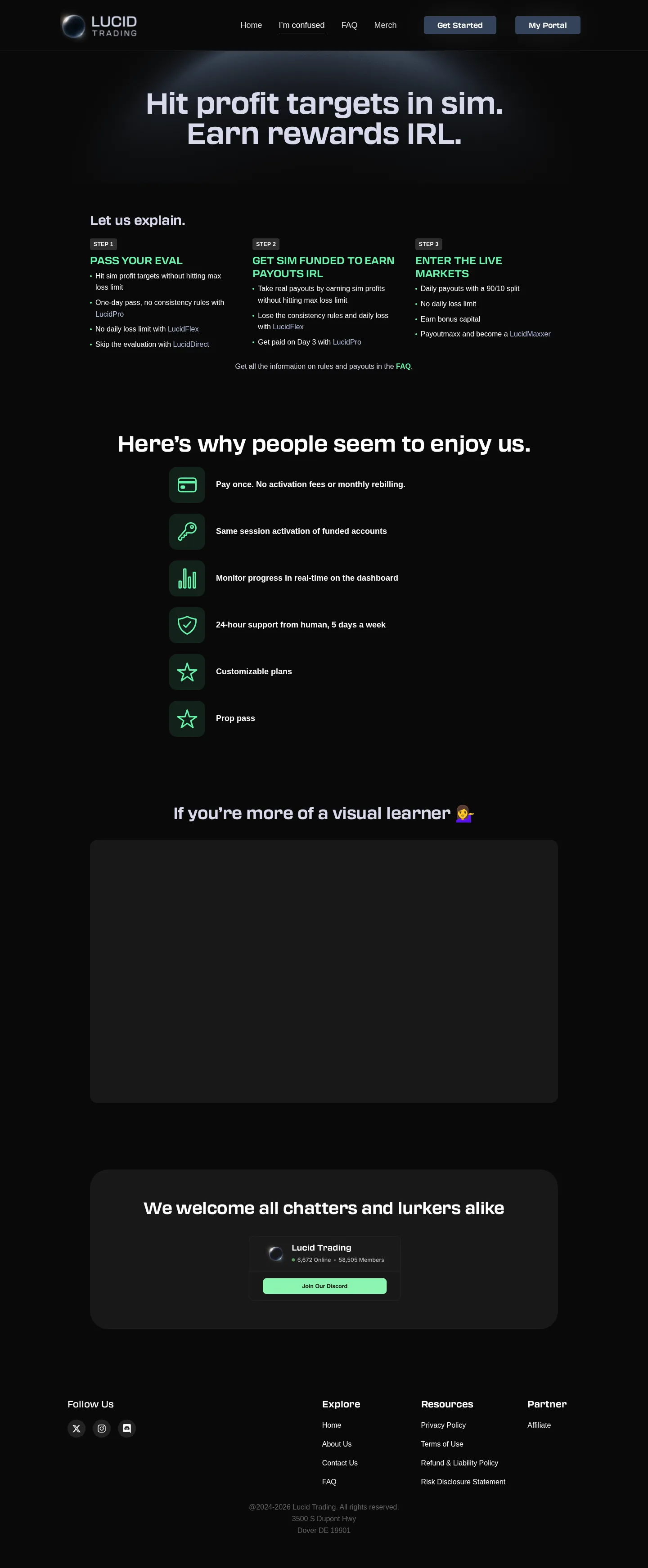
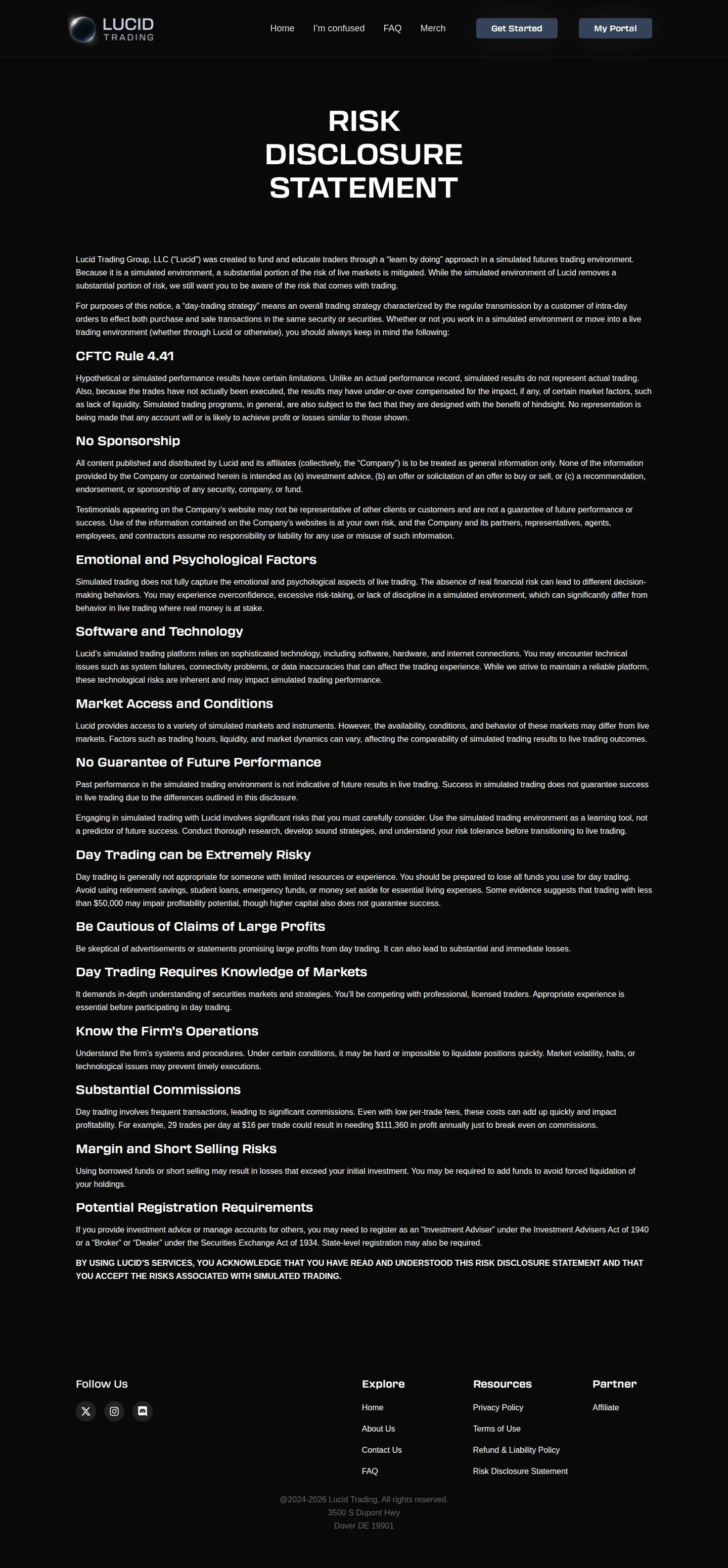
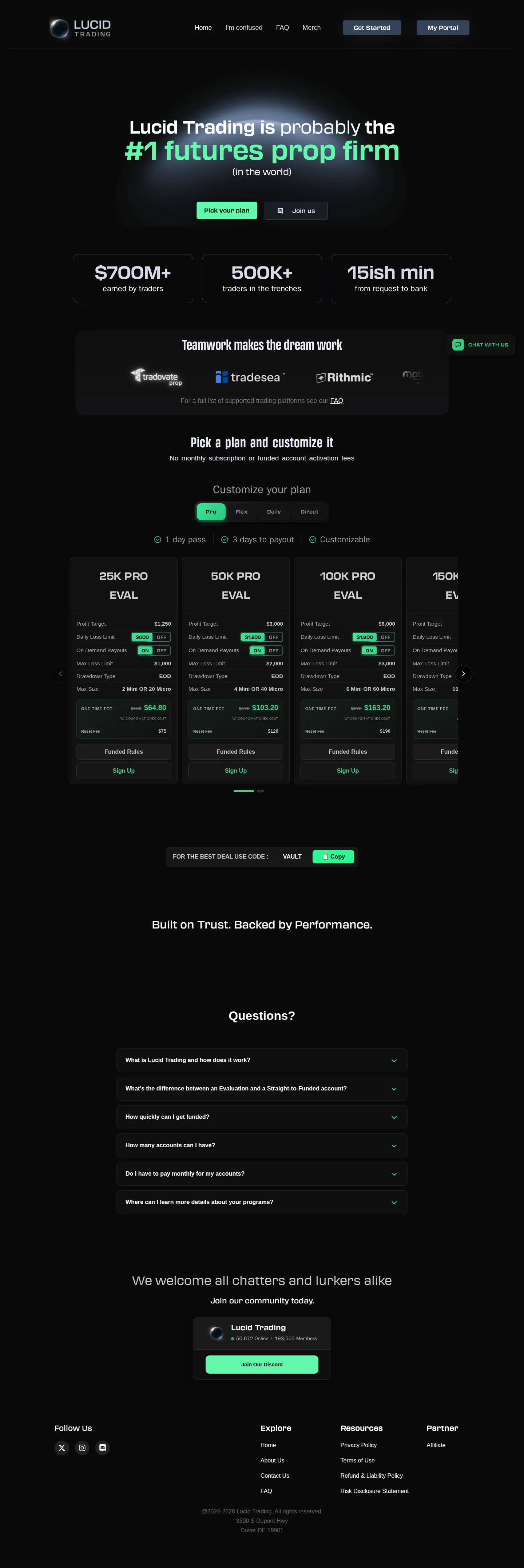
Pages captured from Lucid Trading’s own site when this review was written. Brokers change their terms; these are what we read.

FAQ
Is Lucid Trading regulated?
No. It holds no financial licence, which is usual for a prop firm, and its terms say it is not a broker dealer and does not offer financial advice. Trading on its accounts is simulated.
Where is Lucid Trading based?
Its terms name Lucid Trading Group LLC and say the website owner is based in the State of Delaware, with an address in Dover. We could not check the company on Delaware’s register, which sits behind a CAPTCHA.
How much does it cost to get a funded account with Lucid Trading?
The cheapest 100K challenge is the Daily Eval at a USD 200 list price, a one time fee, shown at USD 120 with a code. The Flex Eval lists at USD 215, the Pro Eval at USD 272 and the instant Direct account at USD 700.
What trading platforms does Lucid Trading support?
TradingView, NinjaTrader and Tradovate through CQG, and Quantower, Tradesea, MotiveWave, Sierra Chart, Jigsaw, Bookmap, ATAS, R|Trader Pro and MultiCharts through Rithmic.
Does Lucid Trading serve clients outside the US?
Its terms say the website is for use only by persons located in the United States, yet the site serves localized pages to ten other countries, so a non US client should read the terms closely before paying.
What do traders say about Lucid Trading?
Trustpilot rates it 4.5 from 7,753 reviews with no Trustpilot warning. Its own app averages 4.51 on the App Store from 172 ratings and 4.71 on Google Play from 92.
How this review works
Track Lucid Trading live: score moves and red notices, in your pocket.